Campbell’s Dividend Cut Changes the Math. Is Smucker the Clear Winner?
Campbell's just slashed a dividend it had held steady for years, while its rival moved in the opposite direction. Before you chase the higher yield, the numbers behind each payout tell a very different story about which stock actually protects…

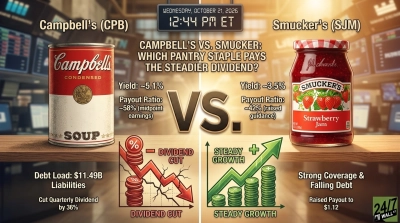
Campbell’s (NASDAQ:CPB | CPB Price Prediction) or J.M. Smucker (NYSE:SJM): which pantry staple offers steadier income for those focused on retirement right now? The dividend picture changed this fall. On September 3, 2026, Campbell’s cut its quarterly dividend 36% to $0.25 per share from $0.39 so it could pay down debt faster. Smucker moved in the opposite direction. It raised its payout to $1.12 in July, then lifted its fiscal 2027 outlook after quarterly results topped expectations.
Current Yield: Campbell’s Still Pays More Per Dollar
The cut leaves Campbell’s with a forward annual payout of $1. At $19.69, that works out to a yield of about 5.1%. Smucker’s forward payout of $4.48 at $127.91 yields about 3.5%. On raw income, Campbell’s wins. That high yield also flagged the cut months before it happened. In May, Jim Cramer pointed to Campbell’s 7.56% yield and warned, “People, you don’t get those kinds of deals unless people are worried that the dividend will need to be cut.” That instinct, that a double-digit yield usually hides a problem, is exactly the pattern we broke down in a free report on the seven warning signs of a dividend trap.

Coverage and Balance Sheet: Smucker Has the Cushion
Campbell’s guided fiscal 2027 adjusted EPS to $1.65 to $1.80, down from $2.17. That puts even the reduced dividend at roughly 58% of midpoint earnings. Smucker’s raised guidance to $10.50-$11.00, which covers its payout at about 42%. The two stocks trade at similar multiples, about 11x for Campbell’s and 12x for Smucker, so investors pay almost nothing extra for Smucker’s better coverage.

Smucker’s cash flow widens the gap. Smucker raised its free cash flow target to about $1.1B and reached a three-times leverage ratio in the first quarter while working toward about $500 million of debt paydown this year. Coffee, which grew 13%, and Uncrustables are funding the payout. The risks are coffee price swings, mid-single-digit inflation, and guidance that includes a $0.60 net benefit from tariff refunds that won’t come back next year.
Campbell’s has $11.49B in total liabilities against $3.85B of equity. It expects interest expense to rise about $25 million because of the La Regina acquisition, and a $500 million bond comes due in March. Operating cash flow fell 8.13% to $1.039B, and management expects a “fairly sharp decline” in first-quarter EPS.
Track Record: Smucker Keeps Raising
Smucker’s quarterly dividend has climbed from $0.15 in 1999 to $1.12, and its payment history back to 1999 shows no reduction in the regular payout. Campbell’s held at $0.39 for seven quarters before the cut. Its record also shows an earlier reduction, from $0.225 to $0.1575 in 2001. Share prices moved in the same direction. Campbell’s is down 32.5% over one year and 47.24% over ten. Smucker is up 26.36% and 35.12% over the same periods.


Verdict: Smucker Pays the Steadier Dividend
For retirees who count on rising income, Smucker wins clearly. It has better coverage, a falling debt load, a free cash flow target raised to roughly $1.1B, and a payout that kept growing through tariffs and the Hostess losses. Its CEO said the company is “increasing our net sales, adjusted earnings per share, and free cash flow outlook for the fiscal year.”
Campbell’s appeals mainly to contrarian income investors seeking a higher 5.1% yield and willing to take on turnaround risk. Its CEO admitted “our performance is not where it needs to be,” and the company’s guidance calls for adjusted EBIT to fall 12% to 7% this year.
Coming up for Campbell’s: how it refinances the March bond (management is “strongly considering” a hybrid security) and whether Snacks steadies. For Smucker, the questions are whether buybacks begin and whether coffee momentum lasts after the tariff refunds roll off.
Contact [email protected] for any questions or corrections.
Chris Lange is a financial and geopolitical writer with more than a decade of experience covering a myriad of topics. He has published thousands of articles for 24/7 Wall St., with past coverage focused heavily on stocks, IPOs, healthcare, defense, global affairs, and technology.
His work has been quoted, or referenced by a number of outlets including Business Insider, USA Today, Yahoo Finance, MSN, The Motley Fool, and many other publications. A graduate of Southwestern University, he studied business with a focus on investments and has previous experience in banking and startups.
When not reading or writing the news, he is following his passion for Lacrosse, playing chess, or building solar projects with his dad.