These 3 Dividend Stocks Paid Out Over 90% of Free Cash Flow, but 1 Has Raised Its Dividend 54 Years in a Row
Three popular dividend stocks are paying out well above their free cash flow, and the gap between what each one earns and what it sends to shareholders reveals very different risks hiding behind familiar, trusted names.


A dividend can look safe on an earnings payout ratio while the cash tells a different story. Earnings run through accruals, one-time charges and adjusted figures that management controls. Free cash flow is harder to dress up: It is the cash a business generates after paying for its plants, pipelines and labs, set against the cash it mails to shareholders.
On that test, three well-known income names are running hot. The best known of them, PepsiCo (NASDAQ:PEP | PEP Price Prediction), paid out about 101% of its free cash flow over the first 36 weeks of its fiscal year. For each one, the question is whether the gap is a warning or simply how the business works.
PepsiCo: A 54-Year Raise Streak Running on Thin Cash Coverage
PepsiCo pays $1.48 per share each quarter, or $5.92 a year. Shares traded around $133.22 at the open on Wednesday, Oct. 21, alongside a yield of about 4.48%. PepsiCo’s own dividend announcement says this year’s raise was its 54th consecutive annual dividend increase, and the payment record shows the quarterly rate rising from $1.4225 to $1.48.
For the 36 weeks ended Sept. 5, PepsiCo produced $7,950 million of operating cash flow, spent $2,182 million on capital projects and paid $5,935 million in dividends. On PepsiCo’s own free cash flow definition, the dividend used about 101% of free cash flow. Buybacks come on top of that: the full-year plan calls for $7.9 billion in dividends and $1.0 billion in repurchases, with free cash flow conversion of at least 80%.
The operating background got harder this quarter. Core EPS of $2.34 beat the $2.30 estimate, and revenue rose 5.6% to $25,274 million. But management cut core EPS growth guidance to 2.5% to 3.5%, below the low end of its earlier 5% to 7% range, and took the top off its organic revenue outlook, which now stands at about 3% versus 2% to 4% before. Core operating profit at the North American foods business fell 12%.
The bull case rests on the balance sheet and on growth outside the U.S. Interest coverage stands at 12.03x, net debt is 2.31x EBITDA, and the company held $10.68 billion in cash at quarter’s end. Organic growth reached 9% in both EMEA and Asia Pacific, and the CEO called international “a big driver of growth for us in the coming years.”
Verdict: The gap can be closed. A single 36-week window with the dividend slightly above free cash flow is a balance-sheet problem PepsiCo can absorb.
The risk: Persistence. A 54-year streak reflects PepsiCo’s past record, and future cash generation will determine whether it continues. If full-year free cash flow keeps landing below the dividend while EPS growth stays in the low single digits, raises would increasingly be paid for with borrowed money.
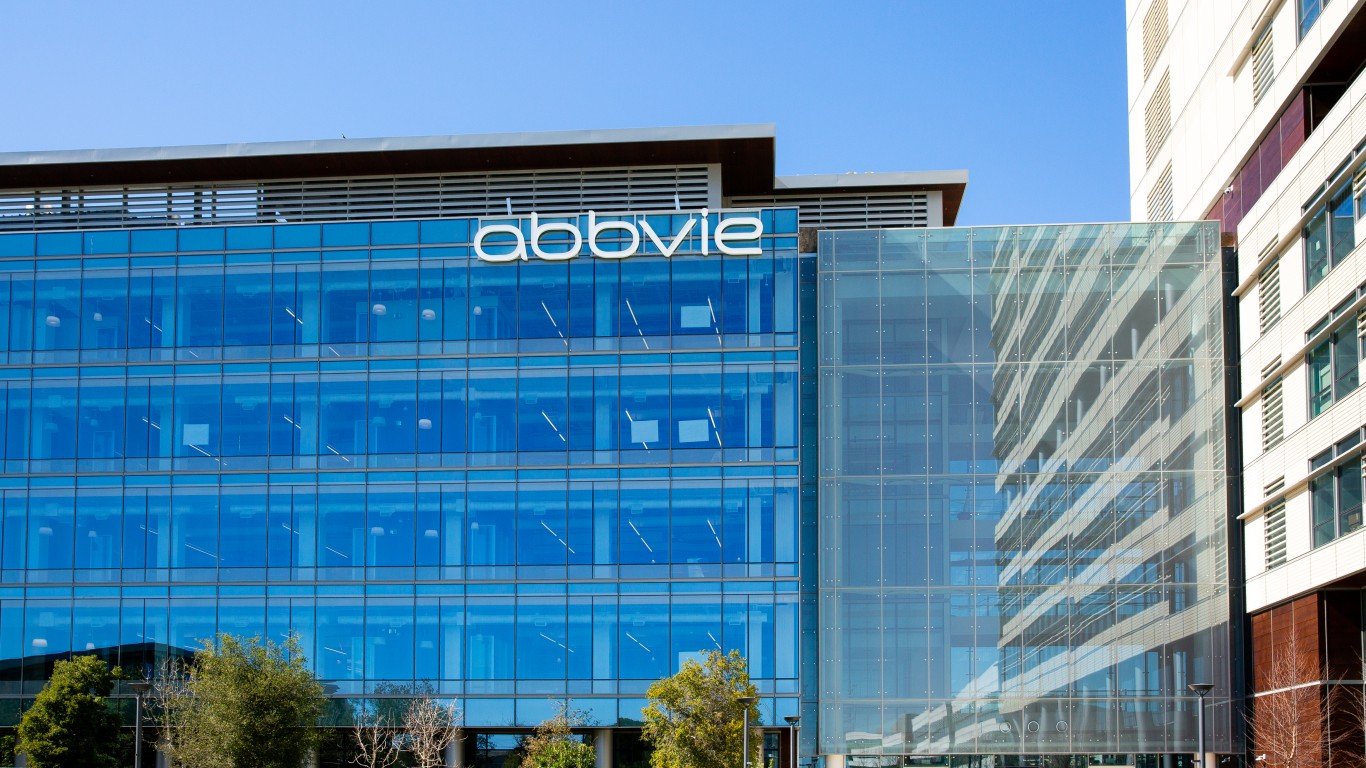
AbbVie: Growth Drugs Cover a 92% Payout as Apogee Debt Builds
AbbVie (NYSE:ABBV) pays $1.73 per share each quarter, or $6.92 annualized. With shares around $289.19, the yield is about 2.40%. The dividend record runs from 40 cents per quarter at the 2013 spinoff to today’s rate, including steps from $1.48 to $1.55, $1.64 and $1.73 over the last four annual raises.
In the first half, AbbVie generated $7,265 million of operating cash flow, spent $587 million on capital projects and paid $6,156 million in dividends. That works out to dividends equal to 92% of free cash flow. Because a drugmaker needs little capital equipment, nearly all of its operating cash is available for the dividend. The pressure comes from deal spending and debt.
The growth engine is strong. Q2 revenue rose 10.2% to $16.99 billion. Skyrizi brought in $5.51 billion (up 24.4%) and Rinvoq $2.53 billion (up 24.5%), together far outpacing Humira’s decline to $756 million. The operating margin is 32.85%.
The balance sheet carries the strain. AbbVie lowered full-year adjusted EPS guidance to $13.87 to $14.07, a range that includes 14 cents of dilution from the $10.9 billion Apogee Therapeutics acquisition. Total debt stood at about $70.8 billion at June 30, against $6.6 billion of cash. Executives say it is “committed to achieving a net leverage ratio of two times within two to three years following the deal close.” Interest coverage is 6.94x.
Verdict: The gap can be closed, and AbbVie has the most room of the three.
The risk: If Skyrizi and Rinvoq growth slows before Humira stops shrinking while Apogee financing raises interest costs, a 92% payout gives little margin for error.
Western Midstream: An Ultra-High Yield With the Widest Cash Gap
Western Midstream Partners (NYSE:WES) pays 93 cents per unit quarterly, or $3.72 annualized. At a share price around $44.56, that is an ultra-high yield of about 8.31%. Western Midstream is a partnership, so unitholders receive a Schedule K-1 in place of a Form 1099-DIV. That matters at tax time because K-1s tend to arrive later and can add complexity to a return.
Western Midstream shows the widest cash gap of the three. For a single quarter, the second, Western Midstream reported $534.7 million of operating cash flow and $270.3 million of capital spending, leaving free cash flow of $263.6 million on the partnership’s own definition. Distributions came to about $374.6 million, or about 142% of free cash flow. By management’s measure, free cash flow after distributions was negative $111 million, after negative $137.4 million in the first quarter.
Growth spending explains the shortfall. More than half of this year’s capital budget goes to the Pathfinder pipeline and the North Loving II processing train, and spending is tracking toward the high end of $850 million to $1 billion. Distributable cash flow, which leaves out expansion capital, was $537 million for the quarter. Full-year guidance midpoints rose to $2.15 billion for DCF and $1.2 billion for free cash flow. The CFO described DCF as “an additional measure of our capacity to fund the distribution and a substantial portion of our expansion capital program.”
The bull case is fee-based contracts with minimum volume commitments, record Adjusted EBITDA of $736.5 million, more than $1.8 billion of liquidity and investment-grade ratings. Pro forma net leverage is about 3.15 times. Income investors should also know the payout has been cut before: The record shows 60.25 cents per unit in early 2019 and 31.1 cents through 2020, followed by a rebuild to today’s rate.
Verdict: The gap can be closed while the big projects are under construction, because DCF covers the payout.
The risk: If free cash flow after distributions stays negative once Pathfinder and North Loving II are running, debt is paying the distribution, and weaker Delaware Basin volumes would widen the shortfall.
Ranking the 3 by Cash Comfort
AbbVie ranks first. It has a 92% first-half payout, double-digit growth from Skyrizi and Rinvoq, and a clear plan to bring leverage down. PepsiCo is second: Its roughly 101% payout over 36 weeks is manageable given its balance sheet, but lower guidance means the streak depends on cash growth returning. Western Midstream comes last at about 142% for the quarter, and its distribution holds up on a cash basis only once the current construction cycle ends. A payout running ahead of free cash flow is one of the classic warning signs we cataloged in a free guide to seven signals that a big yield is about to be cut.
Contact [email protected] for any questions or corrections.
Joel South covers large-cap stocks, dividend investing, and major market trends, with a focus on earnings analysis, valuation, and turning complex data into actionable insights for investors.
He brings more than 15 years of experience as an investor and financial journalist, including 12 years at The Motley Fool, where he served as an investment analyst, Bureau Chief, and later led the Fool.com investing news desk. He has also co-hosted an investing podcast and appeared across TV and radio discussing market trends.