UBS portfolio manager: S&P 500 could hit 9,500 by June 2027 on AI, longevity, energy boom
A UBS portfolio manager sees three technology waves pushing stocks far beyond Wall Street's consensus, but his bullish case runs straight through two more Fed rate hikes that most investors are not pricing in.


The 10-year Treasury yield closed at 5.13% on October 21. That is already above the ceiling Alan Rechtschaffen expects for long-term rates. On the same day, UBS weighed in. UBS’s senior portfolio manager laid out a case for the S&P 500 to reach 9,500 by June 2027.
His target sits well above the UBS base case of 8,400 and above his own call for 8,100 by the end of 2026. He ties it to three long-running technology waves: superintelligence, longevity and disease cures, and energy.
Profits are his strongest evidence. He cited 25% year-over-year earnings growth. He expects double-digit gains next year, so the rally rests on what companies actually earn.
His rate path complicates the outlook. He expects the Fed to pause in October, probably raise rates in December and again in March, and only then consider cuts. A bull case that runs through two more hikes requires you to trust that productivity gains will outrun tighter money.
Profits Are Carrying This Rally
Earnings-driven gains hold up better than price-to-earnings expansion, because multiples can shrink quickly when rates move. For NVIDIA (NASDAQ:NVDA | NVDA Price Prediction), fiscal second-quarter revenue grew 105.8% to $96.22 billion, with Data Center sales of $89.02 billion.
At Microsoft (NASDAQ:MSFT), Azure grew 43% and passed $100 billion in annual revenue for the first time. Google Cloud revenue at Alphabet (NASDAQ:GOOG, NASDAQ:GOOGL) jumped 82%.
Double-digit growth next year depends on that spending continuing to turn into revenue. NVIDIA expects supply to remain a bottleneck at least through the end of fiscal year ’28. That points to strong demand, but it also caps how fast the company can ship.
AI Leads While Longevity and Energy Trail
Superintelligence has the clearest link to earnings today. NVIDIA, Microsoft and Alphabet carry market values of about $5.36 trillion, $3.96 trillion and $4.16 trillion, so much of the index’s gain depends on three names.
Longevity is further along than its label suggests. Eli Lilly (NYSE:LLY) grew revenue 47.7% to $22.97 billion last quarter and raised full-year guidance to $85.0 billion to $87.0 billion.
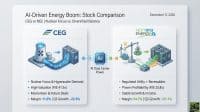
Energy is at an earlier stage. Constellation Energy signed 920 MW of long-term nuclear contracts and plans to restart Crane in 2027, but those contracts begin between 2029 and 2032. Reactors take years to permit and restart. That is why the positioning happens early (we named five ways to play the nuclear restart in a free report).
Share prices reflect that gap. Constellation is down 23.02% this year, while Lilly is up 18.82%.
Rate Hikes Are the Weak Spot
Higher rates raise the discount rate applied to future profits, which hits growth stocks hardest because more of their earnings come years from now.
He expects the 10-year yield to settle between 4.5% and 5%. Today’s yield already sits above that range, so his forecast assumes rates come down from here.
His answer is productivity. Unit costs fall, and margins rise. If AI lets companies produce more without hiring as many people, that can hold down prices even as demand grows.
He said those gains already show up in hiring and operations, although the transition is slow and uncomfortable, and while slower hiring helps margins, job losses and uneven gains could weigh on consumer spending.
Five-to-Seven-Year Bonds Lock In Yield
“Cash is comfortable, but, you know, cash has a cost and has risk to it,” he said. The main risk in cash is reinvestment.
A one-month Treasury yielded 4.09% on October 21, but short-term rates reset quickly once the Fed starts cutting.
For clients who want yield, he suggested bonds that mature in 5 to 7 years. The 5-year Treasury yielded 4.95%, and the 7-year yielded 5.03%. Either one locks in income for years without taking on full stock market risk.
The tradeoff is price risk. If his expected hikes come and yields climb, intermediate bonds lose value in the short run, while cash holds steady.
Are S&P 500 Stocks a Buy?
The bull case rests on 25% earnings growth, AI leaders that keep beating estimates, and Lilly’s proof that longevity science already produces revenue.
The bear case is a Fed that may hike twice, a 10-year yield higher than expected, and heavy concentration in a few megacaps. NVIDIA also expects gross margin to fall to 71% to 72% in its fiscal fourth quarter because memory costs are rising.
Investors considering both sides of the case can research how Vanguard S&P 500 ETF (NYSEARCA:VOO) and 5-to-7-year Treasuries fit their own goals. The fund charges 0.03% and is up 14.32% this year. It gives you all three themes cheaply, and the bonds pay income if rate hikes squeeze valuations first.
Contact [email protected] for any questions or corrections.
Omor Ibne Ehsan is a writer at 24/7 Wall St. He is a self-taught investor with a focus on growth, cyclical, and dividend equities that have strong fundamentals, value, and long-term potential. He also has an interest in high-risk, high-reward investments such as penny stocks.