AMD Has a High Floor, High Volatility Trajectory Through the End of 2026
AMD has booked gigawatts of AI accelerator commitments and posted a 50% revenue jump, yet the stock shed nearly 19% in a single month. Whether the next earnings report confirms a historic ramp or exposes a valuation built on promises…

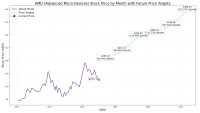
AMD (NASDAQ:AMD | AMD Price Prediction) trades at $507.93. The business has a high fundamental floor, but the stock is prone to sharp swings through the end of 2026. Shares fell 8.1% in a single session as oil prices rose and questions about AI spending returned, so the current price puts investor conviction to a real test.
AMD sells server CPUs, AI accelerators, PC chips and console silicon. It competes with NVIDIA (NASDAQ:NVDA) in AI GPUs and with Intel (NASDAQ:INTC) in processors. Data Center now generates 58% of revenue. The stock is up 137.17% year to date but has dropped 18.57% over the past month.
Gigawatt Deals and Doubling Data Center Sales Build the Floor
Second-quarter revenue rose 50.1% to $11.54 billion, ahead of the $11.31 billion consensus. Non-GAAP EPS of $1.66 beat the $1.61 estimate. Data Center revenue grew 107% to $6.72 billion, and non-GAAP operating margin expanded to 27% from 12%. Management guided third-quarter revenue to about $13 billion, which would be roughly 41% growth.
Much of the demand is already signed. OpenAI has committed to 6 GW, Meta Platforms (NASDAQ:META) to up to 6 GW, and Anthropic to up to 2 GW of MI450 GPUs. The CEO said Helios demand is “tracking ahead of our initial forecast,” and management expects Data Center revenue to more than double in 2027. The consensus 2027 EPS estimate has grown to $15.7553 from $13.4647 90 days ago. That puts the stock at about 32x next year’s earnings.
A 141x Trailing Multiple Leaves No Room for a Capex Pullback
AMD trades at 141x trailing earnings and 21.84x sales, with a beta of 2.454. That price assumes hyperscalers keep spending at full speed. Meanwhile, Meta just reported its first negative free cash flow since 2012, and Brent crude exceeded $112. Higher oil raises the risk of higher borrowing costs for an AI build-out that increasingly runs on debt (the power, cooling, and networking suppliers financing that same build-out are the focus of a free report on seven AI infrastructure names beyond the chipmakers).
Execution risk remains a concern as well. Helios is a complex ramp, and yields are still improving. Gaming fell 31%, and management expects another significant double-digit decline. Export controls already cost AMD about $800 million in MI308 charges. Beating estimates has not protected the stock either: shares fell 17.31% on the day of a 15.98% earnings surprise and 7.04% after the latest beat.
Helios Shipments Will Decide Which Camp Is Right
Record margins and grown estimates support the bull case. Still, 2027 revenue estimates range from $61.26 billion to $118.11 billion. That spread is wide for a stock at this multiple. Three things should settle it over the next two quarters: confirmation that Helios has shipped, a fourth-quarter outlook compared with the $16.11 billion revenue consensus, and the broader customer base management expects by early 2027.
Analysts See 25% Upside Despite a Sharp Monthly Slide
The consensus price target of $637.61 implies 25.5% upside. Price targets are one input and can be wrong. Ratings from 56 analysts break down as follows:
- Strong Buy: 5
- Buy: 40
- Hold: 11
- Sell or Strong Sell: 0
AMD is up 137.17% year to date, compared with 12.05% for the S&P 500. Over the past month, AMD lost 18.57% while the index slid 1.21%. The forward P/E is 40. The stock sits beneath its 50-day average of $541.10 and well above its 200-day average of $399.08.
Helios Revenue Is the Key Test for AMD Through Year-End
AMD trades at $507.93.
The earnings base is solid. Revenue is compounding, margins are expanded, and signed deployments run into 2027.
A stronger bull case would require a third-quarter report at or above the $13 billion guide, Helios revenue that shows up in the results, and a fourth-quarter outlook near or above consensus. A retreat to the 200-day average with guidance unchanged would also lower the valuation. The bear case would strengthen if hyperscalers cut capex, Helios yields delay the ramp, or new export rules hit Instinct.
The analyst target implies room for a rebound, but the stock fell 9.66% in one week on macro news. At this point, proof that Helios is scaling matters more than momentum.
AMD’s fundamentals set a high floor, but at 141x trailing earnings the path to year-end will be volatile, and Helios results are the key signal to monitor.
Contact [email protected] for any questions or corrections.
Alex Sirois is a financial writer with experience spanning both retail and institutional investing. He has written for InvestorPlace and held roles at BNY Mellon and Bernstein, giving him a perspective that bridges Main Street portfolios and Wall Street analysis.
Alex holds an MBA from George Washington University and has built his career across multiple industries, including e-commerce, education, and translation — a breadth of experience that informs how he breaks down complex financial topics for everyday investors. His writing is conversational, actionable, and grounded in long-term, buy-and-hold investing principles.
At 247 Wall St., Alex focuses on delivering analysis that is both accessible and useful, with a clear emphasis on helping readers make more informed decisions with their money.