Trump Says “We’re Making A Freaking Fortune” From The Iran War’s Oil Spike. Here’s What The Economic Data Actually Show
Trump claims the Iran war's oil surge is filling US coffers with hundreds of billions, and the export numbers from April tell a striking story. But what happened to those records by summer, and who actually pockets the windfall while…


President Trump addressed a midterm rally at the Guardian Centers in Perry, Georgia, on Saturday, Oct. 24, and said the US is “making a freaking fortune” on oil, according to Newsweek. He said the country is making “hundreds of billions” because buyers are coming to Texas, Oklahoma and Louisiana, that advisers warned him not to mention it because people pay more at the pump, and that he doesn’t “give a damn” about the criticism.
On Oct. 14 in Bullhead City, Arizona, he said “we’re making a fortune,” citing Texas, Oklahoma and North Dakota, per Common Dreams. On Aug. 3, ABC7 reported, he said Chevron (NYSE:CVX | CVX Price Prediction) and Exxon Mobil (NYSE:XOM) “made too much money” and should give some back.
Where the Data Agree With Trump
EIA data show US exports of crude oil and petroleum products hit a record 13,610 thousand barrels a day in April, about 13.6 million, up 15% from March’s record. Crude exports reached about 5.6 million barrels a day, 21% above the prior record, per the EIA, as Strait of Hormuz disruptions sent buyers to US supply.
NBC reported Exxon’s second-quarter profit doubled to $14.53 billion and Chevron’s nearly quadrupled to $12.07 billion, about $26.6 billion combined by our sum. Brent crude rose from about $70 to above $100 for much of March to May and peaked at $126, per NBC.
Exports Have Retreated Since the Spring Peak
Monthly EIA totals slipped to 13,540 thousand barrels a day in May, 12,540 in June and 11,410 in July, the latest month reported. The EIA’s crude export average alone peaked. The four-week average hit 5,571 in the week ending May 15, fell to 3,391 in the week ending Aug. 7 and stood at 4,087 in the week ending Oct. 16, near the pre-surge 4,084 of the week ending March 6.
What Households Pay for the Windfall
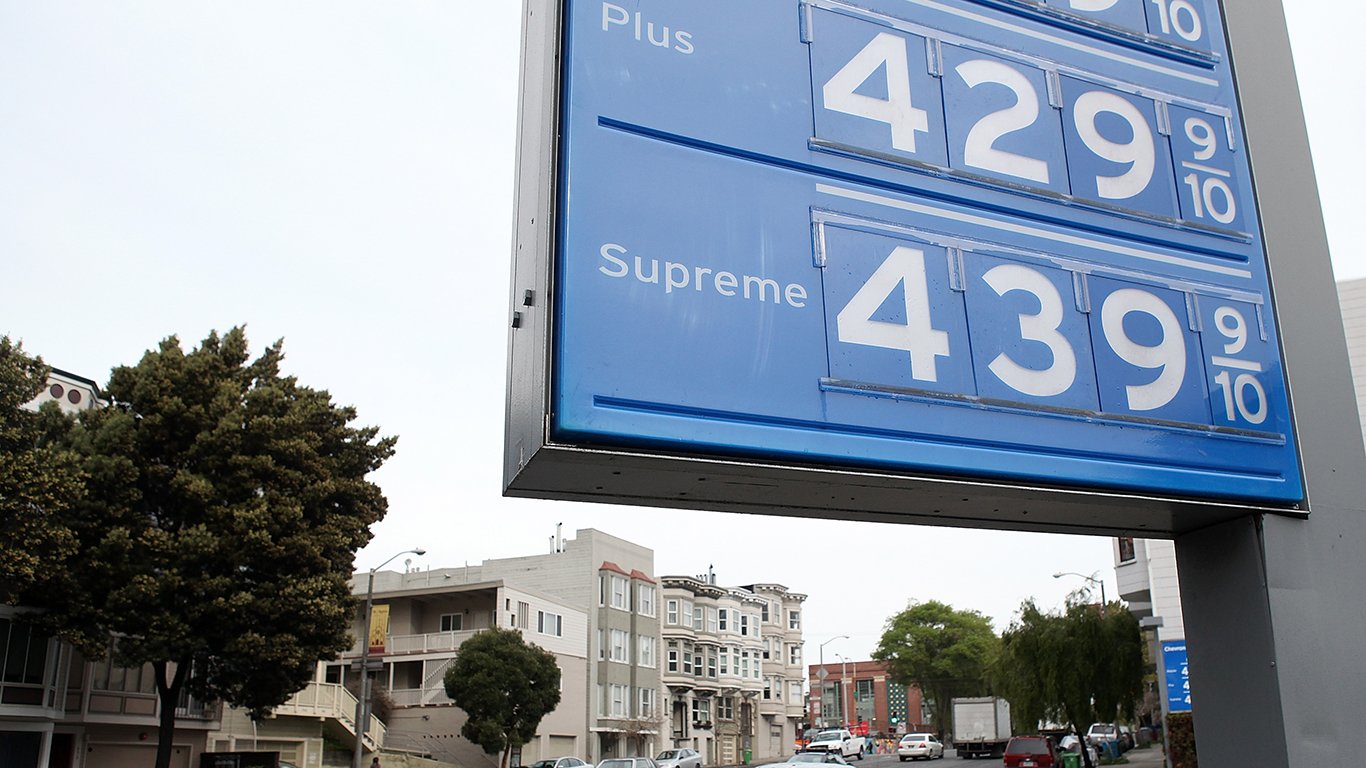
Regular gas averaged $4.28 a gallon as of Oct. 19, up $1.22, or 40%, from a year earlier, per EIA data on FRED. Analyst Patrick De Haan estimated Americans were spending about $250 million more per day on gasoline than a month earlier, more than $1.5 billion a week, IBTimes reported. A New York Times/Siena poll found 73% of likely voters disapprove of Trump’s handling of gas prices. Export revenue goes to producers and exporters; households pay the pump price.
Net Effect: A Modest Drag on Growth
A June 23 Dallas Fed model found a 15% global oil supply disruption cuts annualized US real GDP growth by about 0.3 points. Its working paper puts fourth-quarter 2026 US output down about 0.1%, 0.2% or 0.3% for closures lasting one, two or three quarters, while rest-of-world output falls about 1.7 points annualized. Higher income for US producers partly offsets lost non-oil output. These are model estimates that leave producer gains and consumer spending unmeasured. The US has been a net oil exporter since late 2019, and oil spending fell from nearly 8% of GDP in 1980 to about 3% in 2024, per the Dallas Fed.
In April, EY-Parthenon’s Gregory Daco projected the war could cut 2026 GDP growth by 0.3 points, to 1.8%, CBS reported, mentioning March inflation of 3.3%, the highest since May 2024. Cato’s Scott Lincicome said PCE inflation could reach 4% by year-end. Since then, BEA data show real GDP grew 2.5% in the first quarter and 2.2% in the second, and August PCE inflation was 3.42%, with energy prices up 16.85% from a year earlier.
A Rough Estimate at the April Peak
By a rough 24/7 Wall St. estimate, April’s pace of about 13.6 million barrels a day annualizes to about 4.96 billion barrels. At $30 to $35 of added price per barrel, that implies about $149 billion to $174 billion a year in added export revenue. It reflects the peak month only: exports have since fallen, they mix products priced differently, and the US still imports crude.
White House Response and What to Watch
Per CBS, White House spokesperson Kush Desai responded. He called the disruptions “temporary” and said the economy “remains on a solid trajectory.” Democrats in Congress have proposed a windfall profits tax on large producers, which Exxon’s CEO called short-sighted, NBC reported. Next up: the GDP and PCE inflation releases, EIA’s August export data, and any movement on a windfall tax.
Contact [email protected] for any questions or corrections.
AJ spent 10 years writing about financial markets at The Motley Fool. His coverage centers on technology stocks and the broader macroeconomic trends, from interest rates to geopolitics, that shape where markets are headed next. AJ is drawn to the stories where big-picture economics and individual companies collide.