If You Invest $1,000 in Microsoft Today, Here’s What It Could Be Worth by 2030
Azure just crossed $100 billion in annual revenue and Microsoft's signed backlog hit $678 billion, yet the real question is whether those numbers translate into gains for ordinary investors holding through 2030.


A $1,000 stake in Microsoft (NASDAQ:MSFT | MSFT Price Prediction) puts your money into the company at the center of enterprise AI spending. The forecast model starts from a price of $532.95, and the stock was trading at $525.76 in delayed intraday trading.
Azure growth is speeding up and the signed backlog has reached $678B, so it is worth asking what that $1,000 could turn into by 2030.

Your $1,000 Could Reach About $1,813 in the Base Case
The model projects five years ahead, from 2026-10-22 to 2031-10-22. In its base case, a $1,000 investment could be worth about $1,813.30 at the end of that period, returning 81.33% in all. The base-case share price target of $966.38 works out to an annualized return of 12.64%.
The model’s quarterly price path also passes through 2030. Its base-case price for October 22, 2030 is $889.99, which would make the $1,000 investment worth about $1,669.93. Read the 2030 numbers as illustrative points along the way. The five-year target is the main projection.

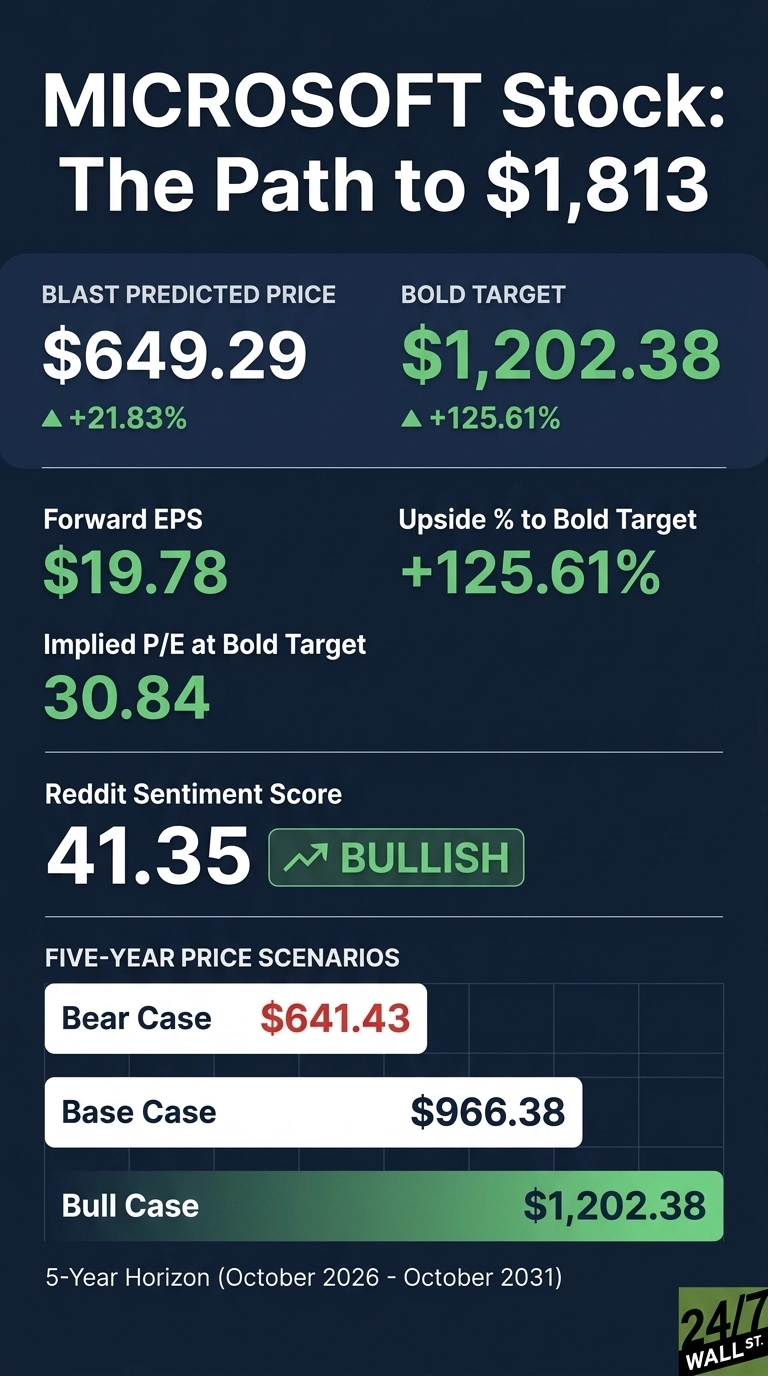
Bull, Base and Bear: What Your $1,000 Becomes
| Scenario (Five-Year) | Target Share Price | Total Return | Annualized Return | Value of $1,000 |
|---|---|---|---|---|
| Bull | $1,202.38 | 125.61% | 17.67% | $2,256.10 |
| Base | $966.38 | 81.33% | 12.64% | $1,813.30 |
| Bear | $641.43 | 20.35% | 3.77% | $1,203.50 |
Illustrative 2030 milestones (October 22, 2030):
| Scenario (2030 Illustrative) | Projected Share Price | Value of $1,000 |
|---|---|---|
| Bull | $1,098.13 | $2,060.47 |
| Base | $889.99 | $1,669.93 |
| Bear | $617.31 | $1,158.29 |
The model gives its forecast a confidence level of 0.9, and its one-year target is $649.29. Wall Street’s consensus target is lower at $600.88. Of the analysts covering the stock, 14 rate it a strong buy, 39 rate it a buy and 2 rate it a hold. None rate it a sell.

Three Growth Engines Behind the Target
Azure Demand Is Ahead of Supply
Azure grew 43% in fiscal Q4, and its full-year revenue passed $100B. On the earnings call, the CFO said “Customer demand continues to exceed available capacity.” Management expects Azure to grow about 45% in constant currency in fiscal Q1 2027.
Copilot Revenue Is Spreading
Microsoft 365 Copilot now has more than 30 million paid seats, and net new paid seats more than doubled from the prior quarter. EY rolled out E7 to 400,000 employees.
The company is also adding usage-based billing on top of per-seat pricing. In the CEO’s words: “So the TAM is much more expansive.”
A Large Backlog and a Run of Earnings Beats
Commercial remaining performance obligations, meaning signed revenue not yet recognized, jumped 84% to $678 billion. Management expects about 30% of that to turn into revenue over the next 12 months.
Fiscal Q4 EPS came in at $4.74 against an estimate of $4.2397, the sixth consecutive quarter of beating expectations. Revenue for the full fiscal year rose 17.79% to $331.84B. The stock trades at about 27 times forward earnings.

Risks That Could Shrink Your Stake
The biggest risk is spending. Capital expenditures hit $115.95B in fiscal 2026, and Microsoft expects to spend more than $50 billion in fiscal Q1 alone. Microsoft Cloud gross margin fell to 65%.
If demand for AI cools, those data centers could earn less than planned (the suppliers behind that expansion, from power to cooling, are the subject of a free report on seven non-chip AI infrastructure stocks). Some of the backlog also depends on a single customer: excluding OpenAI, RPO grew just 25%.
Some parts of the business are shrinking. More Personal Computing revenue fell 4%, and management expects Windows OEM and Devices revenue to drop in the high teens in fiscal 2027.
Valuation matters as well. The stock trades at a trailing P/E of about 30, close to its 52-week high of $551.15. Even the bear case returns only 3.77% a year.
What to Watch on the Way to 2030
Microsoft’s next earnings report is coming up. It will show whether Azure is keeping pace with guidance and whether Copilot seat growth is holding up.
Over the five-year model, a $1,000 investment ends between $1,203.50 and $2,256.10, and the base case is $1,813.30. These are projected scenarios with uncertain results. This article is a model-based projection for research purposes.
Contact [email protected] for any questions or corrections.
Vandita Jadeja is a financial publisher with over a decade of experience writing about financial topics, including investment, savings, retirement, insurance and banking. Vandita is a Chartered Accountant who loves to debunk financial concepts for readers.
Her work has appeared on sites that include The Motley Fool, InvestorPlace, and Benzinga. She covers investing and focuses on stock picks and price prediction for 24/7 Wall St.
When not looking for the next stock investment opportunity, she can be found traveling, reading, chasing sunsets and enjoying her iced latte.