Kraft Heinz’s EPS Is Negative $2.87. Its Dividend Coverage Tells Another Story
Kraft Heinz is posting billions in losses while still writing dividend checks, and the reason comes down to a number most investors never bother to check.

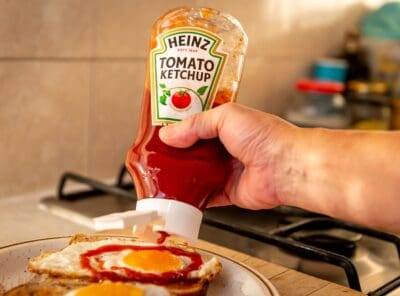
Kraft Heinz (NASDAQ:KHC | KHC Price Prediction) carries trailing twelve-month diluted EPS of -$2.87. Compared with that number, the $0.40 quarterly dividend looks uncovered. A better test is how much of free cash flow the dividend uses up. In 2025, dividends took 51.8% of it.

Why Dividend Share of Free Cash Flow Beats the Payout Ratio
Free cash flow is operating cash flow minus capital spending. It’s the cash left over after the company pays for its plants, and it’s the money that actually funds the dividend. Reported earnings also take non-cash charges. When a company writes down goodwill or brand names on its balance sheet, net income drops, but no cash leaves the company.
At Kraft Heinz, that gap is huge. The FY2025 GAAP net loss of $5.848 billion included $9.3 billion in non-cash impairment losses. In Q2 2026, the net loss of $5.46 billion came from a $7.4 billion non-cash impairment on goodwill and intangible assets. Even so, the company produced $3.7 billion of free cash flow in 2025 and paid $1.9 billion in dividends.

Cash Generation Is Accelerating in 2026
Q1 2026 free cash flow was $766 million, up 58.92% year over year. Dividends paid in the quarter were $474 million. Management raised its FY2026 free cash flow conversion target (adjusted free cash flow divided by adjusted net income) to about 110%, up from roughly 100%. A reading above 100% means adjusted profits are turning into more cash than they show on paper. Lower inventory and better supplier payment terms are driving much of the improvement.
On the August 5, 2026 earnings call, finance chief Andre Maciel said: “Free cash flow is essentially the same dollar amount that we committed at the beginning of the year.” That held even as additional brand spending rose to about $700 million. He added that the company “paid down $1.9 billion of debt in the quarter” and another $1 billion after the quarter closed.
A Covered Dividend That Has Stayed Flat for Years
The quarterly payout has been $0.40 since 2019. In 2018, it was $0.625, a 36% cut. At a share price of $24.05, the yield is about 6.65%.
So the question stands: why hasn’t a dividend this well covered gone up? Several other uses are competing for the cash: brand investment, debt paydown, and about $1.5 billion left on the buyback authorization. Meanwhile, the planned split into two companies is on hold with no set timeline. Until that’s settled, it’s unclear what each company’s balance sheet would look like.
Signals That Would Shift the Dividend Math
- Bullish: conversion stays above 100%, and Emerging Markets growth of 10.4% keeps offsetting the 2.7% decline in North America.
- Bearish: conversion falls as the extra investment ramps up, volume and mix keep declining in meats and spoonables, the SNAP drag runs near 100 bps, or another round of impairments increases the paper losses.

The stock is up 4.23% year to date, suggesting the market has already looked past the GAAP losses.
Verdict: Cash Says the Dividend Holds
Dividends using just over half of free cash flow show a payout that is safe for now, and that tells investors more than any EPS headline. The one thing to watch is whether full-year FY2026 free cash flow conversion reaches the 110% target once the full $700 million investment is spent.
Contact [email protected] for any questions or corrections.
Chris Lange is a financial and geopolitical writer with more than a decade of experience covering a myriad of topics. He has published thousands of articles for 24/7 Wall St., with past coverage focused heavily on stocks, IPOs, healthcare, defense, global affairs, and technology.
His work has been quoted, or referenced by a number of outlets including Business Insider, USA Today, Yahoo Finance, MSN, The Motley Fool, and many other publications. A graduate of Southwestern University, he studied business with a focus on investments and has previous experience in banking and startups.
When not reading or writing the news, he is following his passion for Lacrosse, playing chess, or building solar projects with his dad.