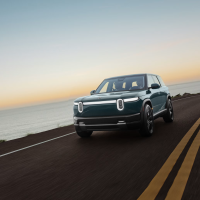
Rivian Gains 5% as R2 Ramp Drives Raised Delivery Outlook; Tesla Falls 3%, Lucid Slides 2%, Ford Eases
Rivian just posted results that surprised Wall Street while almost every other EV name slid, and the question now is whether its cheapest vehicle is the turning point investors have been waiting for or a quiet threat to its own…


Stronger-than-expected Q3 2026 results are lifting Rivian Automotive (NASDAQ:RIVN | RIVN Price Prediction) despite weakness in electric vehicle (EV) stocks, and its cheaper R2 SUV drove a raised outlook. Rivian stock is at $12.06, up 5% in early trading. For a sector-level check, the iShares Self-Driving EV and Tech ETF (NASDAQ:IDRV) is down 1.3%. The broader market, tracked by the SPDR S&P 500 ETF Trust (NYSEARCA:SPY), is down 1.2%.
That background follows an October 29 session in which the tech-heavy index closed more than 1% lower after a weak report from Intel hit technology shares. A disappointing report from Amazon added to the pressure, and Rivian is one of the few growth names in the green. Year to date (YTD), Rivian stock is still down 40%.
R2 Ramp Lifts Rivian’s Results and Outlook
Rivian’s revenue rose 38% year over year (YoY) to $2.155 billion, exceeding the Bloomberg consensus estimate of $2.02 billion. On the bottom line, Rivian posted an adjusted loss of $0.48 per share, smaller than the $0.61 Bloomberg consensus estimate. The company swung to a $176 million consolidated gross profit, though its automotive segment posted an $80 million gross loss that included roughly $120 million in R2 ramp costs.

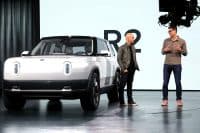
Management raised the low end of Rivian’s 2026 delivery guidance to 67,000 from 65,000 and held the top at 70,000, while Wall Street analysts expected 67,227. Beyond deliveries, Rivian improved its adjusted earnings before interest, taxes, depreciation and amortization (EBITDA) loss guidance to $1.75 billion to $1.85 billion and cut its capital spending range to $1.40 billion to $1.50 billion. Deliveries at Rivian jumped 46% YoY to 19,248. CEO RJ Scaringe said on the call that “R2 is already our best-selling vehicle by volume, outselling both R1 and EDV in the third quarter.”
Software and services revenue at Rivian grew 45% to $605 million, with 59% coming from the Volkswagen joint venture. Scaringe confirmed that partnership after a report earlier this week that Volkswagen is weighing Chinese software for some European models sent Rivian stock to a fresh low. A robotaxi milestone with Uber Technologies could unlock a further $250 million equity investment by year-end, and Amazon’s electric delivery van order with Rivian runs up to 100,000 vehicles.
Cash, cash equivalents and short-term investments at Rivian amounted $5.502 billion at quarter end. Mizuho, however, cut its Rivian price target to $10 from $13 after the October 29 report and kept its Underperform rating. In Mizuho’s view, the quarter was solid with good deliveries, but the EV market stays challenged into 2027 and R2 could cannibalize some R1 demand.

Tesla, Lucid and Ford Slip as Rivian Climbs
Tesla (NASDAQ:TSLA) stock is at $390.35, down 3%. On the October 21 earnings call, Tesla CEO Elon Musk said, “We are in a huge investment cycle to set us up for the future.”
Lucid Group (NASDAQ:LCID) stock is at $3.14, down 2%. The company is further back in a turnaround, with Q2 2026 results that missed expectations on August 4 and a $1.4 billion cash flow improvement plan.
Meanwhile, Ford Motor (NYSE:F) stock is at $12.27, down 0.8%. Ford topped expectations on October 28 and raised the low end of its 2026 adjusted earnings before interest and taxes (EBIT) guidance, though its Model e electric vehicle unit still lost $1.06 billion.
How Rivian’s Model Differs From Its Rivals
Rivian sells premium R1 SUVs, the mass-market R2 and commercial vans, and it also licenses software through its Volkswagen joint venture. That mix gives the company revenue beyond its own vehicle sales.
Tesla is steering its story toward energy storage, robotaxis and humanoid robots. Lucid sells luxury sedans and SUVs, and its largest shareholder is a Saudi Arabian related party. Ford funds its money-losing EV unit with gas and hybrid trucks.
Rivian’s Path to Automotive Profit
Rivian’s next test is whether the second R2 shift lifts its production run rate over the coming quarters. Interim CFO Derek Mulvey stated on the call, “We expect that R2 will help us achieve a positive automotive gross margin exit rate for the year.” Scaringe noted cheaper R2 versions aim to capture customers “from the $45,000 price point all the way up to the $57,000 price point.”
Optimists can point to Rivian’s smaller losses, raised outlook and fresh outside capital. Skeptics note that Rivian still burns cash, faces the risk that R2 eats into R1 sales and depends on funding that comes only if it hits certain milestones.
Another checkpoint for Rivian is the remaining $460 million in Volkswagen joint venture capital, expected in late 2027. Investors may want to stay conservative with their share-position sizes while Rivian’s R2 margin push plays out.
Contact [email protected] for any questions or corrections.
David Moadel is financial writer specializing in stocks, ETFs, options, precious metals, and Bitcoin. David has written well over 1,000 articles for leading online publications, helping investors understand markets, income strategies, and risk.His work has appeared in The Motley Fool, InvestorPlace, U.S. News & World Report, TipRanks, ValueWalk, Benzinga, Market Realist, TalkMarkets, Finmasters, 24/7 Wall St., and others.With a master’s degree in education, David has taught at the elementary, high school, and college levels. That teaching background shapes his writing style: clear, educational, and practical. David has also built a loyal social-media audience by providing trustworthy financial content on YouTube, X/Twitter, and StockTwits.