If You Invest $1,000 in Arm Holdings Today, Here’s What It Could Be Worth by 2030
Arm Holdings has quietly shifted from smartphone chips to hyperscale data centers and its own silicon, a pivot that splits analyst opinion sharply and sends five-year return scenarios ranging from a loss to a nearly fourfold gain.

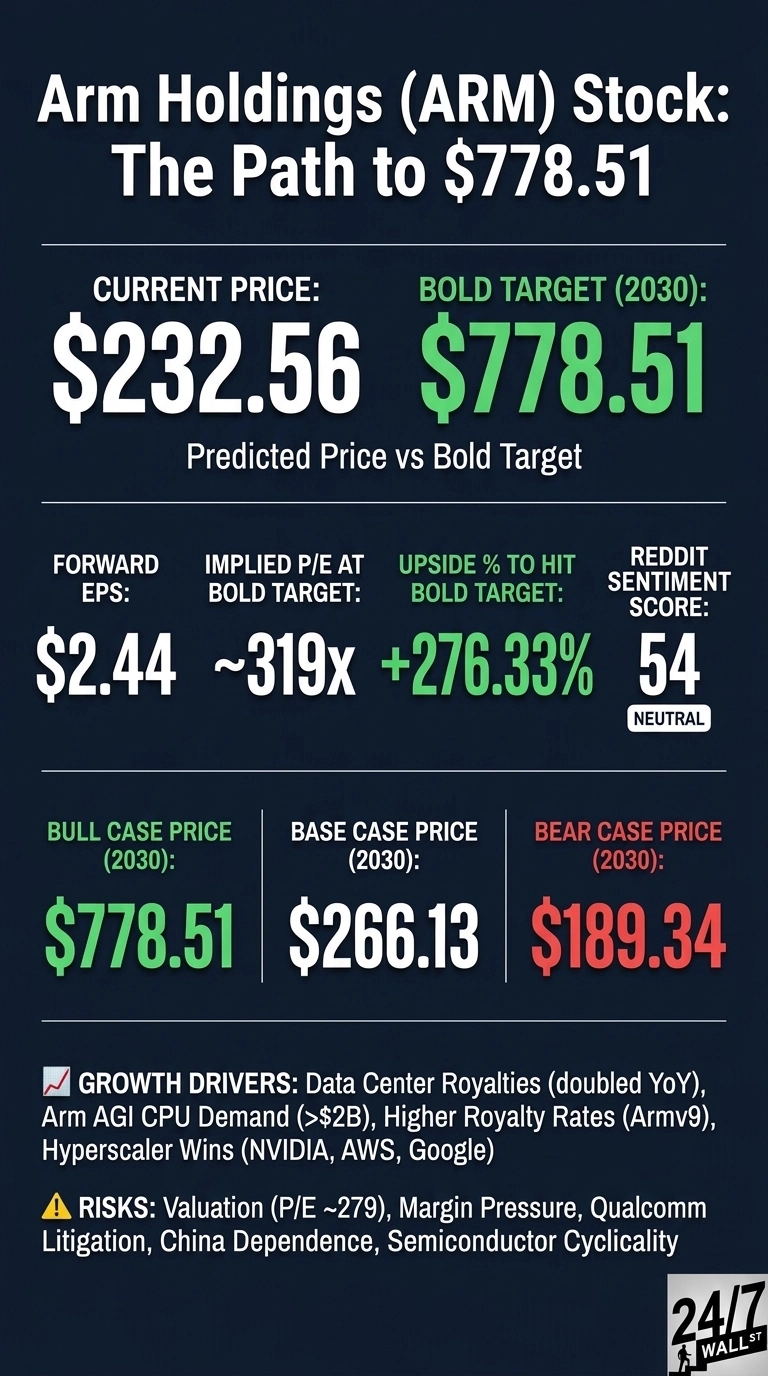
Picture putting $1,000 into Arm Holdings (NASDAQ:ARM | ARM Price Prediction) at its latest close of $232.56 and holding it until 2030. Arm designs the chip architecture inside most of the world’s smartphones.
It is now moving into hyperscale data centers and selling its own production silicon, and that shift is the reason its long-range outlook is worth modeling.

What $1,000 in Arm Could Become by 2030
Under the central scenario, a $1,000 investment could be worth about $1,237.70 by 2030, a total return of 23.77%. Behind that figure is a projected share price of $266.13 on October 28, 2030, corresponding to 4.36% on an annualized basis.
| Scenario | 2030 Target Price | Total Return | Value of $1,000 Stake |
|---|---|---|---|
| Bull | $778.51 | 276.33% | $3,763.30 |
| Base | $266.13 | 23.77% | $1,237.70 |
| Bear | $189.34 | -15.53% | $844.70 |
The 2030 figures are a checkpoint inside the five-year model. That model runs through October 28, 2031, where its central forecast reaches $287.84. The upside scenario at that point is $875.20 and the bear case is $196.43.
Over one year, the model projects a base target of $240.95, or 3.61% upside. It rates the stock a hold (“Near fair value”) with a confidence score of 0.9.
Wall Street is more optimistic. The analyst consensus target is $290.70, and the ratings break down as 8 strong buy, 21 buy, 12 hold, 1 sell, and 1 strong sell.

Three Growth Engines That Could Push Arm Toward the Bull Case
Data Center Royalties Are Growing Fast
Management said “data center royalties more than doubled year over year once again.” Arm Neoverse shipments have passed 1.5 billion cores. The most recent 500 million shipped in nine months, while the first 1 billion took six years.
NVIDIA (NASDAQ:NVDA) has put its Arm-based Vera CPU into production, and Amazon (NASDAQ:AMZN) plans to deploy tens of millions of Graviton 5 cores for AI workloads. Management puts the CPU market at $100 billion plus in the later years.
Arm AGI CPU Demand Is Running Ahead of Plan
Arm’s first in-house data center chip has drawn more than $2 billion in demand, against an initial $1 billion opportunity outlined across fiscal 2027 and fiscal 2028.
Meta Platforms (NASDAQ:META) is the lead partner on a multi-generation roadmap. First-generation gross margins are expected in the high 30% range to low 40s, going up toward 50% over the next couple of years.
Higher Royalty Rates Lift Every Chip
Armv9 and compute subsystems carry higher royalty rates per chip. That mix shift helped first-quarter fiscal 2027 revenue reach $1.289B, up 22.4% and ahead of estimates. Guidance for the next quarter calls for $1.38 billion, plus or minus $50 million.
In the fourth-quarter fiscal 2026 report, CEO Rene Haas said “demand for Arm AGI CPU, Arm’s first data center chip, has exceeded expectations, reinforcing Arm as the compute platform for the AI era.”
Risks That Could Drag Your Stake Toward $844.70
- Valuation and volatility: Arm trades at about 279 times trailing earnings with a beta of 3.79. Shares hit $396.34 on June 16 after trading at $105.78 in mid-January, and they have fallen 19.2% over the past month.
- Margin pressure: GAAP operating margin contracted to 7% from 11% as operating expenses rose 28% to $1.16B. GAAP EPS of $0.25 missed expectations, although non-GAAP EPS of 45 cents exceeded the high end of guidance.
- Legal and geopolitical exposure: The litigation involving Qualcomm (NASDAQ:QCOM) and Nuvia has a trial expected in Q4 calendar 2026. Arm also depends on Arm China for access to the Chinese market and faces evolving US export controls, a possible 25% semiconductor tariff, and PRC-Taiwan tensions.
- Supply and smartphone softness: Higher memory prices are weighing on handset demand, and wafers, substrates, memory, and test capacity remain tight.
- Controlling shareholder: SoftBank’s majority ownership makes potential conflicts of interest.
Where Your $1,000 Could Land by 2030
The model puts a $1,000 stake in Arm between $844.70 and $3,763.30 by 2030, with a base case of about $1,237.70.
The upside scenario depends on data center adoption and AGI CPU sales; the bear case reflects the stock’s valuation and its sharp price swings. All of these numbers are scenarios, not promises. They are model projections and should not be treated as investment advice.
Contact [email protected] for any questions or corrections.
Vandita Jadeja is a financial publisher with over a decade of experience writing about financial topics, including investment, savings, retirement, insurance and banking. Vandita is a Chartered Accountant who loves to debunk financial concepts for readers.
Her work has appeared on sites that include The Motley Fool, InvestorPlace, and Benzinga. She covers investing and focuses on stock picks and price prediction for 24/7 Wall St.
When not looking for the next stock investment opportunity, she can be found traveling, reading, chasing sunsets and enjoying her iced latte.