3 Dividend Aristocrats Growing Their Payouts the Fastest
Some Dividend Aristocrats raise their payouts at a pace that turns a small starting yield into a compounding income machine, but the tradeoffs between yield, growth rate, and financial safety look very different across these three names.

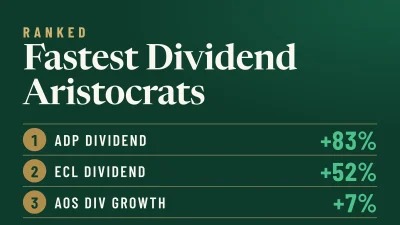
A dividend that grows faster than inflation turns a modest starting yield into a paycheck that keeps getting bigger, and these three Dividend Aristocrats are raising their payouts at a pace most income stocks can’t keep up with. Automatic Data Processing (NASDAQ:ADP | ADP Price Prediction), Ecolab (NYSE:ECL) and A.O. Smith (NYSE:AOS) all pair long runs of annual increases with earnings and cash flow strong enough to keep paying for them. ADP has grown the fastest of the three. Its quarterly dividend went from $0.93 to $1.70 over five annual increases, a gain of about 83%.
Automatic Data Processing: Payroll Cash Flow Funds Double-Digit Raises
At a share price of $299, ADP yields about 2.27% on a forward annual dividend of $6.80 per share. The most recent raise lifted the quarterly payment from $1.54 to $1.70, an increase of roughly 10.4%. The year before, it went up from $1.40.
Dividend safety. The forward dividend takes about 60% of trailing earnings of $11.28 per share. On a cash basis it’s well funded. In the last fiscal year ADP generated $5.44B of operating cash flow and spent only $196.6M on capex, so free cash flow covered the $2,626.3M in dividends about 2.0 times. That remaining cash also paid for $2.08B of buybacks last fiscal year and another $758.8M in the latest quarter. The dividend record shows a higher quarterly rate every year for a decade, rising from $0.63 to $1.70.
Can growth keep up? Management lifted its full-year outlook to about 6% revenue growth and 10%–12% adjusted EPS growth. That earnings pace lines up with recent increases of about 10%. First-quarter adjusted EPS of $2.82 beat the $2.77 estimate, and revenue rose 6.1% to $5.49B.
Bull case. ADP serves 1.1 million clients and more than 42 million workers, and payroll is a service businesses almost never stop paying for. AI is also bringing down ADP’s cost to serve. Its AI service platform now reaches 60% of the service population, and contacts per client in the downmarket business fell 7%. As management put it, "Our continued investment in our products, our people, and our AI capabilities sets us up to deliver sustainable revenue growth, margin expansion, and shareholder returns over time." The shares trade at about 24 times forward earnings.
Risk. Part of ADP’s profit comes from interest earned on client funds it holds. Management expects $1.59 billion to $1.61 billion from that this year at an average yield of about 3.8%. If rates fall, that income contracts.
Ecolab: Smallest Yield, Biggest Latest Raise
Ecolab yields only about 0.95% at $308.86, on a forward dividend of $2.92. Its latest raise was the largest of the three, taking the quarterly payout from $0.65 to $0.73, or about 12.3%. Five increases ago the quarterly rate was $0.48, so the payout has grown about 52% since then.
Ecolab shows the trade-off between yield and growth most clearly. You collect a small check today, and the return depends on double-digit increases compounding year after year. Investors who need maximum current income will find too little here. Investors with a long time horizon gain an income stream that has been growing well ahead of inflation.
Dividend safety. The forward dividend takes about 39% of trailing GAAP earnings of $7.48 per share and about 36% of the midpoint of full-year adjusted EPS guidance of $8.10–$8.20. That low payout ratio is Ecolab’s main safety margin. The dividend record shows a higher quarterly rate every year for nearly two decades, from $0.14 to $0.73.
Can growth keep up? Management expects next year’s adjusted EPS growth to meet or exceed its long-term 12%–15% target, which supports increases at the current pace. Third-quarter revenue rose 12.7% to $4.69B, and adjusted EPS of $2.18 beat the $2.17 estimate.
Bull case. Ecolab has added real growth businesses on top of its cleaning and water treatment core. Global High-Tech, which includes data-center cooling, grew 63% organically, and Life Sciences grew 17%. Pricing power helps protect margins. In the chief executive’s words, "Our value-price approach has been so steady, sticky, and reliable for the past few years, and nothing is going to change in the years to come." That growth comes at a high price: about 32 times forward earnings.
Risk. The CoolIT acquisition raised leverage. Net debt now stands at 2.9x adjusted EBITDA, up from 1.6x a year ago. CoolIT’s interest and amortization cut EPS by about 10% in the third quarter, and management expects a hit of about 12% in the fourth.
A.O. Smith: Lowest Valuation and the Widest Cash Cushion
A.O. Smith yields about 2.32% at $65.42, the highest starting yield of the three, on a forward dividend of $1.52. The company’s board approved a 6% increase, lifting the quarterly payment from $0.36 to $0.38. The company has raised its dividend for more than 30 consecutive years and reports a five-year compound annual dividend growth rate of approximately 7%. Five increases ago the quarterly rate was $0.26.
Dividend safety. The forward dividend takes about 42% of trailing earnings of $3.58 per share. Over the first nine months, operating cash flow of $429 million minus $33 million of capex covered $149 million in dividends about 2.7 times, the widest cash coverage in this group. Debt-to-capital rose to 27% from 9.2% after the $470 million Leonard Valve deal, and that remains moderate. The CFO said, "Our healthy cash flow lets us invest in growth and return cash to shareholders at the same time."
Can growth keep up? Earnings growth is slower here, which explains why A.O. Smith raises by mid-single digits rather than double digits. Full-year adjusted EPS guidance, excluding China, is $3.42–$3.52, on sales growth of about 4%.
Bull case. Replacement demand drives 80% to 85% of the core business, so most sales come from water heaters that have to be replaced when they fail. Selling the China business should free up about $350 million for buybacks once the deal closes, on top of a $300 million repurchase target for this year. At about 15 times forward earnings, it’s the cheapest stock of the three.
Risk. Management expects steel and freight costs to each rise about 15% from last year. Price increases take time to catch up with costs, and the CFO warned that fourth-quarter North America margins will come under pressure as a result.
Faster Raises Make Up for Smaller Starting Checks
ADP has grown its dividend the fastest over five years and still covers it about twice with free cash flow. Ecolab pays the smallest yield but delivered the biggest latest raise, supported by a low payout ratio and a 12% to 15% earnings growth target. A.O. Smith offers the highest starting yield, the lowest valuation and the widest cash coverage, in exchange for slower increases. For income that needs to outrun inflation, all three lean toward growth over current yield, and all three have the earnings and cash flow to keep raising.
Contact [email protected] for any questions or corrections.
Lee Jackson has covered Wall Street analysts' equity and debt research and equity strategy daily for 24/7 Wall St. since 2012. His broad, diverse career, including a stint as creative services director at an NBC affiliate in Austin, Texas, gives him unique insight into the financial industry.
Lee Jackson's journey in the financial industry spans more than 30 years, including nearly two decades as an institutional equity salesperson at Bear Stearns, Lehman Brothers, and Morgan Stanley. His career spanned pivotal sell-side Wall Street events, from the dot-com rise and bubble to the Long-Term Capital Management debacle, 9/11, and the Great Recession of 2008. This reflects his resilience and adaptability amid market volatility.
Lee Jackson’s practical financial industry experience, gained through a career at some of the biggest banks and brokerage firms, is complemented by a lifetime of writing across various platforms. This unique combination allows him to shed light on the intricacies of Wall Street in a way only someone with deep insider experience and knowledge can. Moreover, his extensive network across Wall Street continues to provide direct access for him and 24/7 Wall St., a privilege few firms enjoy.
Since 2012, Jackson’s work for 24/7 Wall St. has been featured in Barron’s, Yahoo Finance, MarketWatch, Business Insider, TradingView, Real Money, The Street, Seeking Alpha, Benzinga, and other media outlets. He attended the prestigious Cranbrook Schools in Bloomfield Hills, Michigan, and has a degree in broadcasting from the Specs Howard School of Media Arts.