Eli Lilly Just Delivered Another Monster Quarter. But There’s More to This Story Than Weight-Loss Drugs
Eli Lilly's weight-loss drugs get all the headlines, but CEO David Ricks is betting the company's next act looks nothing like its last one. Here is what it would actually take for shares to reach $1,700 in 2027.

Eli Lilly (NYSE:LLY | LLY Price Prediction) has become a major growth engine in pharma, and its third-quarter report added to that case. Revenue rose 38.6% to $24.40 billion as worldwide tirzepatide volume climbed 53%.
Even so, CEO David A. Ricks spent much of the call talking about other things: “With three-fourths of our clinical pipeline focused on diseases outside of obesity, we’re developing new medicines that have the potential to impact a broad range of disease to deliver diversified and durable growth.”
Shares are up 30.44% year to date and 72.56% over the past year, at roughly $1,395. Here’s what Lilly must achieve to reach $1,700 per share in 2027.

Wall Street’s Price Targets Are Trailing Lilly’s Momentum
The average analyst target of $1,333.72 means 4.4% downside. That gap mostly shows how fast the stock has moved (up 17.76% in a month), and the earnings estimates are still climbing.
Analysts see 2027 revenue of $102.11 billion, about 15% growth, and EPS of $47.2209, roughly 37% above the 2026 estimate. Ninety days ago, that 2027 EPS figure was $44.8794.

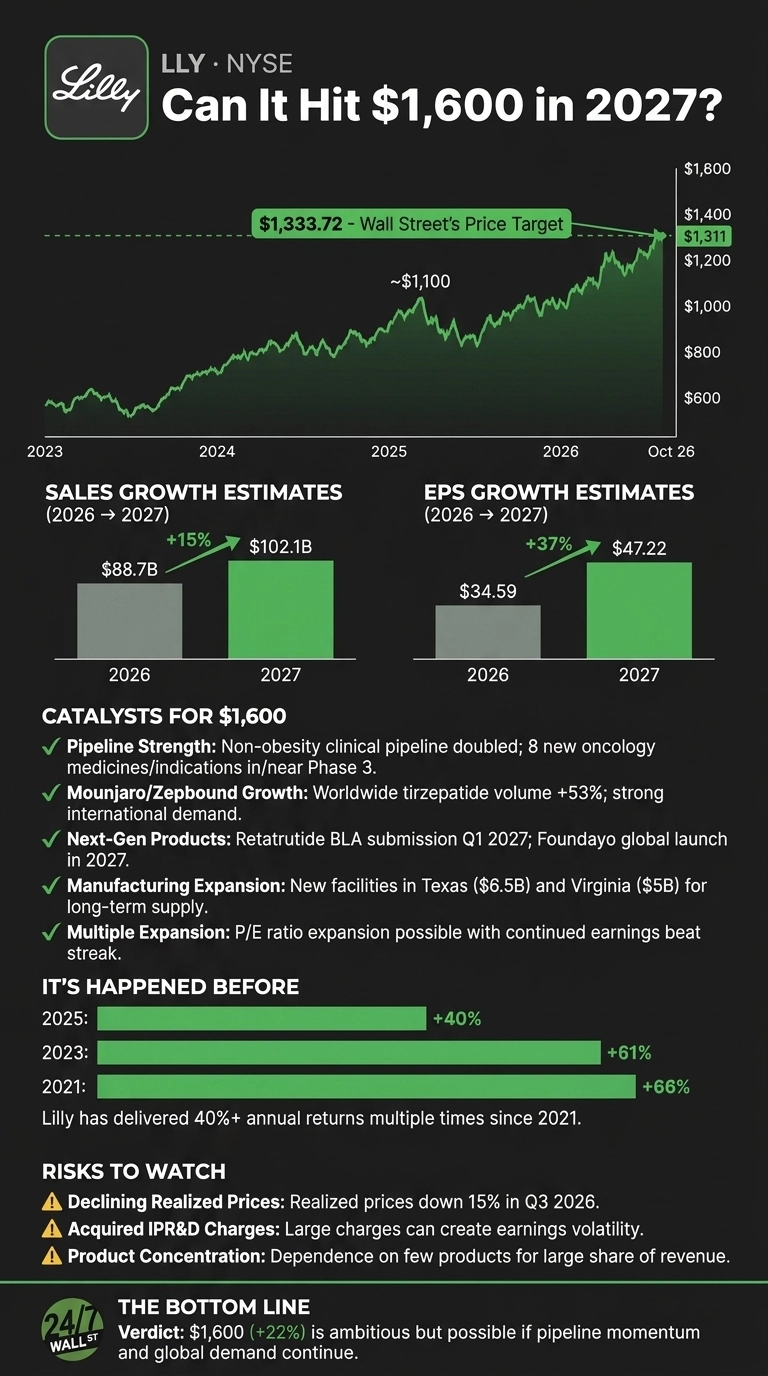
Lilly has also beaten EPS estimates for five consecutive quarters. Q3 non-GAAP EPS of $7.48 beat the $6.67 consensus despite $4.57 per share of acquired R&D charges. Management also raised full-year revenue guidance to $91 billion to $92 billion.

Here’s the Math Behind $1,700 Per Share
Lilly currently trades at about 30x 2027 estimated earnings. At $1,700, that multiple would rise to 36x, still below its trailing P/E of 43. A mid-30s multiple is easy to justify for a company expected to grow EPS by more than a third.

What Could Push Lilly to $1,700?
- Growth beyond obesity: Key products in immunology, oncology and neuroscience grew 100%. Kisunla revenue rose 175%, and Jaypirca gained 59% ahead of its newly expanded first-line CLL label.
- Oncology depth: Lilly has eight new oncology medicines or major indications in Phase 3 or about to start, with EMBER-4 breast cancer data due in 2027.
- Retatrutide: The BLA submission is planned for Q1 2027. In a head-to-head trial, retatrutide produced 20% to 21% weight loss, compared with 9.4% for semaglutide.
- Foundayo rollout: The oral GLP-1 is under review in more than 40 additional countries, and a global launch is expected in 2027.
- Medicare access: The Bridge program covers about 20 million seniors, and more than half a million people have filled a Lilly prescription through it since July 1.
- Near-term events: Innovation Day is on December 7, and 2027 guidance comes in January.
Lilly’s History Says $1,700 Is Within Reach
Reaching $1,700 requires a gain of about 22%. Lilly topped that bar in seven of the 10 calendar years from 2016 through 2025. Shares rose 66% in 2021, 61% in 2023 and 40% in both 2018 and 2025.
Over five years, the stock has gained 472.9%. With a market cap near $1.22 trillion, matching those years gets harder, but the base needed for a 22% gain keeps growing.
My Take on $1,700 for Lilly
Reaching $1,700 means a 22% gain in 2027. Earnings estimates are rising, Lilly keeps beating them, and its non-obesity portfolio doubled last quarter.
There are real challenges. Realized prices fell 15%, and about $2 billion in one-time 2026 revenue won’t repeat. Returns at this level shouldn’t be expected every year, but this is the model for how Lilly could deliver outsized returns in 2027.
Contact [email protected] for any questions or corrections.
Vandita Jadeja is a financial publisher with over a decade of experience writing about financial topics, including investment, savings, retirement, insurance and banking. Vandita is a Chartered Accountant who loves to debunk financial concepts for readers.
Her work has appeared on sites that include The Motley Fool, InvestorPlace, and Benzinga. She covers investing and focuses on stock picks and price prediction for 24/7 Wall St.
When not looking for the next stock investment opportunity, she can be found traveling, reading, chasing sunsets and enjoying her iced latte.