The Average Stock Just Beat the S&P 500 by the Most Since 2009
October cracked open a rare divide between the S&P 500 and the typical stock inside it, a gap not seen in over 15 years, and now investors face a decision before NVIDIA reports and the rotation either holds or collapses.

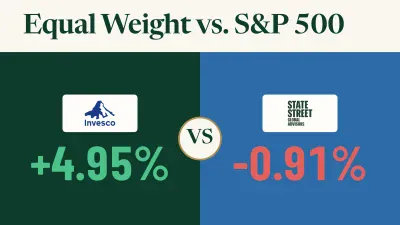
October, which ended Friday, October 30, split the stock market’s headline number from its typical stock. The Invesco S&P 500 Equal Weight ETF (NYSEARCA:RSP) rose 4.95%, from $208.02 on September 30 to $218.31. The State Street SPDR S&P 500 ETF Trust (NYSEARCA:SPY) fell 0.91%, from $762.63 to $755.72.
That 5.85-point gap is the widest monthly margin for the equal-weight index since April 2009. The “average stock” is shorthand for the equal-weight index, which gives each member about the same weight.
The split continued on November 2, when RSP rose 0.76% to $219.98, and SPY fell 0.48% to $752.10, which raises the question of whether this marks a lasting change in leadership.
April 2009 Still Holds the Record Gap
RSP rose 18.69% in April 2009 while SPY rose 9.93%, a gap of 8.76 points. The next largest since were 4.34 points in February 2026 and 3.42 in November 2020.
Equal weight trailed by 4.6 points in September, and Bespoke Investment Group counts the swing of more than 10 points as the largest monthly reversal in either direction since at least 1990. The S&P 500 closed October 30 at 7,580.07, one penny above its May 29 close of 7,580.06.
Why Falling Tech Drags SPY but Spares RSP
Technology makes up about 37% of the S&P 500’s market value, so a cap-weighted fund takes most of any tech selloff. Equal weight gives each tech company the same small piece as everyone else.
In October, the Technology Select Sector SPDR Fund (NYSEARCA:XLK) fell 8.30%, from $195.75 to $179.51. The Consumer Staples Select Sector SPDR Fund (NYSEARCA:XLP) rose 10.94%, from $80.60 to $89.42. Staples added 1.6% on November 2 as seven of 11 sectors gained, a sign that money is seeking steady performers as well as leaving tech.
Through October 7, the S&P 500 was up 14.0% for the year against 9.9% for equal weight.
By November 2, RSP was up about 14.8% from its $191.56 close at the end of 2025, while SPY was up about 10.3% from $681.92, on price alone. RSP still sits below its $222.77 record close from August 14 and its 52-week high of $223.44.
Soon, the midterm elections on November 3 and the October jobs report on November 6 could quickly shift the mood.
The bigger test is NVIDIA (NASDAQ:NVDA | NVDA Price Prediction), which reports after the close on November 17. It was SPY’s largest holding at 7.58% as of March, and a strong report could pull money back into the biggest AI names, where RSP holds the least.
What RSP Offers Investors Before NVIDIA Reports
RSP gives investors S&P 500 exposure with less dependence on a handful of AI stocks. Each holding sits near one-fifth of 1% of assets, so no single company can drive returns. For investors who still want AI exposure without crowding into the chipmakers, we profiled seven suppliers powering the data-center expansion, from electricity to cooling, in a free report you can grab here.
Equal weight carries trade-offs, because the fund holds less of the fastest growers and quarterly rebalancing trims winners to buy laggards.
That wider spread is what helped equal weight in a month like October.
Check back after NVIDIA reports on November 17. If RSP closes above its $222.77 record by November 30, the rotation is holding, and if SPY regains the year-to-date lead, the October rotation likely faded.
Contact [email protected] for any questions or corrections.
Omor Ibne Ehsan is a writer at 24/7 Wall St. He is a self-taught investor with a focus on growth, cyclical, and dividend equities that have strong fundamentals, value, and long-term potential. He also has an interest in high-risk, high-reward investments such as penny stocks.