Counterparty Concentration and Depreciation Define CoreWeave Now
CoreWeave's GPU empire carries a backlog that Wall Street analysts value at more than double today's share price, yet the same contracts burying rivals in debt may be quietly burying CoreWeave too. One upcoming quarter will decide which side is…

CoreWeave (NASDAQ:CRWV) is a Hold at $53.74. That price comes after a 40.04% drop over the past month, as investors consider two questions: who is paying CoreWeave’s bills, and how quickly its GPUs lose value.
CoreWeave rents NVIDIA (NASDAQ:NVDA | NVDA Price Prediction) GPU capacity to AI labs, hyperscalers such as Meta (NASDAQ:META) and enterprises. It competes with Microsoft (NASDAQ:MSFT) Azure, Google Cloud and AWS. Its largest counterparties are OpenAI, Meta and Microsoft. Second-quarter revenue reached $2.58 billion, up 112.3% YoY. Shares have fallen from $136.80 at the first-quarter report to $87.64 at the second-quarter report, and have kept falling.
A $104 Billion Backlog Priced Like a Broken Story
Revenue backlog stands at $104.2 billion, and management added more than $25 billion of net new commitments early in the third quarter. Adjusted EBITDA hit $1.51 billion at a 59% margin. Management raised prices approximately 25% across SKUs in July and says new contracts carry contribution margins 5 to 10 percentage points higher than recent ones. The company guides to a year-end revenue run rate of $18.5 billion to $19.5 billion.
Bulls also have an answer to the depreciation worry. CoreWeave signed “an A100 contract that extends into 2029 at an attractive price” on a chip introduced in 2020. That suggests old GPUs still earn money after their first contract ends. A CNBC commentator recently argued that the stock could potentially triple.
Depreciation and Interest Are Growing Faster Than Profits
Depreciation and amortization reached $1.393 billion last quarter, about 54% of revenue, compared with $560 million a year earlier. Interest expense rose to $640 million from $267 million, and third-quarter guidance calls for $860 million to $940 million. Total liabilities of $72.05 billion sit against just $5.02 billion of equity, and full-year capex guidance runs $35 billion to $39 billion.
Concentration amplifies that leverage. Meta committed up to $14.2 billion and later $21 billion, while OpenAI commitments total about $22.4 billion. If one of those buyers pulls back, both the backlog and the debt service behind it come under pressure. CoreWeave also faces a securities fraud class action over construction delays.
Third-Quarter Margins Will Decide the Next Move
Management expects adjusted operating margins to reach the low teens in Q4. More than two-thirds of the second-quarter backlog should be in active delivery by year-end. Third-quarter guidance calls for revenue of $3.45 billion to $3.6 billion and adjusted operating income of $200 million to $260 million. Reaching those numbers would show that scale is absorbing depreciation. Missing them would confirm the bear case.
Analysts See 150% Upside as Shares Trail the S&P 500
The average analyst target of $134.58 implies about 150.4% upside across 42 analysts. Targets are not guarantees, especially for a stock that has fallen this far. The ratings break down this way:
- Strong Buy: 8
- Buy: 23
- Hold: 8
- Sell: 2
- Strong Sell: 1
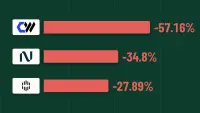
Over the past year, CoreWeave dropped 57.46% as the S&P 500 gained 10.4%. Year to date, the stock is down 24.95%, compared with a 10.63% gain for the index. Shares trade near the $49.46 52-week low at 4 times sales. The fiscal 2026 consensus EPS estimate is -5.1813.
Why CoreWeave Rates a Hold Until Margins Outrun Depreciation
At $53.74, CoreWeave is a Hold.
Growth is rapid and the backlog is real, but depreciation and interest absorb nearly all of that growth. A move to Buy would need third-quarter adjusted operating income within guidance, interest costs at or below the guided range, and new customer wins that reduce reliance on Meta and OpenAI.
A move to Sell would follow if a major counterparty trims its commitments, borrowing costs rise, or analysts keep cutting estimates. Four analysts lowered their fiscal 2026 estimates in the past month, and only one raised it. The stock could recover if margins improve, while counterparty risk has yet to be tested.
The next quarter will show whether CoreWeave’s contracts can pay down debt faster than its GPUs lose value.
Contact [email protected] for any questions or corrections.
Alex Sirois is a financial writer with experience spanning both retail and institutional investing. He has written for InvestorPlace and held roles at BNY Mellon and Bernstein, giving him a perspective that bridges Main Street portfolios and Wall Street analysis.
Alex holds an MBA from George Washington University and has built his career across multiple industries, including e-commerce, education, and translation — a breadth of experience that informs how he breaks down complex financial topics for everyday investors. His writing is conversational, actionable, and grounded in long-term, buy-and-hold investing principles.
At 247 Wall St., Alex focuses on delivering analysis that is both accessible and useful, with a clear emphasis on helping readers make more informed decisions with their money.