Nvidia Isn’t the Only AI Stock That Could Surprise Wall Street in 2027
Memory chips were once the dullest corner of semiconductors, yet one stock has tripled while trading at a fraction of the market's earnings multiple. Wall Street and the market disagree sharply on what comes next, and the gap could close…

This post may contain links from our sponsors and affiliates, and Flywheel Publishing may receive compensation for actions taken through them.

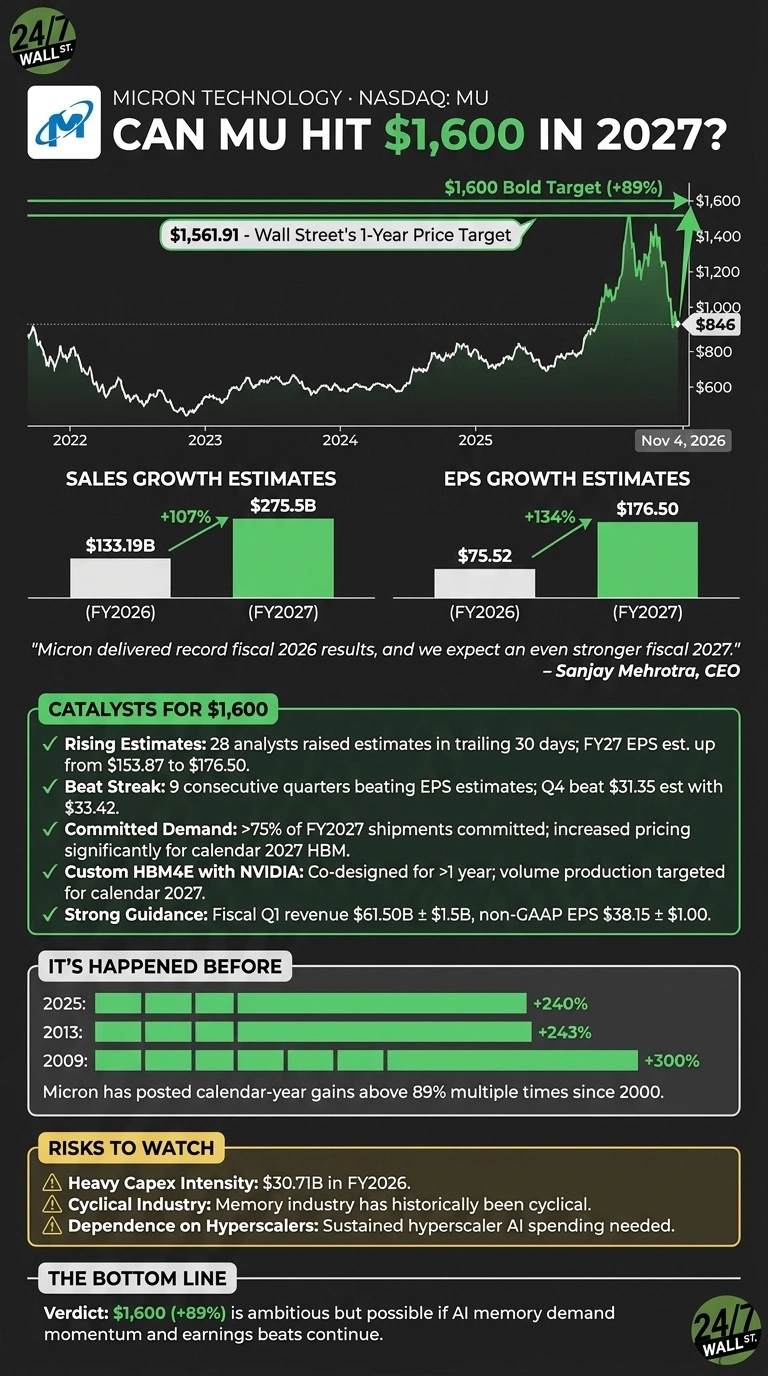
Memory used to be the commodity corner of the chip world. AI has changed that. Micron Technology (NASDAQ:MU | MU Price Prediction) posted fiscal 2026 revenue of $133.19 billion, up 256.3%. Its fiscal Q4 non-GAAP gross margin reached 87.0%, compared with 45.7% a year earlier.
CEO Sanjay Mehrotra says “memory enhances this intelligence and the competitiveness of our customers’ platforms,” and he expects “an even stronger fiscal 2027.”
Shares are up 196.65% year-to-date after gaining 240% in 2025. Over the past month, though, the stock has fallen 21.28% to $846, well below its 52-week high of $1,254.61. While NVIDIA (NASDAQ:NVDA) gets most of the AI headlines, Micron could deliver the bigger surprise in 2027. Here is how shares could reach $1,600.

Wall Street Already Sees 85% Upside for Micron
The consensus price target is $1,561.91, which means about 85% upside. Analysts rate the stock with 9 Strong Buys and 36 Buys against 3 Holds. They expect fiscal 2027 revenue of $275.5 billion, roughly 107% growth, and EPS of $176.5017, about 134% above fiscal 2026’s $75.52.

Barron’s recently noted that the market and Wall Street are “poles apart” on the stock. A gap that wide leaves plenty of room for the price to catch up.
Micron at $1,600 Would Still Trade Under 10x Earnings
At $846, Micron trades at about 5x fiscal 2027 estimates. At $1,600, that multiple would rise to about 9x. The S&P 500 trades at 21x to 23x forward earnings. Even after a cyclical discount, the stock could expand its multiple a long way before it looks extended.
What Could Push Micron to $1,600?
- Rising estimates: 90 days ago, analysts expected fiscal 2027 EPS of $153.8669. Now it stands at $176.5017, and 28 analysts raised estimates while 2 cut them in the past 30 days.
- Beat streak: Micron has topped EPS estimates for 9 consecutive quarters. In fiscal Q4 it reported $33.42 against a $31.35 estimate.
- Committed demand: “More than 75% of our shipments” for fiscal 2027 are already committed. President Manish Bhatia said, “We really don’t have line of sight to when supply and demand balance.” Micron has also “increased that pricing significantly” on HBM for calendar 2027.
- Custom HBM4E with NVIDIA: Micron has co-designed “NV HBM” with NVIDIA for “over a year”, and HBM4E volume production is targeted for calendar 2027.
- Strong guidance: Fiscal Q1 guidance calls for $61.50 billion in revenue and $38.15 in non-GAAP EPS.
- Buybacks: Barron’s reports that massive buybacks are expected in December.

Micron Has Topped 89% Gains Before
To reach $1,600, the stock would need to rise about 89%. Micron has posted calendar-year gains above that level three times since 2000: 300% in 2009, 243% in 2013, and 240% in 2025.
The stock also swings hard in both directions. It fell 46% in 2022 and carries a beta of 2.398.

$1,600 Is a Stretch, but the Blueprint Is in Place
A move to $1,600 would require an 89% gain in 2027. Analysts already project 85% upside, estimates keep climbing, and most of next year’s supply is sold.
The hurdles are real. Fiscal 2026 capex totaled $30.71 billion, memory has a long history of boom-and-bust cycles, and hyperscalers would need to keep spending. If AI demand holds and Micron keeps beating forecasts, $1,600 is within reach.
Gains this large are unlikely to repeat every year, but this is the template for how Micron could post outsized returns in 2027 (we reverse-engineered what the biggest tech winners looked like early and put the pattern in a free playbook here).
Contact [email protected] for any questions or corrections.
Vandita Jadeja is a financial publisher with over a decade of experience writing about financial topics, including investment, savings, retirement, insurance and banking. Vandita is a Chartered Accountant who loves to debunk financial concepts for readers.
Her work has appeared on sites that include The Motley Fool, InvestorPlace, and Benzinga. She covers investing and focuses on stock picks and price prediction for 24/7 Wall St.
When not looking for the next stock investment opportunity, she can be found traveling, reading, chasing sunsets and enjoying her iced latte.