Buy The Market’s Knee-Jerk Derisking of GE Vernova While You Can
One election headline erased a fifth of GE Vernova's value in a month, yet the company just posted record orders. Sellers fixated on data centers, but the order book hints they may have misread who is actually buying.

This post may contain links from our sponsors and affiliates, and Flywheel Publishing may receive compensation for actions taken through them.

GE Vernova (NYSE:GEV | GEV Price Prediction) trades at $774.13. An election-driven selloff has cut the stock sharply just as its order book reached a record, which leaves the stock trading lower against a larger order book.
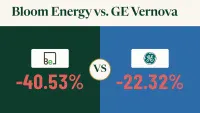
GE Vernova was spun off from General Electric (NYSE:GE). It sells gas turbines, grid equipment and wind systems to utilities, industrial customers and data center operators in about 100 countries. That data center exposure is what sellers went after. A Democratic congressional sweep raised fears of a backlash against data centers, and GE Vernova closed down about 9% in a single session. Shares are down 9.76% over the past week and 22.32% over the past month.
Record Orders Show Data Centers Are a Minority of Demand
Third-quarter revenue rose 26.8% to $12.64 billion. EPS came in at $4.81, well ahead of the $4.01 consensus. Orders rose 96% to $29.3 billion, which lifted backlog to $197 billion. Management raised its free cash flow guidance to $16 billion to $17 billion, up from $11.5 billion to $12.5 billion.
The selloff gets the demand mix wrong. Traditional customers account for roughly 80% of gas demand, and data centers make up about 20%. Pricing on full-year 2026 gas orders is running about 50% higher per kilowatt than on 2025 orders. CEO Scott Strazik said, “We are still in the early stages of this electricity investment supercycle.” The board also doubled the buyback authorization to $20 billion. GE Vernova is one of the picks-and-shovels suppliers behind the AI expansion, and we featured seven of these non-chip beneficiaries in a free report on the companies powering the AI boom.
Policy Risk Collides With a Lower 2027 Earnings Bar
Bears say the election changes the multiyear outlook. Clean-energy stocks rallied on expectations that a Democratic Congress could bolster federal support for renewables, which could weaken the boost for gas turbines. More friction over data center permits could also slow how quickly turbine slot reservations turn into firm orders.
Valuation leaves little margin. The stock’s forward earnings multiple is 30, compared with 20 for trailing earnings. Consensus 2027 EPS of $25.845 is below the $31.731 expected for 2026. Wind is still guiding to $400 million to $500 million in EBITDA losses, and Electrification orders fell 9% organically. Past selloffs have also run long: after the Q4 2024 report, shares fell 26.03% over 30 days.
January Results Could Clear Up the Policy Picture
The business keeps delivering. Power margins reached 21.4%, and management raised its free cash flow guidance. The policy questions will stay open until the new Congress acts, though, and the stock trades below both its $923.51 50-day average and its $948.73 200-day average. The fourth-quarter report should show whether backlog exceeded $200 billion and whether at least 130 GW of gas equipment is under contract. Cancellations would weaken the recovery case. Clean confirmation would strengthen it.
Analysts See 53% Upside After a 22% Monthly Drop
The consensus target of $1,182.83 implies 52.79% upside. Targets offer limited insight, and they often trail sharp moves. All 38 analysts covering the stock rate it as follows:
- Strong Buy: 6
- Buy: 26
- Hold: 6
- Sell or Strong Sell: 0
Even after the slide, GE Vernova is up 18.73% year to date, compared with 7.83% for the S&P 500. Over the past month it has fallen 22.32%, and the index lost 5.39%. The stock sits 35% below its 52-week high of $1,195.24.
Election Selloff Meets a Backlog Nearing $200 Billion
At $774.13, GE Vernova faces several near-term catalysts.
The fastest path to recovery is the January report. Management expects backlog above $200 billion, plus a $1.5 billion Barmer HVDC order in the fourth quarter. Strazik also promised to show the higher margins now built into the Power backlog. Meanwhile, the remaining $10.1 billion buyback can retire shares at lower prices.
On the conference call, Strazik said customers are not facing financing problems or canceling slot reservations. About four-fifths of gas demand comes from customers outside the data center trade, so the market has priced in a policy risk that touches only a slice of the order book.
The investment case falls apart if reservations get canceled, if federal action curbs gas generation, or if Power margins slip below the 19% to 21% guidance range.
The selloff treated a midterm headline as a broken business, and a $197 billion backlog says otherwise.
Contact [email protected] for any questions or corrections.
Alex Sirois is a financial writer with experience spanning both retail and institutional investing. He has written for InvestorPlace and held roles at BNY Mellon and Bernstein, giving him a perspective that bridges Main Street portfolios and Wall Street analysis.
Alex holds an MBA from George Washington University and has built his career across multiple industries, including e-commerce, education, and translation — a breadth of experience that informs how he breaks down complex financial topics for everyday investors. His writing is conversational, actionable, and grounded in long-term, buy-and-hold investing principles.
At 247 Wall St., Alex focuses on delivering analysis that is both accessible and useful, with a clear emphasis on helping readers make more informed decisions with their money.