Wall Street Turns Bullish on Uber as Profitability Strengthens Its Growth Story

This post may contain links from our sponsors and affiliates, and Flywheel Publishing may receive compensation for actions taken through them.
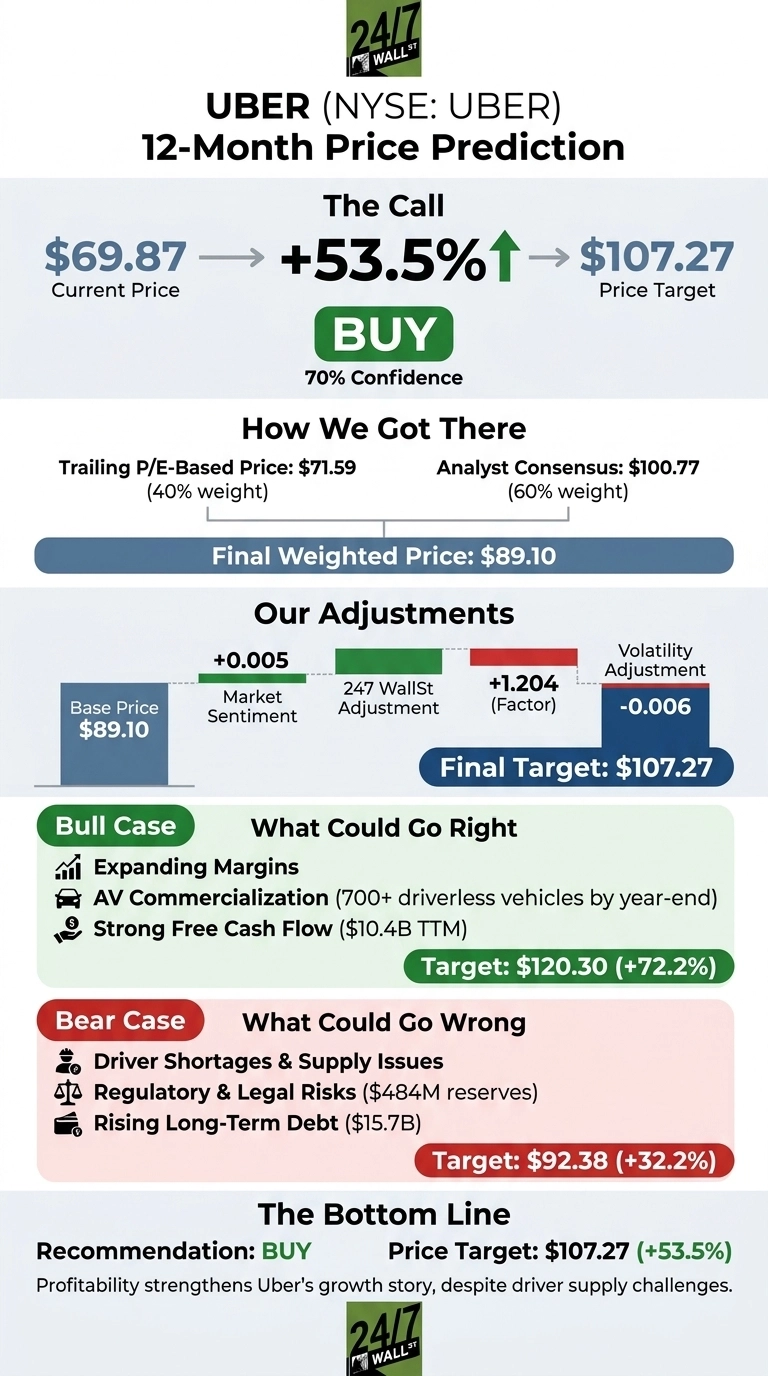
Analysts are lining up behind Uber (NYSE:UBER | UBER Price Prediction), with 9 Strong Buy and 32 Buy ratings against a single Sell. The 24/7 Wall St. price target for Uber is $107.27, which means 53.5% upside from the $69.87 close.
| Metric | Value |
|---|---|
| Current Price | $69.87 |
| Price Target from 24/7 Wall St. | $107.27 |
| Upside | 53.5% |
| Model Rating | BUY |
| Confidence Level | 70% |

A 70% confidence reading is fairly high. Profits are rising quickly, but the stock still carries a 15 trailing earnings multiple. Q4 guidance calls for non-GAAP EPS growth of 34% to 39%.
Uber Bounces Off Its Lows After a Revenue Beat
Shares rose 4.91% on earnings day and 7.05% for the week. The shares remain down 14.49% year to date and sit 26.6% below the 52-week high of $95.18.
Q3 revenue of $14.77 billion beat the $14.67 billion estimate, while non-GAAP EPS of $0.88 fell short of the $0.90 expected. Gross Bookings rose 20% to $59.8 billion. The CEO told CNBC that Uber is “investing significantly” to add drivers.

Why Bulls See $120 Within Reach
The bull case hits $120.30, or 72.2% upside. Delivery is the main driver. Segment operating income rose 30% to $1.057 billion, and grocery and retail now run at a $15 billion annual rate that is growing 40%.
Autonomous vehicles add a second leg, with about 700 driverless vehicles by year-end and more than 2,000 by the end of 2027. Trailing free cash flow hits a record $10.4 billion. The CFO said, “If anything, you’re seeing the profit ramp expand, and that puts us in a pretty good spot for 2027.”

Driver Shortages and GAAP Noise Could Cap the Rally
The bear case lands at $92.38, still 32.2% above the current price. Mobility revenue fell 2% as driver supply lagged demand, and fuel costs weighed on markets such as Brazil and India. GAAP EPS of $0.25 included $484 million in legal and regulatory reserves.
Long-term debt rose to $15.664 billion, and Freight is still losing money. To be fair, Mobility Gross Bookings grew 18%, segment profit rose 27%, and management said driver supply improved in October.

Uber Sits Between Lyft’s Discount and DoorDash’s Premium
Lyft (NASDAQ:LYFT) is Uber’s direct rideshare rival. Its P/E of 2 is skewed by a $2.90 billion non-cash tax benefit, and its operating margin is still negative.
DoorDash (NASDAQ:DASH) competes head-on with Uber Eats. The stock carries a far higher multiple while it works through a pending $17 billion Instacart deal.
| Company | Trailing P/E | Price/FCF | Operating Margin |
|---|---|---|---|
| Uber | 14 | 14.6 | 10.7% |
| Lyft | 2 | 6.4 | -3.0% |
| DoorDash | 88 | 37.6 | 5.3% |
Our target means a multiple of about 23 times earnings. That is well below DoorDash’s multiple even though Uber’s operating margin is higher, so the 24/7 Wall St. price target looks reasonable, if not conservative.
Profit Momentum Keeps Our Model Constructive
The 24/7 Wall St. price target stands at $107.27, with a buy model rating at 70% confidence.
Rising margins tip the scale: Adjusted EBITDA hits 5% of Gross Bookings, up from 4.5%. I would grow more confident if Q4 EPS lands within the $0.95 to $0.99 guidance range. I would turn cautious if driver shortages last into 2027. For now, profit growth is outpacing the stock.
| Year (November) | Price Target from 24/7 Wall St. |
|---|---|
| 2026 (current) | $69.87 |
| 2027 | $105.39 |
| 2028 | $140.42 |
| 2029 | $174.53 |
| 2030 | $192.73 |
Uber would need to keep executing its current strategy for these projections to hold. Getting autonomous vehicles to scale might raise results above this path, while worker-classification rulings could pull them below it.
Contact [email protected] for any questions or corrections.
Vandita Jadeja is a financial publisher with over a decade of experience writing about financial topics, including investment, savings, retirement, insurance and banking. Vandita is a Chartered Accountant who loves to debunk financial concepts for readers.
Her work has appeared on sites that include The Motley Fool, InvestorPlace, and Benzinga. She covers investing and focuses on stock picks and price prediction for 24/7 Wall St.
When not looking for the next stock investment opportunity, she can be found traveling, reading, chasing sunsets and enjoying her iced latte.