3 Beaten-Down Stocks With a Real Catalyst for a Comeback

This post may contain links from our sponsors and affiliates, and Flywheel Publishing may receive compensation for actions taken through them.

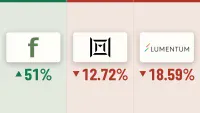
Wix (NASDAQ:WIX | WIX Price Prediction), Marvell Technology (NASDAQ:MRVL) and On Holding (NYSE:ONON) have fallen for three unrelated reasons. Marvell has an acquisition problem, On has a problem with how its earnings report landed, and Wix has a margin problem. Wix shows the most damage of the three: shares have fallen 48.99% over the past year. Each company also has a specific catalyst that could reverse its slide, and each catalyst can fail in its own way. The three cases are taken one at a time below, with no assumption that a lower price makes a stock a buy.
Wix: Base44 Spending Squeezed Margins, and a New Co-CEO Now Owns the Payoff
Wix is down 35.5% year to date and down 64.6% over five years. At $67 in premarket trading, the stock is 50.0% below its 52-week high of $135.00. It also lost 10.3% in the past week, even though the third-quarter results topped estimates.
Setback
Growth held up while profitability weakened. Third-quarter revenue of $570.16 million rose 12.9% year over year, and non-GAAP EPS of $1.42 came in ahead of the $1.35 estimate. Sales and marketing expense climbed to $193.19 million from $137.43 million, and the non-GAAP operating margin fell to 12% from 18%. Management also lowered its full-year free cash flow margin target to approximately 16% from high-teens. Wix’s balance sheet leaves less room for error than it used to. Wix ended the quarter with about $1.05 billion in cash against $1.63 billion in debt, after a large tender offer pushed shareholders’ equity into deficit.
Named Catalyst
Wix changed its leadership in its Q3 2026 earnings release. Co-founder and President Nir Zohar became co-CEO alongside co-founder Avishai Abrahami, effective immediately. The release describes the split this way: “Nir will lead our business strategy, go-to-market and operations, overseeing how we grow and scale the company. I will lead product, AI, and technology, focusing on what we build and how we bring it to our users.” Under that structure, one executive is now accountable for converting Base44’s growth into bookings. On Base44 itself, the release says, “Base44, our biggest bet, continues to outperform expectations, driven by our leading product, clear strategy and relentless execution underpinned by aggressive and necessary investments.” The words “aggressive and necessary investments” raise the central margin question: how long those investments last before they pay off.
The operating data shows progress. Base44’s annual recurring revenue (ARR) is approaching $250 million. Its non-GAAP gross margin rose to 58% in the third quarter, up from close to zero in the first quarter. Annual plans made up more than 20% of subscriptions in the September 2026 cohort, compared with about 5% a year earlier. Total company ARR reached $2.02 billion, up 15%. The stock trades at 11x forward earnings, and the consensus price target is $80.30.
Bull-Case Requirements
Base44 spending needs to turn into faster bookings growth. Management forecast fourth-quarter revenue growth in the low double digits and expects bookings to keep lagging revenue. Wix also has to deliver margin improvement in 2027 rather than another cut to its targets. What falsifies it: weaker retention in Base44 cohorts, deeper softness in the Partners channel, or a third straight quarter in which sales and marketing spending grows faster than bookings.

Marvell: The Lumentum Deal Erased a Month of Gains, but the Year Still Shows a Big Run
Marvell has a different problem from Wix. Its stock fell 39.4% over the past month, and at $166.70 it is 49.4% below its 52-week high of $329.88. Shares are still up 96.5% year to date. This is a sharp pullback after a big run, and the case should be judged on those terms.
Setback
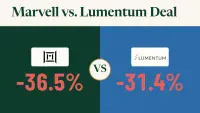
Kit Norton of Barron’s reported that Marvell plans to acquire Lumentum Holdings (NASDAQ:LITE) at a valuation of $115 billion, and that both stocks were then on pace for historically poor weeks. The deal is paid entirely in stock, according to MarketWatch. Investors often sell the buyer in deals like this for three reasons. First, issuing new shares dilutes existing holders. Second, a large premium raises the risk of overpaying. Third, the period before closing can drag on for months while regulators review the deal, and the stock tends to trade on that uncertainty. Shareholders of both companies criticized the terms, MarketWatch reported. Marvell’s board chair and chief executive, Matt Murphy, called the deal a “once in a generation” chance to create a category leader in AI connectivity.
Named Catalyst
The main catalyst is how the Lumentum deal ends. Investors will be looking for clarity on financing and dilution, progress through regulatory review, and then either a closing or a termination. Any of those outcomes would replace the current uncertainty with known numbers. Behind the deal, the core business is strong. In the second quarter of fiscal 2027, revenue of $2.74 billion rose 36.5%. Data center revenue rose 46% and made up 79% of the total. Management forecast third-quarter revenue of $3.150 billion, plus or minus 5%. Marvell also expanded its custom silicon partnership with Alphabet (NASDAQ:GOOGL) unit Google, which includes a warrant allowing Google to acquire up to 7% of Marvell’s shares as revenue milestones are met.
On valuation, Marvell trades at 21x forward earnings, compared with 51x trailing earnings, so the market is pricing in strong earnings growth. The consensus price target is $310.07. Jim Cramer of CNBC’s Mad Money called it “a broken stock” but “not a broken company,” and suggested buying “some, but not a lot.”

Bull-Case Requirements
The ramp in custom chips needs to show up on schedule, gross margin needs to hold near the forecast 57.5% to 58.5% range, and the Lumentum terms need to look less dilutive as more detail comes out. What falsifies it: regulators block or delay the deal, Marvell loses the Google program or another major custom program, or hyperscalers move more chip design in-house. Expect large swings while this plays out. The stock’s beta is 2.327, and long-term debt already stands at $4.96 billion.

On Holding: Record Sales Still Sent Shares Lower, and the Cloudsurfer 3 Has to Answer
On Holding fell 7.5% on November 10 to close at $34.70, after the company reported its third-quarter results. Shares are down 24.8% year to date, and 31.6% below their 52-week high of $51.08. Before this report, sentiment in China had already been hurt by a controversy involving brand ambassador Kylian Mbappe.
Setback
Coverage that day from Yahoo Finance, Seeking Alpha, and the Wall Street Journal gave three reasons for the drop. First, a tariff refund made the profit beat look better than it was. Second, the full-year sales outlook did not change. Third, direct-to-consumer (DTC) growth fell short of hopes. The reported figures support all three explanations. Gross margin of 72.6% included a refund of U.S. tariffs that added 570 basis points. Without the refund, gross margin was 66.9%. The full-year outlook stayed at low-20% constant-currency growth. DTC sales grew 24.8% in constant currency, a slowdown from 34.3% in the second quarter. Third-quarter wholesale sales also included some holiday deliveries pulled forward from October, and inventory rose 30.2%.
The release gives the company’s view: “In a promotional market, we stayed true to who we are and held full price, delivering record sales and record underlying margins.” Revenue of $1.136 billion rose 17.3%, and adjusted EPS of $0.6584 beat the $0.4027 estimate. Asia Pacific sales grew 31.1%.
Named Catalyst
The catalyst is a new product cycle. The release calls the Cloudsurfer 3 “the first proof point of our biggest innovation cycle.” In its first week, the shoe sold through at more than four times the rate of the Cloudsurfer 2’s launch week, and a wider rollout is planned for January. By the end of 2027, management expects almost all of its performance running franchises to use the new superfoams. On also authorized a buyback of up to $1 billion running through December 2029, but no shares had been bought back as of September 30. The stock trades at 20x forward earnings versus 25x trailing earnings, and the consensus price target is $44.15.
Bull-Case Requirements
The January rollout has to keep the strong launch sell-through going at full price, fourth-quarter growth has to accelerate as forecast and be driven mainly by DTC, and the underlying gross margin has to stay near the raised approximately 66% outlook despite Section 301 tariffs. What falsifies it: DTC growth slowing further, discounting starting to erode full-price sales, or inventory continuing to grow faster than sales.

Ranking the Three Comeback Cases
On Holding has the strongest comeback case. Its sales hit a record, its underlying margins are rising, and the catalyst is already producing sell-through data while an unused buyback sits in reserve. Marvell comes second: the core business is accelerating, but the stock will probably stay tied to the Lumentum deal until it closes or is terminated. Wix has the weakest case, because the new co-CEO structure and Base44’s growth still have to overcome falling margins and a leveraged balance sheet.
Contact [email protected] for any questions or corrections.
Trey has been an editor and author at 24/7 Wall St. for more than a decade, where he has published thousands of articles analyzing corporate earnings, dividend stocks, short interest, insider buying, private equity, and market trends. His comprehensive coverage spans the full spectrum of financial markets, from blue-chip stalwarts to emerging growth companies.
Beyond 24/7 Wall St., Trey has created and edited financial content for Benzinga and AOL's BloggingStocks, contributing additional hundreds of articles to the investment community.
Trey's editorial expertise extends across multiple publishing environments. He served as production editor at Dearborn Financial Publishing and development editor at Kaplan, where he helped shape financial education materials. Earlier in his career, he worked as a writer-producer at SVE. His freelance editing portfolio includes work for prestigious clients such as Sage Publications, Rand McNally, the Institute for Supply Management, the American Library Association, Eggplant Literary Productions, and Spiegel.
Outside of financial journalism, Trey writes fiction and has been an active member of the writing community for years, moderating workshop sessions at regional conventions.