Elon Musk Just Put a $1 Trillion Chip Bill on Tesla’s Table. That’s a Warning for Anyone Holding 1,000 Tesla Shares

This post may contain links from our sponsors and affiliates, and Flywheel Publishing may receive compensation for actions taken through them.
Elon Musk spent five days putting a $1 trillion chip bill, Cybertruck refunds, a moon factory and a Friday rocket catch in front of Tesla shareholders, and the stock rose 6% through it. Tesla closed Tuesday at $379.78, up 0.46% on the day after Monday’s 5.54% jump. It still sits 22.5% below its record close of $489.88 on Dec. 16, 2025.
Take a 67-year-old retired aerospace engineer in Texas who bought 1,000 Tesla (NASDAQ: TSLA) shares on Jan. 3, 2023, at $108.10, the stock’s lowest close of the past four years, in a taxable brokerage account. He and his wife, 64, are a scenario, and their numbers are round on purpose. The shares cost $108,100 and closed Tuesday worth $379,780, a gain of $271,680. With $1,100,000 in a rollover IRA, Tesla is 25.7% of a $1,479,780 portfolio. They draw $60,000 a year from the IRA and collect $4,500 a month in Social Security.
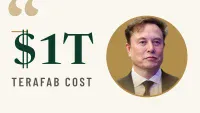
Read together, Musk’s week says that Tesla’s factory space and capital are moving from cars toward robotaxis and AI chips while its chief executive’s attention is on the moon and a rocket catch, and that the biggest bill of the lot, a chip plant Musk agreed could cost $1 trillion over time, has no shareholder’s name on it yet. That is the warning in Musk’s week for anyone holding a large Tesla position: the Terafab bill is real, it is phased, and nobody has said which shareholders pay it. The limit of that reading is that cars still pay Tesla’s bills, Musk says the Cybertruck was profitable, and the $1 trillion would be spent over years, in pieces.
Five days of Musk, in his words
Friday, Nov. 6. Musk wrote on X that “Tesla will be winding down production of the Cybertruck at Gigafactory Texas around the middle of next year to make room for increased Cybercab production.” The same day, by video to the Baron Investment Conference, he answered Ron Baron’s estimate that Terafab, the chip plant Tesla and SpaceX are building in Grimes County, Texas, would cost $1 trillion: it probably will over time, he said, with the money spent in phases, according to 24/7 Wall St.’s account of the livestream. Tesla rose 4.23% to $358.22.
Saturday, Nov. 7. Musk said Tesla would add a production shift to fill outstanding Cybertruck orders before the line comes down. NASA named SpaceX among eight companies eligible to compete for up to $10 billion in moon cargo contracts.
Monday, Nov. 9. “The Cybertruck order rate far exceeds our production rate,” Musk wrote on X. “We will try to make as many as possible before shutting down the line in about 8 months, but will have to return deposits for a lot of people.” He added: “This is not a case of Cybertruck being unprofitable, as has been misreported by legacy media,” and said the opportunity cost of the truck’s complexity “is vastly outweighed by the value of incremental Cybercab production.” Tesla’s robotaxi service opened in San Antonio the same morning, its eighth city with unsupervised rides and its largest launch area yet at about 275 square miles, according to TechCrunch. Tesla rose 5.54% to $378.05.
Tuesday, Nov. 10. Fortune reported on the moon plan in SpaceX’s IPO filing: factories on the moon that would build AI satellites from lunar raw materials, with chips shipped from Earth. SpaceX confirmed that Starship Flight 15 is targeted for Friday, Nov. 13, at 5:45 PM ET, the first attempt to catch both the booster and the ship on the launch tower, which Musk called “more likely than not” to work on the company’s third-quarter call. Tesla rose 0.46%.
What five days did to 1,000 shares
Thursday, Nov. 5, the broad sell-off took Tesla down 10.77% and cost the position $41,500 in one session. Since that close the stock is up 10.5%, and the 1,000 shares have gained back $36,090. Monday alone added $19,830. Each 1% move in Tesla is now worth $3,798 to this household.
Measured from the record, the shares were worth $489,880 on Dec. 16, 2025, and have given back $110,100 since. Getting back there takes a 29.0% gain.
Why a holder stays
Musk’s own number is demand. If the order rate “far exceeds” production, the problem Tesla is solving is where to spend its factory space, and it chose the robotaxi. Of the 44 analysts Fuse tracks, 20 rate the stock a buy or strong buy, 22 a hold and 2 a sell, and the average target of $413.10 is 8.8% above Tuesday’s close. At the target, 1,000 shares are worth $413,100.
Why a holder trims
The numbers under the story are thin for a $1.50 trillion company. Tesla’s revenue over the past four quarters was $103.57 billion, down 0.2% in the latest quarter from a year earlier, with a profit margin of 3.11%. At $379.78 the stock trades at 415 times trailing earnings and 147 times the forward estimate, according to Fuse data.
The Cybertruck is a warning about forecasts. Musk once talked of a million reservations and 250,000 sales a year. Kelley Blue Book counts 20,237 U.S. sales in 2025, down 48%, which is 8.1% of that goal, and about 71,000 trucks in total since late 2023. Tesla has not said how many deposits it will return or how much they add up to.
Then there is the $1 trillion. That figure is 67% of Tesla’s entire market value at Tuesday’s close, and 60 times the $16.8 billion the Texas governor’s office put on Terafab’s first phase. Tesla and SpaceX have special committees discussing a combination, and they have not agreed on terms, so nobody has said which company’s shareholders pay for the plant. For a retiree, that is the real question in Musk’s week: how much of your portfolio should ride on a bill with no name on it.
The tax bill on a 400-share trim
Say he sells 400 shares. The proceeds are $151,912 against a cost of $43,240, a long-term gain of $108,672. That gain does three things to the couple’s 2026 return.
First, it pulls more Social Security into taxable income. With no sale, $42,550 of their $54,000 in benefits is taxable. The gain lifts that to the 85% cap, $45,900, which is $3,350 more.
Second, it trims the new senior deduction. He is 67, so the couple gets the $32,200 standard deduction, the $1,650 addition for one spouse over 65, and the $6,000 senior deduction, which shrinks by 6% of income above $150,000. At an adjusted gross income of $214,572 that deduction is $2,126, for total deductions of $35,976.
Third, part of the gain is taxed at 0%. Their ordinary taxable income is $69,924, and the 0% capital gains bracket for a couple runs to $98,900 of taxable income, so the first $28,976 of the gain is tax-free. The remaining $79,696 is taxed at 15%, or $11,954. Their income stays under the $250,000 line for the 3.8% net investment income tax, and Texas has no state income tax. The federal bill is $11,954, which is 11.0% of the gain, and they keep $139,958.
The line that matters most is Medicare’s. A 2026 income of $214,572 is under the $218,000 threshold where a couple’s 2028 Part B premiums start carrying a surcharge. The most he can sell this year and stay under it is 412 shares. At 500 shares the couple crosses it and each pays $81.20 a month more in 2028, $1,949 for the year between them.
Selling all 1,000 shares this year would cost $41,573 in federal tax, including $4,848 of net investment income tax, plus $7,790 in 2028 Medicare surcharges, $49,363 in all. Selling 500 now and 500 in January, at the same prices and with 2027 rules assumed to match 2026, would cost $36,446. After a 400-share trim, Tesla is 15.5% of the portfolio.
The bottom line
Elon Musk’s week moved Tesla’s future further from the cars it sells today and toward products that do not yet report revenue, and the stock rose 6% on it. For a retiree with 1,000 shares worth $379,780 and a $271,680 gain, the question is how much of a $1 trillion plan with no shareholder’s name on it you want to hold at 25.7% of your money. A 400-share trim costs $11,954 in tax, keeps the couple clear of the Medicare surcharge, and leaves 600 shares to ride Friday’s catch and the robotaxi rollout. Selling everything costs four times as much. Pick the share count from the tax table, then decide what you believe about the next five years.
Contact [email protected] for any questions or corrections.
I've been writing about stocks and personal finance for 20+ years. I believe all great companies are tech companies in the long run, and I invest accordingly.