Alibaba Is Spinning Off Its Nvidia Rival in a Hong Kong IPO

This post may contain links from our sponsors and affiliates, and Flywheel Publishing may receive compensation for actions taken through them.
Alibaba (NYSE:BABA | BABA Price Prediction) disclosed late on November 10, 2026, that it plans to spin off T-Head, its in-house AI chip designer, through a Hong Kong listing. The U.S. shares closed at $101.52 on November 11, down 1.17% for a third straight loss. They traded at $101.25 after hours at 7:59 p.m. ET.
Declines of 3.72% on November 9 and 2.52% on November 10 left the stock about 7.2% below its November 6 close of $109.45, although nothing ties that drop to the spin-off. The shares are down 30.1% year to date. T-Head may be worth tens of billions, but Alibaba is keeping that value in-house, and Chinese regulators still have to sign off.
What Alibaba Has Committed To
T-Head was founded in 2018 and is fully owned by Alibaba. It designs data center chips for computing in China. It privately filed its listing application on September 11, 2026, and the exchange has confirmed Alibaba may proceed.
The listing still needs approval from the exchange’s Listing Committee and a completed filing with the China Securities Regulatory Commission (CSRC), China’s securities regulator. Alibaba says there is no assurance the spin-off will happen. No date, size, or valuation was announced, and Alibaba has not confirmed a reported raise of $2 billion to $3 billion in 2027.
Alibaba plans to spend more than $53 billion over three years on AI, and free cash flow was -$6.584 billion in the June 2026 quarter. A listed T-Head gets outside capital, its own stock to pay engineers and a market price for value now buried inside a conglomerate, but minority T-Head investors may later clash with Alibaba holders over future capital.
What T-Head Could Be Worth to BABA Holders
Nomura estimates T-Head could be worth about $85 billion, while a wider analyst range spans $25 billion to $86 billion. Alibaba’s market value is $252.56 billion, so the top of that range would be a large piece of the company and the bottom a modest one.
Press estimates put T-Head’s annualized revenue at 10 billion yuan (about $1.5 billion) in March 2026. The global offering combines a Hong Kong public offering with a placing to institutional investors, and Alibaba also obtained a waiver of its shareholders’ assured right to T-Head shares. T-Head is expected to stay a subsidiary, so any value reaches you only when the market prices Alibaba’s retained stake.
Regulators Are a Bigger Hurdle Than the Filing Suggests
In China, T-Head competes with Nvidia (NASDAQ:NVDA), Huawei, Cambricon and Kunlunxin, a unit of Baidu (NASDAQ:BIDU), after U.S. export limits cut off Nvidia’s top chips. Its press-estimated about 7% share of China’s AI accelerator market shows how much ground remains (we studied what the early Nvidia-style winners looked like and put the pattern in a free Next Nvidia playbook).
Alibaba says its Zhenwu V900, revealed September 22, 2026, delivers three times the performance of the M890 released in May 2026. Mass production is scheduled for the first quarter of 2027.
Baidu has reportedly delayed Kunlunxin’s Hong Kong IPO, and YMTC has reportedly shelved its own IPO amid tighter scrutiny of tech listings. That record makes CSRC sign-off a real hurdle.
Signals BABA Holders Need to Track Before T-Head Lists
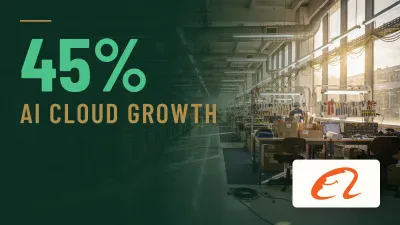
The AI Cloud and Compute Services division, which includes T-Head, grew revenue 45% in the June 2026 quarter, although the shares now trade below their level at the start of the year.


Customer management revenue fell 7%, and spending will stay heavy, but a public T-Head price would give the chip business a visible value.

Look for a Listing Committee hearing, a completed CSRC filing, and a disclosed offering size and valuation. The spin-off’s support for the stock likely weakens. That happens if none of those arrives before V900 mass production begins in the first quarter of 2027, or if the shares fail to climb back above the $109.45 November 6 close.
Contact [email protected] for any questions or corrections.
Omor Ibne Ehsan is a writer at 24/7 Wall St. He is a self-taught investor with a focus on growth, cyclical, and dividend equities that have strong fundamentals, value, and long-term potential. He also has an interest in high-risk, high-reward investments such as penny stocks.