Elon Musk Just Ended the Cybertruck. Will He Kill the Model 3 Next?

This post may contain links from our sponsors and affiliates, and Flywheel Publishing may receive compensation for actions taken through them.
Elon Musk has now ended three of the five cars Tesla sells to the public in one year, and the Cybertruck is the third. On Wednesday he said Tesla will keep building the truck through the end of summer 2027, a few months past the mid-2027 shutdown he announced on Nov. 6, and then hand its line at Gigafactory Texas to the Cybercab. "This is not the smartest move from a profit-maximizing standpoint btw, but there must be some room in this world for sentimentality or what’s the point?" he wrote on X.
Tesla closed Wednesday at $390.84, up $11.06 on the day and its fourth straight gain. The stock is about 14% above where it stood the day before Musk’s first Cybertruck post, and about 20% below its record close of $489.88 on Dec. 16, 2025.
The Model S and X went first. On Tesla’s Jan. 28 earnings call Musk said, "It’s time to basically bring the Model S and X programs to an end with an honorable discharge." Tesla tore down their lines at the Fremont factory over the summer to make room for a line meant to build 1 million Optimus robots a year, and on Oct. 21 Musk said the company had "started what I’d call early production on a high-volume line in Fremont." When the Cybertruck goes, the Model 3 and the Model Y will be the only Teslas an individual can order.
Read together, the three cancellations say that Tesla’s factory floor now goes to whatever Musk thinks is bigger than a car, and on that logic the Model 3, which sells about half as many units as the Model Y, is the next candidate. The limit of that reading is that Musk told analysts on Oct. 21 that the 3 and the Y are the cars customers will still want to own, and nothing Tesla has filed points to ending either one.
For a Tesla holder the question is practical. Take Kevin and Grace, 58 and 56, a scenario built for this story: they retired early from software jobs, live in Nevada, and bought 1,000 Tesla (NASDAQ: TSLA) shares on Nov. 30, 2023, the day the first Cybertrucks were handed over, at $240.08. They have $3.1 million in all, with the Tesla shares inside a $1.1 million brokerage account, and they buy their own health insurance until Medicare. Here is what Musk’s week does to their numbers.
What Musk has said he wants the Cybercab to be
Musk’s own words set the direction. On Nov. 6 he wrote that Tesla would wind down the truck "to make room for increased Cybercab production." On Nov. 9, explaining why Tesla would "have to return deposits for a lot of people," he wrote that "the opportunity cost of the complexity of Cybertruck is vastly outweighed by the value of incremental Cybercab production." He also said Tesla has "a very limited number of smart, dedicated people," and that keeping the truck means "we can’t use those people or factory space and machinery for scaling Cybercab."
On Nov. 10 he went further on X: "Cybercab will do a majority of all passenger miles in any jurisdiction where it is not prohibited by law." On the Oct. 21 call he said that "as Tesla grows, we’ll mainly deliver fully designed autonomous vehicles to our customers, and CyberCab will be the first,". Tesla’s third-quarter update lists installed capacity of more than 125,000 a year for the Cybercab line in Texas, the same figure it gave the truck.
Against that, the Cybertruck never got close to the "roughly" 250,000 a year Musk projected in October 2023. Kelley Blue Book counted 20,237 U.S. sales in 2025, down 48% from 38,965 in 2024. Tesla’s "other models" line, which holds the truck, delivered 8,295 of the company’s 486,532 vehicles in the third quarter.
The Model 3’s numbers, and why they are estimates
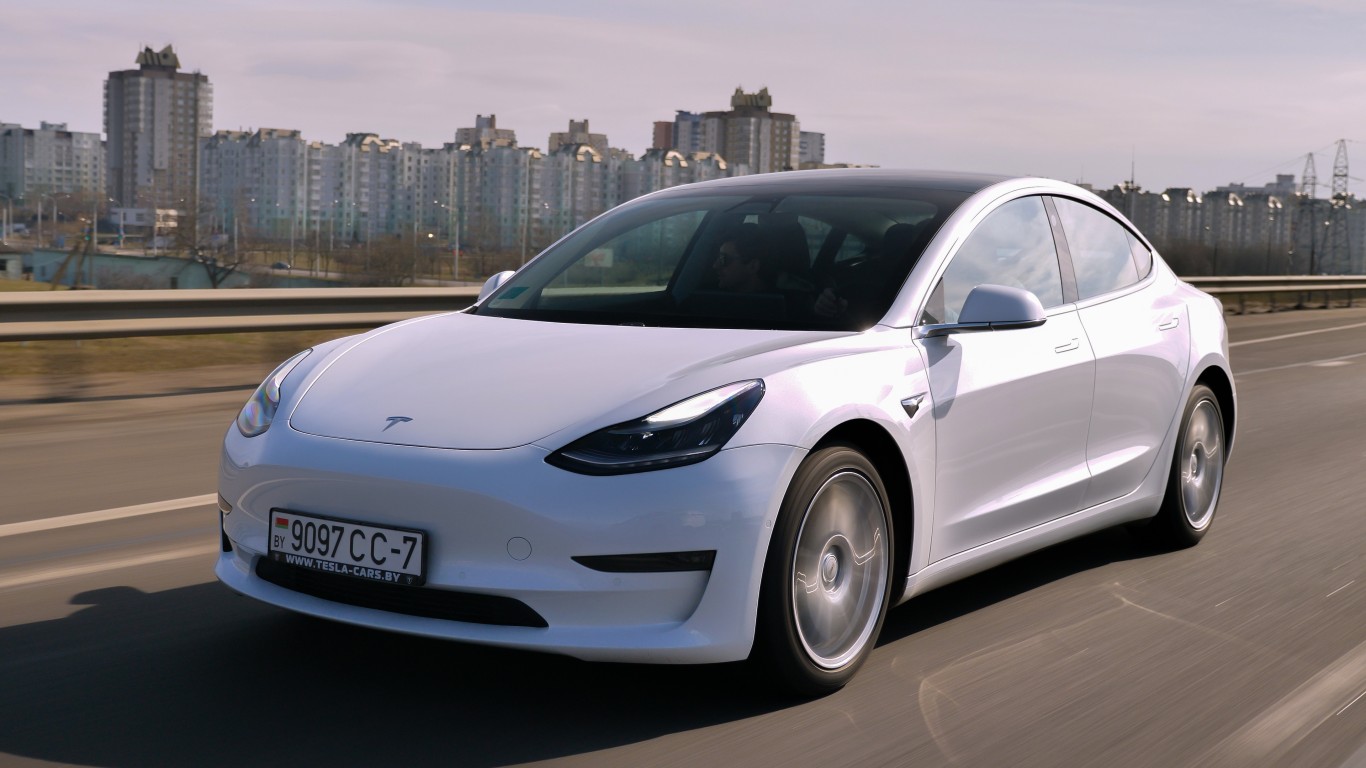
Tesla reports the Model 3 and Model Y as one line, so every per-model figure is a third-party estimate. The combined line delivered 1,739,707 in 2023, 1,704,093 in 2024 and 1,585,279 in 2025, and 1,287,892 through the first nine months of 2026.
The trackers split it this way. In 2021 the two were close: Investing.com puts the Model 3 at about 501,000 and the Model Y at 410,517. By 2023 the Model Y had reached 1,211,601, which leaves about 528,000 for the Model 3; in 2024 the Model Y held near 1,200,000 and the Model 3 about 504,000. For 2025, CleanTechnica and EV Volumes estimate 1,069,846 Model Ys against 518,274 Model 3s, about 2 to 1. In the United States in the third quarter of 2026, Cox Automotive counted 99,037 Model Ys and 40,346 Model 3s, 2.5 to 1.
So the Model 3 has sold roughly half a million cars a year for five years while the Model Y doubled past it. That is a steady business. It is also a line the Model Y’s factories could absorb, which is the case for the Model 3 being the next space Musk reclaims, and it is why the question is worth asking even though Musk has not asked it in public.
What the week did to their shares
The couple’s 1,000 shares cost $240,080. At Wednesday’s close they are worth $390,840, a gain of $150,760, or 62.8%. At last December’s record they were worth $489,880, so they are still $99,040 below that mark. Tesla is 12.6% of the couple’s $3.1 million.
That concentration is the real issue, and Musk’s week sharpens it. The company they bought three years ago sold five cars. The one they own in 2028 may sell two cars, a robotaxi it mostly keeps for itself, and a robot. If that is the company you want, 12.6% is a position; if it is a bet you did not mean to make, this is a reasonable moment to size it.
The tax math on a trim
Say the couple has $80,000 of other taxable income in 2026, all ordinary, from interest and a small consulting contract. After the $32,200 standard deduction their taxable income is $47,800, which leaves $51,100 of room under the $98,900 line where the federal long-term capital gains rate is zero for a married couple. Each Tesla share carries a $150.76 gain, so 338 shares can be sold this year with a gain of $50,957 and no federal tax on it.
Sell 500 shares and the gain is $75,380: $51,100 at 0% and $24,280 at 15%, a federal bill of $3,642. Sell all 1,000 and the gain is $150,760, with $99,660 taxed at 15% for $14,949. Their income stays under the $250,000 line where the 3.8% net investment income tax begins, and Nevada has no income tax.
The trap is health insurance. The enhanced marketplace credits expired at the end of 2025, so a household above 400% of the poverty line gets no premium credit at all, and there is no longer a cap on paying back advance credits. For a couple, the 2026 line is $84,600 and the 2027 line is $86,560. At $80,000 of income the couple is under the line, and a benchmark silver plan for a 58-year-old and a 56-year-old runs about $28,600 a year at the national average, so their credit is worth about $20,700. They have $4,600 of room, which is 30 shares. Share 31 costs them the entire credit. A trim of any size belongs in a year they are off the marketplace.
Where the reading is weak
Three things cut against the Model 3 case. Musk said on the Oct. 21 call that the Cybercab "is primarily going to be something that is offered as like transport as a service whereas our other cars would be more the cars that you’d want to own like the 3 and the Y." The Model 3 still outsells every other Tesla but one. And the Cybercab is early: Tesla said in October that every one built so far went into its own fleet, with more than 300 in Austin.
The truck’s end date also moved twice in five days. A Model 3 decision, if it ever comes, would arrive the same way, in a post, after the fact.
The bottom line
Tesla will build Cybertrucks through the end of summer 2027 and then give the line to a two-seat robotaxi. The Model S and X are already gone for a robot line. The Model 3 sells about half what the Model Y does, which makes it the next candidate on the logic Musk has used twice this year, even though he has said the 3 is a car people will want to own.
For a couple with $390,840 in Tesla, the week is a reason to decide how much of the new company they want, and to do the trimming by the calendar: 338 shares at a zero federal rate this year, or 30 shares if they are collecting a marketplace credit, with the rest in a year the credit does not matter.
Contact [email protected] for any questions or corrections.
I've been writing about stocks and personal finance for 20+ years. I believe all great companies are tech companies in the long run, and I invest accordingly.