Kalshi Ended Donald Trump Jr.’s Advisory Contract Over His Polymarket Role

This post may contain links from our sponsors and affiliates, and Flywheel Publishing may receive compensation for actions taken through them.
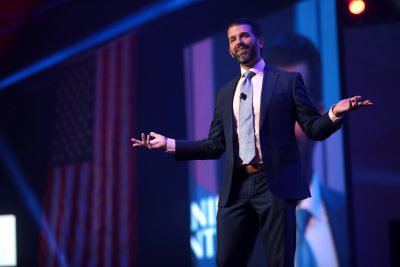
Kalshi, the prediction-market startup valued at $40 billion, ended Donald Trump Jr.’s advisory contract on Thursday, November 12, 2026. A Kalshi spokesperson said both sides agreed to end the role because his firm made a “significant investment in a competitor”. The spokesperson also said political considerations played no part.
The competitor is Polymarket. Trump Jr. is a partner at 1789 Capital, which reportedly led a Polymarket funding round around the end of August 2026 at a valuation of about $21 billion. Both companies are private.
The listed company with the most exposure is Robinhood Markets (NASDAQ:HOOD | HOOD Price Prediction), Kalshi’s largest distribution partner. HOOD closed Thursday at $81.35, down 3.82%, before most of the Kalshi coverage appeared, and no cause for the drop was given. It traded at $81.92 after hours as of 7:59 p.m. ET.
What Kalshi Said
Talks to end the contract began in August 2026, after 1789 Capital’s Polymarket investment became public. Because that was well before the midterm results, the timing supports Kalshi’s stated reason.
Two people familiar with the matter described a second motive. They said some people inside Kalshi worried about what the Democrats’ sweep of both houses of Congress could mean for the company, and Democrats have said they plan to look into the Trump family.
Kalshi did not say whether Trump Jr. holds his equity, which was reported to be worth about $300,000 when he joined in January 2025. Polymarket and Trump Jr. did not respond right away, and 1789 Capital could not be reached.
Rival Valuations Made a Dual Role Untenable
1789 Capital reportedly committed about $300 million in new money on top of around $200 million it had already invested, which brings its reported total to about $500 million. Polymarket has not announced the round.
Kalshi was valued at about $22 billion in May. With the two rivals at similar valuations and competing for the same traders, an adviser with money on both sides could not stay.
Congress Is Targeting the Contracts That Drive Volume
Sen. Elizabeth Warren has promised to crack down on insider trading on prediction markets. Sen. Chris Murphy and Rep. Greg Casar have introduced a bill that would ban contracts on military operations and other sensitive government actions.
Political and news contracts are where inside information matters most, and they also bring in new customers. Under a Congress with subpoena power, a platform linked to the president’s family and the brokers that sell its contracts face higher costs.
How Exposed Robinhood Really Is
As of early 2026, Robinhood had driven more than half of Kalshi’s trading volume since it launched event contracts in March 2025. In October 2026, its customers traded 5.9 billion event contracts, up 136% from a year earlier.
Robinhood’s protection against that dependence is Rothera, its venture with Susquehanna, which bought 90% of the MIAXdx exchange. On the October 27, 2026 earnings call, the chief financial officer said Rothera would be the primary exchange and added, “We’ll be getting off most of our competitors.”
Rothera reached $100 million in annualized revenue in its first full quarter. Robinhood does not operate it, though.
What Could Change the Outlook for HOOD Stock

Robinhood is moving its order flow from Kalshi to a venue it partly owns, so any Kalshi-specific examination falls on a smaller share of its business.
Third-quarter revenue rose 12% to a record $1.4 billion. The stock’s 26.39% one-month drop to a market value of about $64.55 billion came before the latest regulatory headlines.
The main risk is that new rules would apply to Rothera’s contracts just as much as to Kalshi’s. If the Murphy and Casar bill reaches a committee markup, or if a hearing notice names Robinhood, the outlook for Robinhood weakens.
October PPI is due at 8:30 a.m. ET Friday, November 13. A cleaner test comes with Robinhood’s November operating data. Event-contract volume that holds its growth while flow moves to Rothera would support this view, and a close below $81.35 after any announcement of hearings would contradict it.

Contact [email protected] for any questions or corrections.
Omor Ibne Ehsan is a writer at 24/7 Wall St. He is a self-taught investor with a focus on growth, cyclical, and dividend equities that have strong fundamentals, value, and long-term potential. He also has an interest in high-risk, high-reward investments such as penny stocks.