Micron Is Down 20% in a Month. What Will It Take to Get MU Stock Back to $1,000?

This post may contain links from our sponsors and affiliates, and Flywheel Publishing may receive compensation for actions taken through them.
The AI memory trade that lifted chip stocks through much of 2026 is cooling fast, with Micron Technology (NASDAQ:MU | MU Price Prediction) right in the middle of it. Micron stock is down 20% over the past month to $760.11 in afternoon trading. That’s a sharp turn from the $953.03 the shares fetched on October 13.
Within the past year, Micron has traded above $1,000, reaching a 52-week high of $1,254.61. A 5% drop in Micron stock from the prior close adds to the pressure as a broad selloff in chip and AI hardware names drags on technology stocks. Tech-heavy indexes are falling as NVIDIA (NASDAQ:NVDA) keeps sliding.
Micron already delivered strong results, so getting back to $1,000 now depends on market conditions. What matters now for Micron is whether memory pricing and AI data center demand hold up while sentiment toward AI hardware steadies.
What Pulled Micron and Its Storage Peers Lower
This slide in Micron follows a record Q4 FY2026 report on September 30[1], when its revenue reached $54.23 billion, up 379.3% year over year. The company’s adjusted earnings per share (EPS) of $33.42[1] exceeded the $31.35 consensus estimate. For Q1 FY2027, management guided Micron’s revenue to $61.5 billion[1], plus or minus $1.5 billion.

Over the same stretch, SanDisk (NASDAQ:SNDK) has fallen even harder than Micron. SanDisk stock is down 42% over the past month to $857.71. Western Digital (NASDAQ:WDC) stock is down 24% over the past month to $289.86, which also leaves it behind Micron.
Taken together, the declines look like a pullback after a powerful run, with selling hitting memory and storage names at the same time. All three companies, Micron included, reported surging AI-driven demand. The results came in the latest quarter and point to a sector-wide shift in sentiment toward AI hardware.
How Micron’s Business Differs From SanDisk and Western Digital
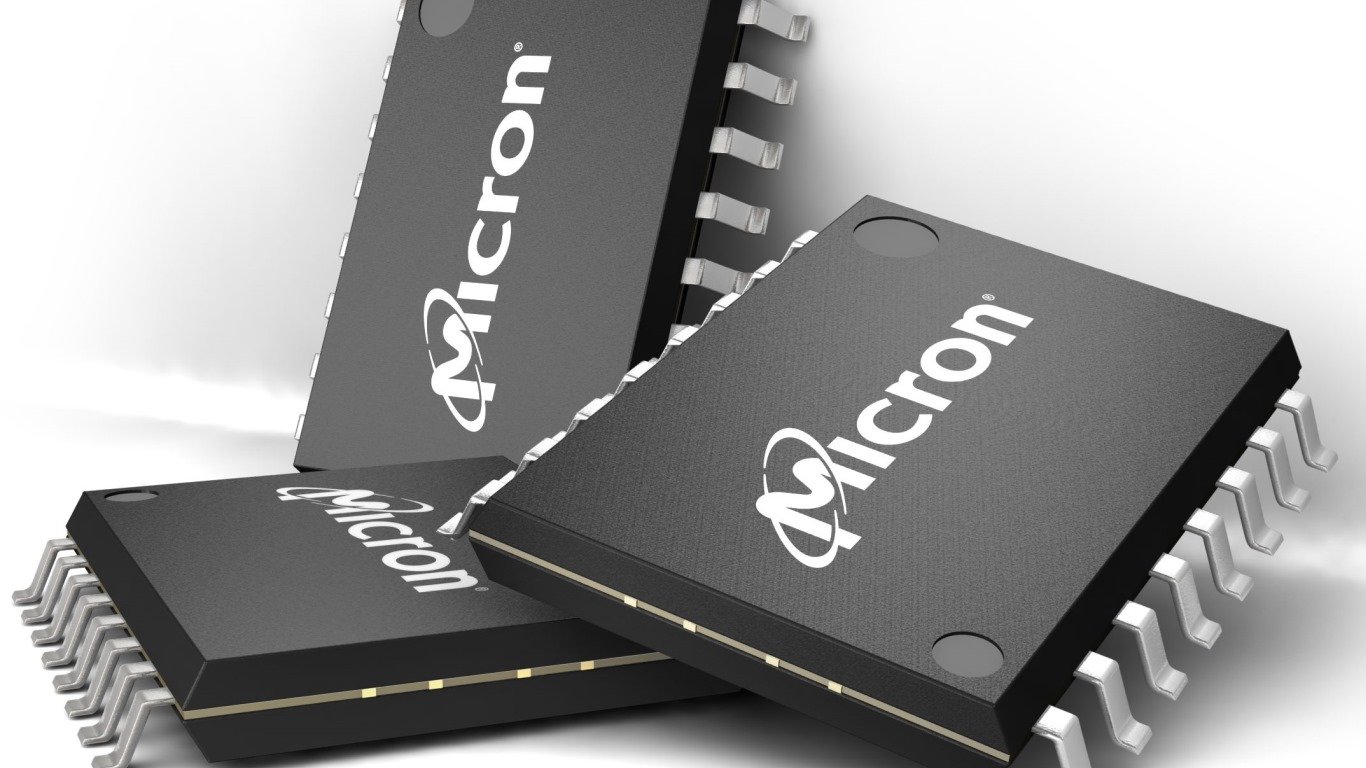
Micron makes both dynamic random-access memory (DRAM) and NAND flash, along with high-bandwidth memory (HBM) used in AI accelerators. The vertically integrated manufacturer sells into multiple markets. These include cloud, data center, mobile, PC and automotive, and it locks in demand through long-term Strategic Customer Agreements. That range ties Micron to AI servers and consumer devices alike.
SanDisk focuses on NAND flash and enterprise solid-state drives (SSDs), producing its wafers through a joint venture with Kioxia. Western Digital now builds hard disk drives (HDDs) for hyperscalers and cloud providers after separating its flash business into SanDisk, and it keeps an ownership interest in SanDisk. Of the three, only Micron sells DRAM and HBM, giving it the most direct link to the AI accelerator buildout.
What It Would Take for Micron to Reclaim $1,000

The bulls have plenty to point to at Micron. Wall Street remains overwhelmingly positive, with 9 Strong Buy ratings, 36 Buy ratings, 3 Hold ratings and 1 Strong Sell rating, plus an average price target of $1,561.91. At a trailing price-to-earnings (P/E) ratio of 11x, the company trades at a low multiple for its growth rate.

On the company’s earnings call, Micron President and Chief Operating Officer Manish Bhatia said more than 75%[2] of the company’s fiscal 2027 shipments are committed. Bhatia added that “we really don’t have line of sight to when supply and demand balance.”[2] He also noted that customer supply agreements now extend through 2030.
The bears have their own case on Micron. Chief Financial Officer Mark Murphy spoke on the call. He stated that price increases should continue in fiscal 2027, “albeit at a more moderate pace,”[2] and he flagged start-up costs as a partial offset. New clean rooms at Micron aren’t due online until late 2028[2] and beyond, so spending rises before output does. A deeper AI hardware selloff could keep pressure on the whole memory group regardless of results. Riding a mania like this one is fine as long as you plan the exit, which is the whole subject of our free bubble survivor’s handbook.
Micron’s Road Back to $1,000 Runs Through Memory Pricing
The question for Micron is whether its higher HBM pricing for calendar 2027[2] holds once it resets at the start of the year. Sentiment matters too, and investors can watch for signs that the selloff in AI hardware stocks is easing across Micron, SanDisk and Western Digital.

Shares could recover $1,000 if memory pricing and AI data center demand hold, or the stock could slip further if spending on AI hardware cools. Sentiment toward the memory/storage group may remain fragile until the AI hardware selloff eases.
Contact [email protected] for any questions or corrections.
David Moadel is financial writer specializing in stocks, ETFs, options, precious metals, and Bitcoin. David has written well over 1,000 articles for leading online publications, helping investors understand markets, income strategies, and risk. His work has appeared in 24/7 Wall St., The Motley Fool, InvestorPlace, U.S. News & World Report, TipRanks, ValueWalk, Benzinga, Market Realist, MarketScreener, TalkMarkets, Finmasters, and others. With a master’s degree in education, David has taught at the elementary, high school, and college levels. That teaching background shapes his writing style: clear, educational, and practical. David has also built a loyal social-media audience by providing trustworthy financial content on YouTube, X/Twitter, and StockTwits.