AST SpaceMobile Stock Could Be Headed for a Major Revaluation by 2027

This post may contain links from our sponsors and affiliates, and Flywheel Publishing may receive compensation for actions taken through them.

AST SpaceMobile (NASDAQ:ASTS) is building a space-based cellular broadband network that links BlueBird satellites directly to ordinary smartphones. It sells that capacity through carriers, and its agreements cover more than 60 mobile network operators representing over 3 billion subscribers.
On the third quarter call, CEO Abel Avellan said the company is “on track for nationwide intermittent service activation in the United States and other key markets before year-end 2026.”
The stock has gone the other way. Shares are down 52.5% year-to-date at $31.66, well below the $89.90 they fetched in March. With commercial service close, let’s look at what AST SpaceMobile needs to do to hit $60 per share in 2027.
Wall Street Sees More Than 100% Upside
Analysts’ average price target is $66.18, meaning 109% upside. Revenue estimates explain the optimism: $167.2 million for 2026, rising to $609.1 million in 2027, a 264% jump.
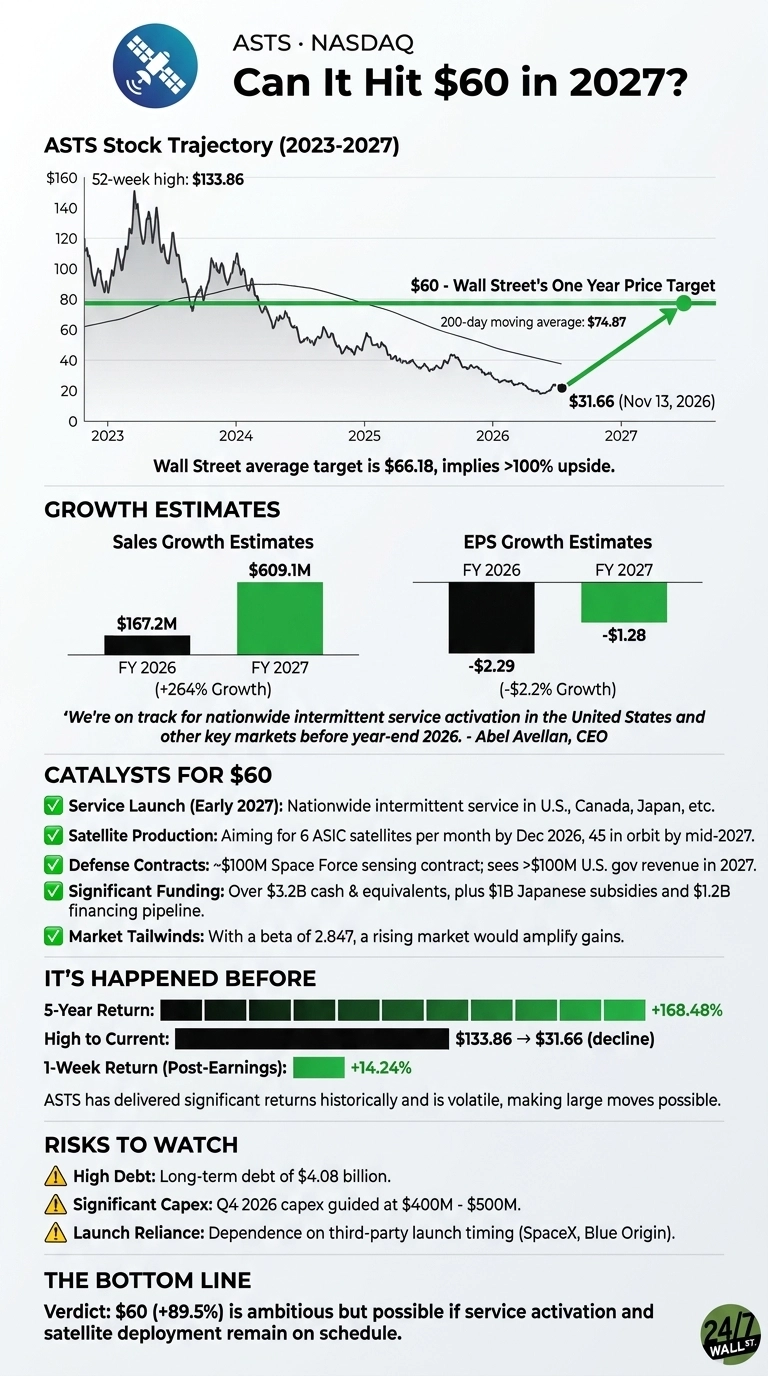
The 2027 EPS consensus has slipped to -$1.2782 from -$0.6863 90 days ago as spending rises. There is no beat streak yet. Third quarter EPS of -$0.44 exceeded the -$0.4479 consensus, while revenue of $42.32 million missed the $46 million estimate.
Here’s What It Takes for AST SpaceMobile to Reach $60
AST SpaceMobile is unprofitable, so price-to-sales is the better yardstick. At $31.66, shares trade at roughly 16x 2027 revenue estimates. At $60, that rises to about 30x, a market value near $18 billion.
That’s a steep multiple, but management maintains that revenue in the 12 months after commercial service begins could approach $1 billion. Removing that figure would compress the multiple quickly.
What Could Push AST SpaceMobile to $60?
- Service launch: Initial coverage targets the U.S., Canada, Japan, Saudi Arabia and the U.K., with end-user beta trials expected in early 2027.
- Constellation scale: Management targets about 45 BlueBirds in orbit by mid-2027. ASIC satellites deliver a 10 times processing improvement, and production should reach six per month in December.
- Defense demand: A roughly $100 million Space Force sensing contract brings government awards to 16, and management sees more than $100 million of U.S. government revenue in 2027.
- Funding: Cash and restricted cash exceeded $3.2 billion, with about $1 billion in Japanese subsidies and a $1.2 billion quasi-governmental financing pipeline for 2027.
- Market tailwinds: With a beta of 2.847, a rising market would amplify gains.
AST SpaceMobile’s History Says $60 Is Possible
Reaching $60 requires an 89.5% gain. For this stock, that is familiar territory. Shares hit a 52-week high of $133.86 and remain up 168.48% over five years.
The 200-day moving average is $74.87, so simply returning to that level would clear the target. Shares also rose 14.24% in the week after earnings.
Is $60 Realistic? Here’s My Take
Reaching $60 means AST SpaceMobile must nearly double. Wall Street’s target already sits higher, revenue is forecast to more than triple, and service activation is weeks away.
Key hurdles include long-term debt of $4.08 billion, fourth quarter capex guided at $400 million to $500 million, and reliance on SpaceX and Blue Origin launch timing. If BlueBirds reach orbit on schedule and paying customers follow, the revaluation could come quickly.
Annual returns of this magnitude are rare, but we’ve outlined the pattern for how AST SpaceMobile could see outsized returns in 2027 (we reverse-engineered what the biggest tech winners looked like early and turned it into a free playbook here).
Contact [email protected] for any questions or corrections.
Vandita Jadeja is a financial publisher with over a decade of experience writing about financial topics, including investment, savings, retirement, insurance and banking. Vandita is a Chartered Accountant who loves to debunk financial concepts for readers.
Her work has appeared on sites that include The Motley Fool, InvestorPlace, and Benzinga. She covers investing and focuses on stock picks and price prediction for 24/7 Wall St.
When not looking for the next stock investment opportunity, she can be found traveling, reading, chasing sunsets and enjoying her iced latte.