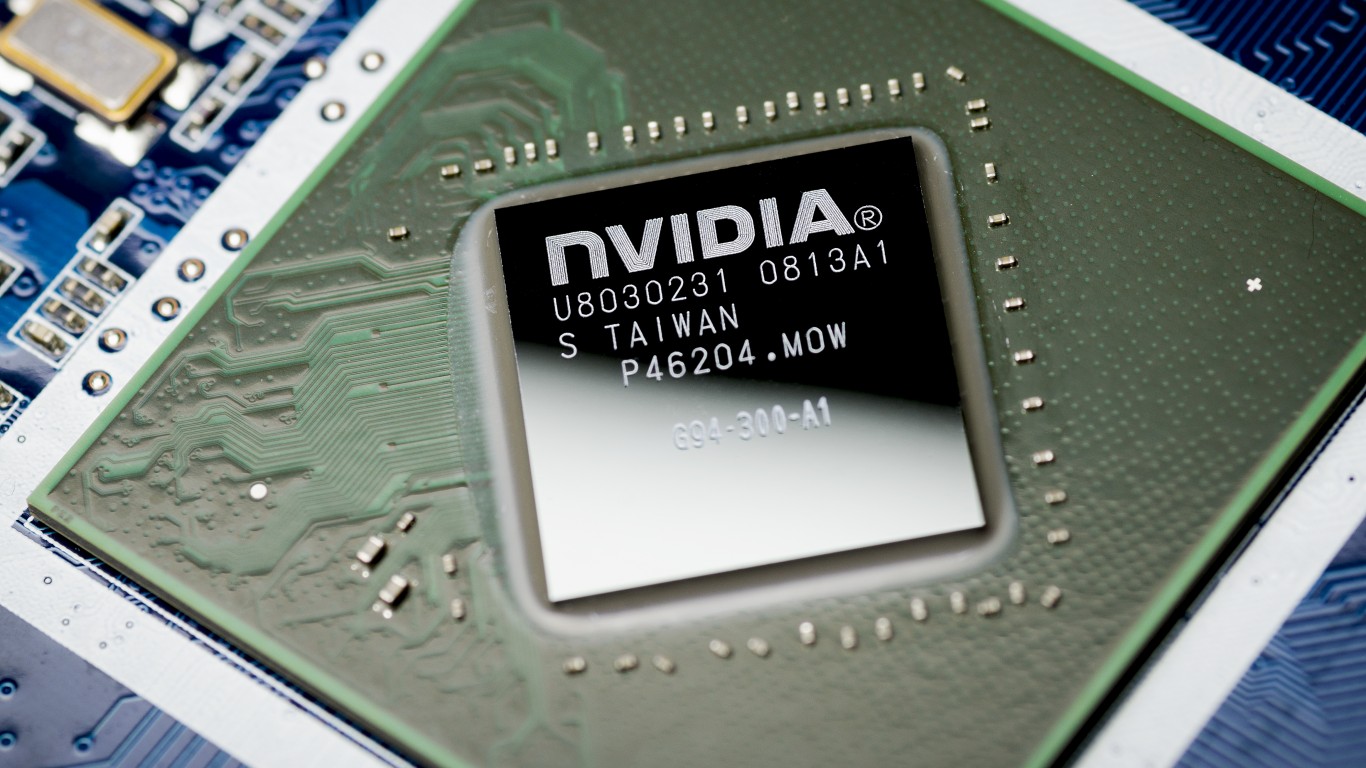
At $162, Nvidia’s Going to Get Institutional Support From Those Who Missed Out Earlier, So I’m Buying

This post may contain links from our sponsors and affiliates, and Flywheel Publishing may receive compensation for actions taken through them.
I have bought NVIDIA (NASDAQ:NVDA | NVDA Price Prediction) on every leg down this fall, and at $162.85 I added again. The stock fell 26.41% in a month. From where I sit, the business underneath it keeps getting stronger.
Why I Keep Hitting the Buy Button
My thesis comes down to one idea: NVIDIA sells the whole AI factory. Chips, CUDA software, NVLink, networking and now CPUs all come as one platform, and customers who build on it come back for the next generation. Vera Rubin began production shipments in August and has purchase orders from every major hyperscaler[1]. Management expects fiscal 2028 revenue growth of approximately 70%[1], and supply limits that number. On the August call, Jensen Huang said: “Our demand is much higher than that.”[1]
Three Reasons I Can’t Stop Adding
Growth keeps compounding. Q2 FY27 revenue reached $96.22 billion[2], up 105.8% year over year. Non-GAAP EPS of $2.22[2] topped the $2.09 consensus, which makes 6 consecutive quarters of beats. Q3 guidance calls for $108.0 billion[2], and that figure includes no China data center compute.
Profitability leads the sector. NVIDIA makes a 55.60% net margin and a 101.5% return on equity. Interest coverage stands at 503x, and fiscal 2026 free cash flow came in at $96.58 billion[3]. Shareholders also get paid. The quarterly dividend rose from $0.01 to $0.25, and roughly $99B of buyback authorization remains.
The valuation has contracted. The trailing P/E stands at 33, and on forward estimates the multiple has contracted into the low-to-mid 20s. That compression gives long-only funds that missed the earlier run a lower multiple to evaluate. Some are already moving: 3 of 5 tracked filers, including Marshall Wace and ARK Investment Management, added shares in the September quarter.
Why My Money Skips AMD and Broadcom
Advanced Micro Devices (NASDAQ:AMD) grows fast, but it trades at 202 times earnings on a 12.5% net margin. Its Q3 free cash flow came to $554 million, down 70.86%, while inventory rose 35% sequentially.
Broadcom (NASDAQ:AVGO) posted AI semiconductor revenue of $16.70 billion. Even so, its quarterly free cash flow of $13.665 billion trails NVIDIA’s $21.34 billion[2], and Broadcom lists its debt load and its reliance on a limited number of AI customers among its key risks.
Risk That Could Still Hurt Me
The leadership crisis concerns me. A board investigation and reports about Huang’s future sent the stock lower, and two major investors urged the board to consider his potential return. Memory costs will also pull gross margins to 71% to 72%[1] in Q4, and supply commitments have reached $279B[2].
Those risks have left my thesis intact because the demand belongs to customers. Cloud backlog runs above $2 trillion[1], and AWS is installing an additional 2 million GPUs through fiscal 2029. CUDA, NVLink and the Vera Rubin roadmap will survive any single boardroom fight, and the power, cooling and networking suppliers feeding that expansion are a trade of their own (we rounded up seven of them in a free report on the AI infrastructure names behind the chipmakers).
What Keeps My Buy Button Active Into Earnings
The next earnings report is close at hand, and I plan to watch the stock around it. Revenue per gigawatt rises from $25 billion[1] on Grace Blackwell to $40 billion on Vera Rubin, so every build-out cycle hands NVIDIA a bigger check. I remain a buyer because every dollar of AI infrastructure spending still runs through this company.
Contact [email protected] for any questions or corrections.
Alex Sirois is a financial writer with experience spanning both retail and institutional investing. He has written for InvestorPlace and held roles at BNY Mellon and Bernstein, giving him a perspective that bridges Main Street portfolios and Wall Street analysis.
Alex holds an MBA from George Washington University and has built his career across multiple industries, including e-commerce, education, and translation — a breadth of experience that informs how he breaks down complex financial topics for everyday investors. His writing is conversational, actionable, and grounded in long-term, buy-and-hold investing principles.
At 247 Wall St., Alex focuses on delivering analysis that is both accessible and useful, with a clear emphasis on helping readers make more informed decisions with their money.