SanDisk Stock Could Have Another Big Year. Here’s My 2027 Price Prediction

This post may contain links from our sponsors and affiliates, and Flywheel Publishing may receive compensation for actions taken through them.
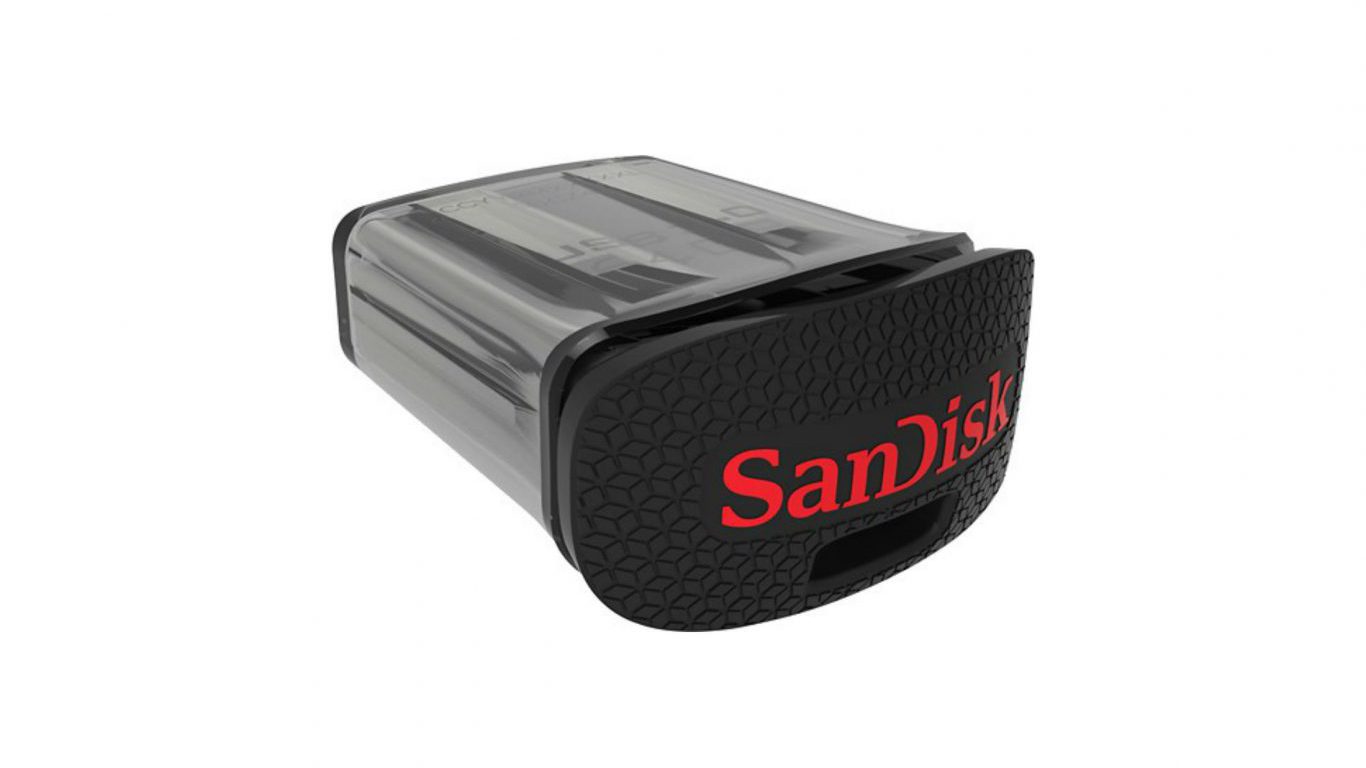
SanDisk (NASDAQ:SNDK | SNDK Price Prediction) has turned NAND flash, once a commodity business, into one of the most profitable franchises in hardware. Fiscal Q1 2027 revenue reached $11.03 billion, up 377.9% year over year, at an 85% GAAP gross margin.
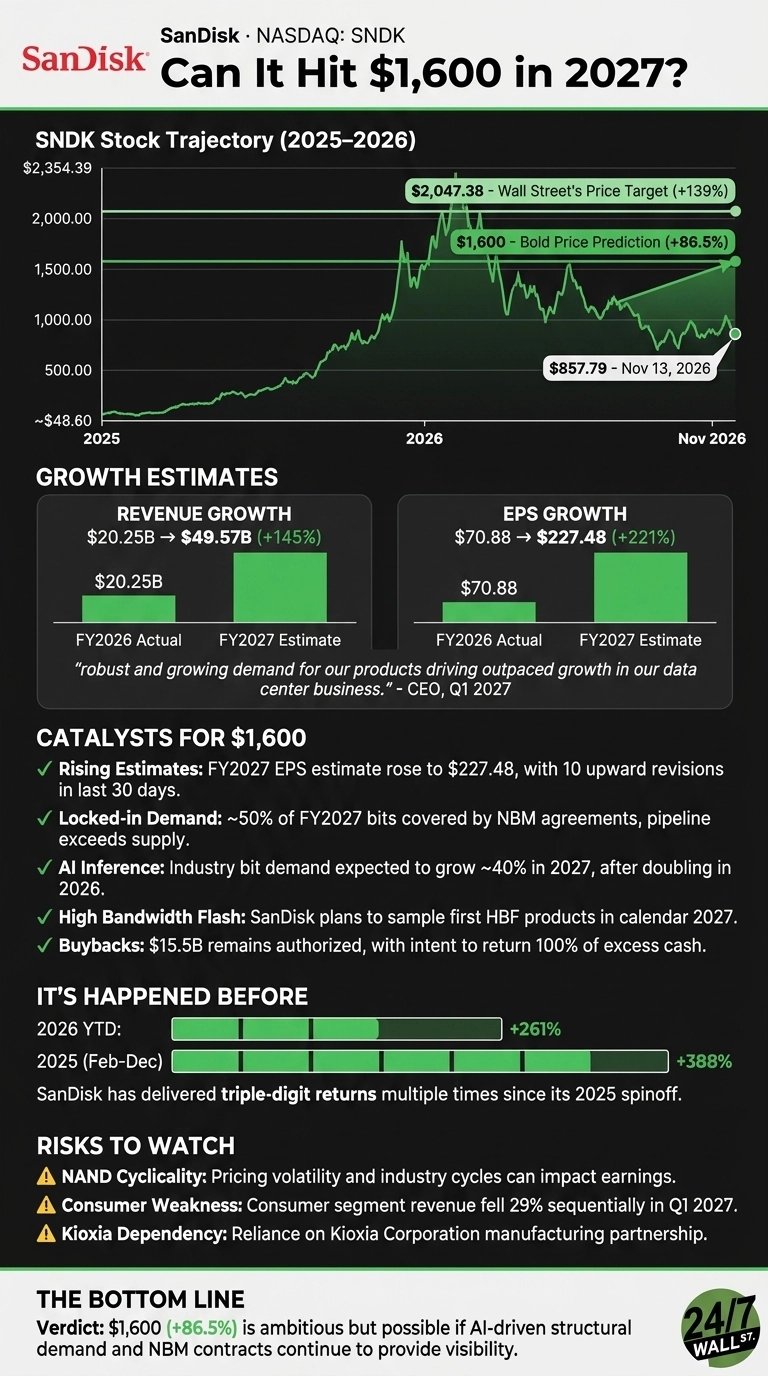
Datacenter sales rose 61% sequentially to $4.80 billion. In the earnings release, the CEO pointed to “robust and growing demand for our products driving outpaced growth in our data center business.”
Shares are up 261.36% year to date, but the stock has declined over the past month. The stock fell 22.26% on November 5 as chip stocks slid. It now trades at $857.79, 42.13% below where it stood a month ago. With an 8-for-1 split taking effect November 19, I see a path to $1,600 per share (pre-split), or $200 split-adjusted, in 2027.

Wall Street Sees Even More Upside for SanDisk
The consensus price target is $2,047.38, which implies 139% upside. Analysts count 4 Strong Buy and 17 Buy ratings, compared with 3 Holds. For fiscal 2027 (ending June), they expect revenue of $49.57 billion, implying 145% growth from $20.25 billion. The fiscal 2027 EPS estimate has rose to $227.4808 from $212.1455 90 days ago, with 10 higher revisions against 1 down in the past 30 days.

SanDisk has also exceeded EPS estimates for 7 consecutive quarters. Most recently, it reported $49.51 against a $46.27 consensus. That track record suggests the forecasts could still be too low.
Here’s What It Takes for SanDisk to Reach $1,600
SanDisk currently trades at about 4x fiscal 2027 EPS and 3x the fiscal 2028 estimate of $289.054. At $1,600, those multiples rise to 7x and 6x. The S&P 500 trades at roughly 21-23x forward earnings. Investors price memory makers as if peak earnings will decline, so reaching $1,600 only requires a modest reduction of that discount.
What Could Push SanDisk to $1,600?
- Rising estimates: The December-quarter EPS estimate is $57.1181, compared with $52.8660 90 days ago.
- Locked-in demand: Roughly 50% of fiscal 2027 bits and two-thirds of fiscal 2028 bits are covered by multi-year New Business Model (NBM) agreements. Management said the pipeline “exceeds our supply throughout the end of the decade.“
- AI inference: Management expects industry bit demand to grow about 40% in 2027, after more than doubling in 2026.
- High Bandwidth Flash: SanDisk plans to sample its first HBF products in calendar 2027. HBF is excluded from the long-term financial model, so any revenue would add to current plans.
- Buybacks: $15.5 billion remains authorized, and management intends to return 100% of excess cash to shareholders.

SanDisk Has Already Done This Twice
Reaching $1,600 requires an 86.5% gain. SanDisk has topped that in both of its years as a public company. Shares rose 388% from $48.60 after the February 2025 spinoff through year-end 2025, then added 261.36% in 2026. The 52-week high of $2,354.39 sits well above my target.
That is the kind of run that usually belongs to AI chip names, and we studied what those early winners had in common in a free Next Nvidia Playbook. Repeating that kind of gain from a $121.45 billion market cap is harder, and Consumer revenue fell 29% sequentially.
My Take on $1,600 for SanDisk in 2027
Reaching $1,600 would take an 86.5% gain, which still lands below Wall Street’s consensus target. Estimates are rising, NBM contracts give SanDisk unusual visibility for a memory company, and the target implies only 7x forward earnings.
NAND cyclicality and SanDisk’s reliance on its Kioxia manufacturing partnership are the main risks. Returns at this level shouldn’t be expected every year, but this is how SanDisk could deliver outsized returns in 2027.
Contact [email protected] for any questions or corrections.
Vandita Jadeja is a financial publisher with over a decade of experience writing about financial topics, including investment, savings, retirement, insurance and banking. Vandita is a Chartered Accountant who loves to debunk financial concepts for readers.
Her work has appeared on sites that include The Motley Fool, InvestorPlace, and Benzinga. She covers investing and focuses on stock picks and price prediction for 24/7 Wall St.
When not looking for the next stock investment opportunity, she can be found traveling, reading, chasing sunsets and enjoying her iced latte.