Druckenmiller Sold All of His Alphabet, AMD and SanDisk

This post may contain links from our sponsors and affiliates, and Flywheel Publishing may receive compensation for actions taken through them.
Stanley Druckenmiller’s Duquesne Family Office filed its 13F for the quarter ended September 30, 2026, on November 16, and three AI names were missing from it. As of June 30, the firm held all three. These were 336,300 Class A shares of Alphabet (NASDAQ:GOOG | GOOG Price Prediction, NASDAQ:GOOGL), 72,900 shares of Advanced Micro Devices (NASDAQ:AMD) and 34,900 shares of SanDisk (NASDAQ:SNDK). All three positions were gone by September 30.
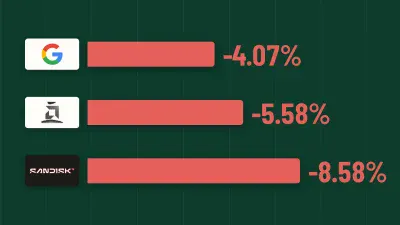
All three stocks fell on November 16. Alphabet Class A fell 4.07% to $283.72, AMD dropped 5.58% to $504.28, and SanDisk lost 8.58% to $809.11.
A 13F is the quarterly holdings report that large money managers file with the SEC, showing long U.S. positions on a single date and leaving out trade dates and sale prices. Druckenmiller gave no reason for the moves.
For shareholders, the more useful question is whether the sales say anything about the underlying businesses, but the filing offers little on that point, so fundamentals and valuations matter more than the fund’s moves.
Small Exits From a Shrinking Portfolio
At June 30 the stakes were worth $120.2 million in Alphabet, $42.3 million in AMD and $79.4 million in SanDisk. That came to about $241.9 million combined, or about 4.6% of a $5.21 billion portfolio.
The portfolio itself fell to $4.47 billion across 65 positions, down from 95. Natera is still the largest holding at 29.2% of assets, a stake worth $1.306 billion.
All three sales look like trading positions. Duquesne held 102,200 Alphabet shares as of September 30, 2025. It rose to 385,000 at December 31 and held none at March 31 before buying back in, so this is its second Alphabet exit in a year. SanDisk went from 166,235 shares to zero and then back to 38,155 at March 31, and AMD first showed up in the June filing.
Losses Since September Outweigh the Signal
During the quarter, Alphabet slipped 3.7%, AMD rose 5.3% to $611.76, and SanDisk fell 23.5%. Losses since September 30 dwarf that, led by SanDisk’s 53.5% drop; Alphabet and AMD lost 17.5% and 17.6%.
The June share counts would have been worth about $221.0 million at September 30 prices and about $160.4 million at the November 16 close. Because the filing never says when Duquesne sold, nobody can claim it avoided that drop.
Measured against Alphabet’s $3.636 trillion market value and AMD’s $827.06 billion, these stakes are trivial. Even SanDisk, at $115.13 billion, barely registers one fund leaving.
Storage and Gold Took the Money
Duquesne raised its stake in Seagate Technology (NASDAQ:STX) by 180% to 341,790 shares worth $315.2 million. It also bought call options on 98,000 Seagate shares and opened an 80,960-share position in Western Digital (NASDAQ:WDC).
It also bought gold mining stocks. Newmont, Barrick and Agnico Eagle were worth about $129.1 million, or 2.9% of the portfolio, at September 30 and about $119.9 million at November 16 closes. The new SpaceX and Palantir stakes are small at 0.68% and 0.34% of the portfolio, worth about $27.8 million and $12.8 million at November 16 closes.
How the AI Bull and Bear Cases Stack Up
The bull case rests on reported demand. AMD guided fourth-quarter revenue to about $17 billion[1], roughly 66% growth, while Google Cloud revenue grew 103%[2] and SanDisk posted an 85.0%[3] gross margin.
The bear case is about price and cost. AMD trades at 191 times earnings, and Alphabet’s free cash flow was negative $9.07 billion[2] after $51.36 billion of capital spending. SanDisk’s margins depend on memory chip prices, and those have fallen sharply in past cycles.
The underlying demand still looks strong, but valuations differ widely across the three names. At 13 times earnings, Alphabet has the most reasonable valuation of the three relative to its growth. AMD’s multiple leaves little margin if growth slows down, and SanDisk at 10 times earnings is the most exposed to a pricing turn.
NVIDIA is listed to report after the close on November 17, although it has not confirmed the date, and Duquesne’s next 13F is due by February 16, 2027. If AMD has not recovered $611.76 by that filing, the valuation concerns will likely have gained ground.
Contact [email protected] for any questions or corrections.
Omor Ibne Ehsan is a writer at 24/7 Wall St. He is a self-taught investor with a focus on growth, cyclical, and dividend equities that have strong fundamentals, value, and long-term potential. He also has an interest in high-risk, high-reward investments such as penny stocks.