Oracle’s 40% 6 Month Slide Continues: This Analyst Maintains His Buy Rating, Predicting 230% Returns

This post may contain links from our sponsors and affiliates, and Flywheel Publishing may receive compensation for actions taken through them.
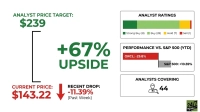
Oracle (NYSE:ORCL | ORCL Price Prediction) trades at $119.05. Wall Street’s average price target is $236.18, suggesting about 98% of potential gain.
Oracle has turned itself from a database and license vendor into a large AI cloud provider. Cloud now makes up 60%[1] of revenue, and cloud infrastructure revenue grew 121% last quarter. Remaining performance obligations (RPO), the backlog of contracted revenue Oracle hasn’t recognized yet, reached $664B[1].
Oracle keeps beating estimates while its stock keeps falling. That leaves two options. Analysts may be holding onto a story the market has given up on, or the market may be mispricing the stock.
Oracle Beat Earnings Estimates and Still Fell 35.73% in Six Months
Cash burn is the main reason for the selloff. Oracle spent $28.5B[1] on capex last quarter, so free cash flow came in at negative $5.40B. Management hasn’t given a timeline for positive free cash flow. To pay for the expansion, Oracle finished a $20B[1] at-the-market equity program and then priced another $20 billion of common stock and senior notes[2]. That means shareholders face dilution and rising interest costs together (the same power, cooling, and networking suppliers riding this AI data-center spend are the subject of a free report we put together, here).
Customer concentration adds to the worry. An estimated $300 billion of the backlog is linked to OpenAI, or about 45% of signed business. Oracle hasn’t disclosed the cancellation terms.
Shares are down 35.73% over six months, including a 5.03% drop in the latest session. Weakness across AI stocks played a part, but peers held up much better, so most of this repricing is specific to Oracle. Results held up. Non-GAAP EPS of $1.92[1] beat the $1.74 consensus, and revenue of $19.345B topped estimates.
Guggenheim’s $400 Target Points to About 236% Upside
Of 43 analysts, 7 rate Oracle Strong Buy, 28 rate it Buy, 7 give a Hold and 1 rates it Sell.
Guggenheim’s John DiFucci has the highest target on the Street, $400, and keeps a Buy rating. That target sits about 236% above the current price. His case depends on RPO turning into cloud infrastructure revenue on the way to management’s goal of $225 billion+ in annual revenue by FY30. Oracle expects around half[3] of its RPO to convert to sales within 36 months.
Pricing power is the second part of the case. GPU utilization was 97.9%[3] last quarter, and capacity coming up for renewal was renewed or resold at a 20% premium. The third part is multicloud database revenue, which grew 353%[3] and puts Oracle’s database inside rival clouds.
The next test is fiscal second-quarter guidance: revenue growth of 30% to 34%[3] and non-GAAP EPS of $1.85 to $1.93. For the full year, Oracle is targeting at least $90B[1] in revenue. Oracle also says it closed more than $30 billion[3] in new AI contracts without needing more of its own capital. Analyst targets are only one data point. They lag the stock price and can be cut quickly.
Microsoft and Amazon Rose This Year While Oracle Fell Alone
Oracle fell by itself. Its hyperscale rivals are up for the year.
Microsoft (NASDAQ:MSFT) trades at $517.99 and is up 7.79% year to date. Its $636.12 average target suggests about 23% of potential gain. The stock has 12 Strong Buy, 40 Buy and 5 Hold ratings and no Sells. Analysts see much less upside here than in Oracle.
Amazon (NASDAQ:AMZN) trades at $257.75 and is up 11.67% year to date. Its $326.29 target suggests about 27% of upside, with 16 Strong Buy ratings, 43 Buy calls and 2 Hold recommendations. Amazon also has a trailing free cash outflow of $42.4 billion, yet investors are giving it the benefit of the doubt.
Oracle has by far the largest implied upside in this group. That shows how much Oracle-specific risk the market is pricing in, from debt-funded growth to its reliance on one customer.
Oracle Trades at 15x Forward Earnings, Near Its 52-Week Low
At $119.05, Oracle trades well below the $236.18 consensus target from 43 analysts. Shares are down 38.11% year to date, while the S&P 500 is up 8.51%. Over the past year Oracle fell 45.87%, while the index rose 10.12%.
The stock trades at about 15x forward earnings. It is below both its 50-day average of $136.67 and its 200-day average of $154.11. The 52-week range runs from $109.21 to $248.46, which puts shares near the low end.
Oracle’s Upside Depends on OpenAI Following Through
The optimistic case holds if RPO converts on schedule, the next earnings report lands within guidance, and prepayments keep net capex at not more than $70 billion[3]. Under those conditions, revenue growth above 30% and a 15x multiple make the consensus target reachable.
It looks like a value trap if OpenAI cuts its spending. Oracle would be left with debt-funded data centers and a backlog that shrinks faster than it converts. More equity raises would keep diluting shareholders even if the business performs.
I lean bullish. Growth is speeding up, renewal pricing is rising, and the valuation already reflects a lot of damage. OpenAI exposure is the variable that matters most. The next earnings report should show whether backlog conversion is keeping up with capex.
Contact [email protected] for any questions or corrections.
Alex Sirois is a financial writer with experience spanning both retail and institutional investing. He has written for InvestorPlace and held roles at BNY Mellon and Bernstein, giving him a perspective that bridges Main Street portfolios and Wall Street analysis.
Alex holds an MBA from George Washington University and has built his career across multiple industries, including e-commerce, education, and translation — a breadth of experience that informs how he breaks down complex financial topics for everyday investors. His writing is conversational, actionable, and grounded in long-term, buy-and-hold investing principles.
At 247 Wall St., Alex focuses on delivering analysis that is both accessible and useful, with a clear emphasis on helping readers make more informed decisions with their money.