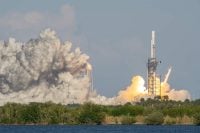
SpaceX Rises 3% on Report of $4 Billion Bond Sale to Fund NVIDIA Chips; Rocket Lab Falls 3%, AST SpaceMobile Slides 2%

This post may contain links from our sponsors and affiliates, and Flywheel Publishing may receive compensation for actions taken through them.

Wall Street is rewarding the artificial intelligence (AI) computing push at SpaceX (NASDAQ:SPCX | SPCX Price Prediction) even as the rest of the space group slips. SpaceX stock trades at $141.32 this afternoon, up 3%. That gain arrives after a quiet stretch, with the stock down 3% over the past month.
The move follows a Bloomberg report on a planned SpaceX bond sale that would help fund chips from NVIDIA (NASDAQ:NVDA). Because the company hasn’t commented, the financing remains unconfirmed. The two closest listed space peers are both lower, leaving SpaceX to move apart from the group.
Inside the Reported SpaceX Bond Sale for NVIDIA Chips
Bloomberg reported on November 17[1] that SpaceX could begin selling $4 billion of bonds this week as part of a $40 billion financing plan to buy NVIDIA’s next-generation Vera Rubin chips for its AI computing business. Two major financial firms are expected to underwrite the sale, according to the report, and funds tied to large asset managers have made financing commitments.
Under the reported structure, a special-purpose company managed by Atlas SP would buy the chips and lease them to SpaceX for five years. That setup would keep the borrowing off the company’s balance sheet and protect SpaceX’s investment-grade credit ratings.
The report lands as SpaceX expands its COLOSSUS II compute expansion, which has reached 1.7 gigawatts of rated capacity. SpaceX disclosed on October 20[2] that its Super Intelligence (SI) segment revenue rose 830% year over year (YoY) to $7.6 billion in Q3 2026. A $25 billion[3] first investment-grade bond issue, referenced in SpaceX’s Q2 2026 report, shows the company has tapped debt markets before.
Rocket Lab and AST SpaceMobile Move Apart From SpaceX
Rocket Lab (NASDAQ:RKLB) stock is at $55.77, down 3%. That pullback comes after a strong run, and Rocket Lab stock is still up 10% over the past month, ahead of SpaceX over that stretch. Back on November 9[4], Rocket Lab reported record Q3 revenue of $267.83 million, up 72.7% YoY, along with a $3.57 billion backlog.
AST SpaceMobile (NASDAQ:ASTS) stock is at $28.03, down 2%. The decline at AST SpaceMobile follows its results from November 9[5], when the company reported Q3 revenue of $42.32 million that missed the $46 million consensus estimate.
For Rocket Lab and AST SpaceMobile, growth plans rest on launch and satellite execution, which keeps both companies outside the AI compute trade lifting SpaceX. Neutron isn’t expected to fly until 2027 at the earliest. Rocket Lab’s reusable medium-lift rocket is called Neutron, while AST SpaceMobile is targeting nationwide intermittent service activation before year-end 2026[5].
How SpaceX’s Business Differs From Its Space Peers
SpaceX runs a vertically integrated business covering Falcon 9 and Starship launches, Starlink connectivity and an AI unit that includes Grok and the Cursor coding platform, and owning the compute layer, the models and the applications gives the company several revenue streams that smaller space names don’t have.
Rocket Lab is a launch and space systems specialist, building Electron and Neutron rockets alongside complete spacecraft and components for government and commercial customers, while AST SpaceMobile, by contrast, is building a direct-to-cell satellite network that partners with mobile carriers to connect standard smartphones. Each of those models is tied to hardware delivery schedules, while a growing share of the SpaceX story now rides on AI demand.
Is SpaceX Now an AI Infrastructure Play?
One open question for SpaceX is whether it now trades more like an AI infrastructure company than a space stock. Bullish investors argue the business can lock in NVIDIA chip supply, grow its SI segment and keep its credit ratings intact through the reported lease structure.
Meanwhile, the bears focus on the cost of that ambition. Large technology companies have turned to the bond market to fund AI spending. Wells Fargo (NYSE:WFC) warned last week that heavy tech borrowing is starting to strain investor demand for corporate bonds. SpaceX also faces heavy capital spending, $23.4 billion[2] in share-based compensation attributable to post-acquisition service at Cursor and execution risk on Starship.
Next up for SpaceX is the question of whether the reported bond sale launches this week on terms that keep the broader chip financing plan on track. The outcome of the reported bond sale could shape how investors value the AI compute push.
Contact [email protected] for any questions or corrections.
David Moadel is financial writer specializing in stocks, ETFs, options, precious metals, and Bitcoin. David has written well over 1,000 articles for leading online publications, helping investors understand markets, income strategies, and risk. His work has appeared in 24/7 Wall St., The Motley Fool, InvestorPlace, U.S. News & World Report, TipRanks, ValueWalk, Benzinga, Market Realist, MarketScreener, TalkMarkets, Finmasters, and others. With a master’s degree in education, David has taught at the elementary, high school, and college levels. That teaching background shapes his writing style: clear, educational, and practical. David has also built a loyal social-media audience by providing trustworthy financial content on YouTube, X/Twitter, and StockTwits.