At 63, He Sold Christmas Trees Planted Six Years Apart. Only One Batch Counted Against His $24,480 Social Security Earnings Limit

This post may contain links from our sponsors and affiliates, and Flywheel Publishing may receive compensation for actions taken through them.

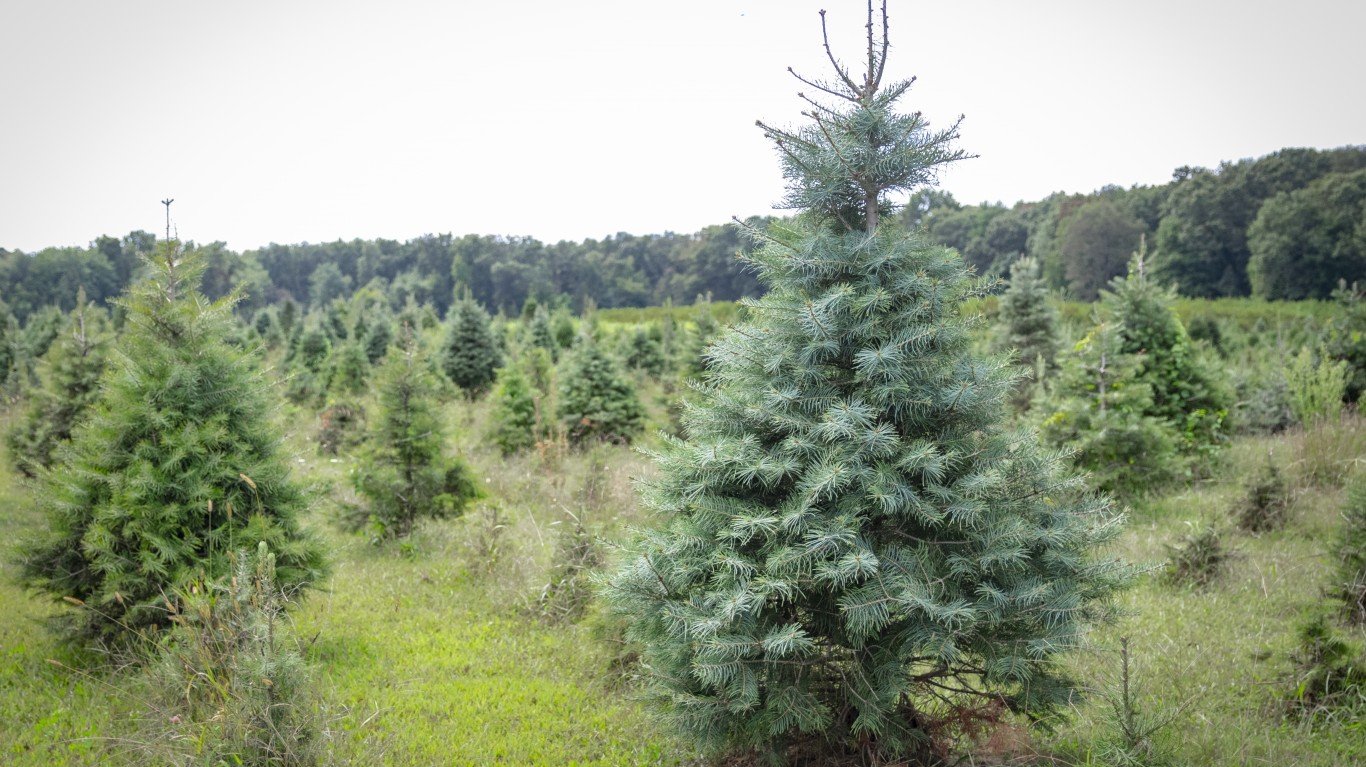
A 63-year-old grower walks a customer down two rows on land his family has farmed for generations. One row went in years before the other. Strapped to a car roof, the two trees look the same. The tax code can treat them as two different things, and only one of them reaches his Social Security check. Growing Christmas trees takes anywhere from eight years to a decade. Just about any working farm will tell you that rows planted at different times are constantly crossing that line at once.
He started benefits before full retirement age, which is 67[1] for anyone born in 1960 and later. That puts him under the retirement earnings test, a rule that temporarily holds back benefits when work income runs too high. In 2026, the limit for someone under full retirement age all year is $24,480. Social Security withholds $1 from your benefit payments for every $2[2] above it.
A Tree’s Age on Cutting Day Draws the Line
Federal tax law counts evergreens as timber when they are “more than 6 years old at the time severed from the roots and are sold for ornamental purposes[3].” The clock that counts stops when the saw goes through the trunk. Two trees sold on the same afternoon can land on opposite sides of that line.
For the older trees, a grower can choose to treat the cutting itself as a sale of timber. The election takes careful steps. He needs to own the trees or hold the right to cut them, must have held them for more than 1 year[3], and has to make the decision on his return. Once he makes it, that choice covers all his timber and stays binding in later years unless the IRS allows him to revoke it.
The decision reaches his benefit check through the earnings test. For a farmer, the earnings test counts net earnings from self-employment, and that figure takes out gain from the cutting of timber when the timber election applies (26 U.S.C. § 1402(a)(3)(B))[4]. A qualifying cutting gain can sit outside the test entirely. The younger trees normally stay farm inventory, reported on Schedule F (the farm profit-or-loss form), and that profit counts toward the earnings limit.
The split is rarely all-or-nothing. Under the tax distinction, the gain is measured using the trees’ fair market value on the first day of the taxable year[3] they are cut, and that value becomes his cost from then on. Value he adds after the cut, such as baling, delivery, or a retail lot markup, can remain ordinary business income that still counts.
Farm Profit That Trips the Test Also Builds His Record
The younger trees come with an upside. Their profit goes onto his covered earnings record. Each year, the agency reviews beneficiaries’ records, and if the latest year is one of your highest years of earnings[2], it recalculates the benefit and pays the increase. A strong selling season can replace a lean year from decades ago.
Withheld checks come back in another form. Once he reaches that threshold, Social Security recalculates his benefit to credit the months it held back because of excess earnings, and the earnings test stops applying. Phasing out of work this way carries its own tax traps, and we mapped out the four biggest in a free semi-retirement guide.
Avoiding the Earnings Test Still Leaves a Tax Bill
Keep these two questions separate. Cutting gain that stays outside the earnings test is still income. It can raise his combined income, the measure the IRS uses to decide the taxable portion of his benefits. Benefits start becoming taxable above $25,000[5] for a single filer or $32,000 on a joint return. A larger share becomes taxable above $34,000[5] and $44,000.
A big harvest at 63 can also show up again at 65. Medicare surcharges are generally based on income from two years earlier, and in 2026 the Part B surcharge starts above $109,000[6] for single filers.
Plan Which Rows Fall Before the Saw Starts
The same principle holds for other assets too. An asset’s tax treatment can turn on a physical fact such as its age, whatever the seller intended. On a tree farm, the planting calendar can matter as much as the sales contract.
Two moves make the biggest difference:
- Talk with a CPA before the first tree comes down. The election and the holding period have to be in place ahead of time, and once made, the election follows every tree on the property for future years. Sorting it out after the season ends is hard to undo.
- Map the harvest against the benefit calendar. Know which plantings clear the six-year line and which do not. In a year benefits are running, that mix determines how much counts toward the earnings limit, how much builds up his record, and how much of his check ends up taxable.
Basis records, land ownership, and family arrangements vary from farm to farm, and any one of them can change the answer. This is general information for educational purposes.
Contact [email protected] for any questions or corrections.
Gerelyn Terzo is the author of dividend investing handbook "Dividend Investing Strategies: How to Have Your Cake & Eat It Too." A veteran financial journalist, she covers agri-finance for outlets like Global AgInvesting and the broader stock market and personal finance for 24/7 Wall Street. She began at CNBC and later helped launch Fox Business in New York. Gerelyn currently resides in Woodland Park, Colorado and dabbles in nature photography as a hobby.