4 Familiar Retail Stocks Have Dividend Warning Signs Investors Shouldn’t Ignore

This post may contain links from our sponsors and affiliates, and Flywheel Publishing may receive compensation for actions taken through them.

Two of the four familiar retail names below have already cut their dividends in the past two years, and the other two rely on earnings boosted by one-time tariff refunds. Wendy’s (NASDAQ:WEN | WEN Price Prediction) reduced its quarterly payout to $0.07 from $0.14 in 2026. A yield matters only if the payout is sustainable, and being a household name doesn’t change that.
A quick test you can run yourself: a dividend holds up when earnings and free cash flow (operating cash flow after capital spending) cover it with room to spare, sales are steady or growing, and debt isn’t paying for it. Those are a few of the red flags we broke down in our free dividend trap guide, which lists the seven signs that a big yield is about to be cut.
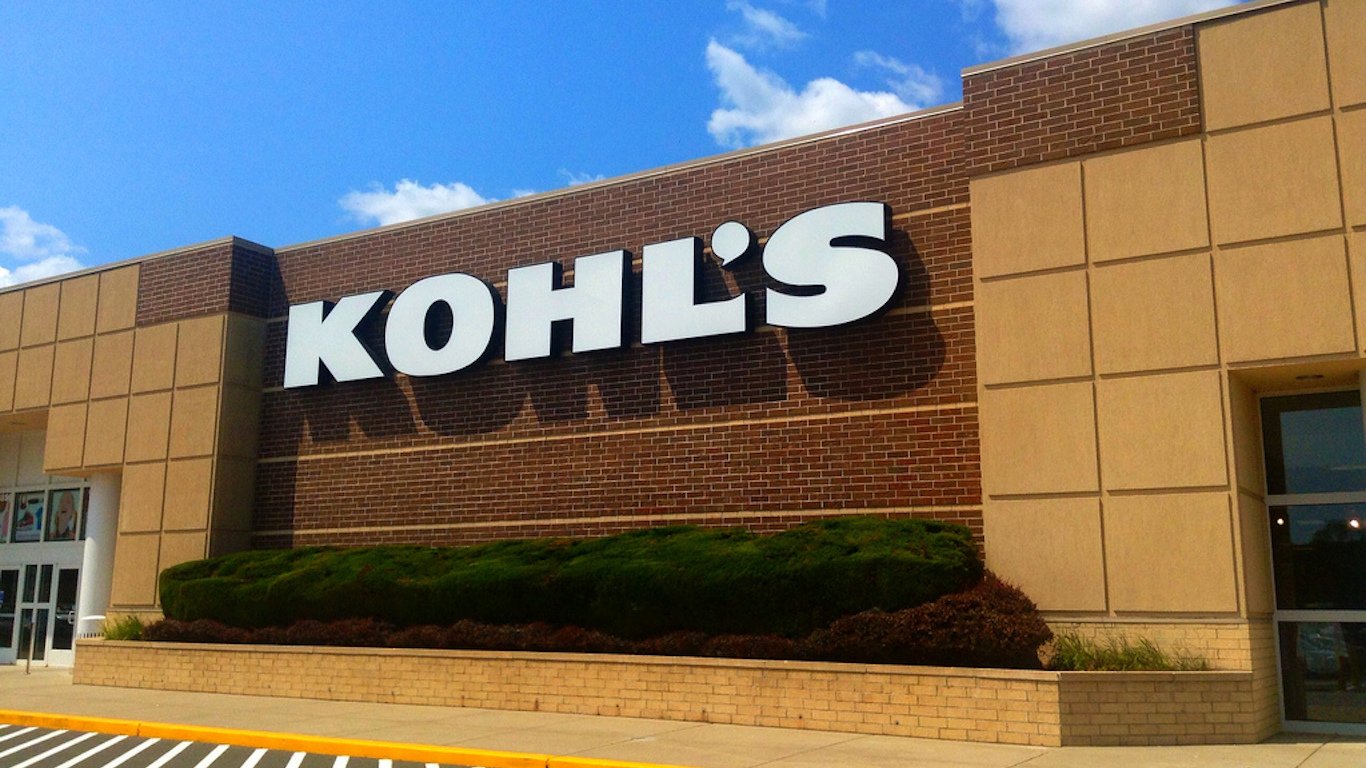
Kohl’s (KSS): A Smaller Dividend Built on Sales That Keep Shrinking
Kohl’s (NYSE:KSS) pays $0.125[1] a quarter, or $0.50 a year. That works out to a forward yield of about 2.14% at $23.40. Price increases have kept the yield in check: shares rose 48.89% over the past year. Over five years, though, they are still down 49.44%.
Kohl’s has cut before. It paid $0.50 a quarter throughout 2024, then dropped to $0.125 starting with the March 2025 ex-dividend date. Comparable sales are still falling: -0.9%[1] in Q2 after -1.1%[2] in Q1. Q2 GAAP EPS of $1.28[1] got help from about $150M in one-time IEEPA tariff refunds. Roughly $100M of that ran through cost of goods and caused 305 bps[1] of gross margin expansion. In Q1, free cash flow was -$158M[2].
On paper, coverage is strong. The payout is about 21% of trailing EPS of $2.33. Last fiscal year’s free cash flow of $1.104 billion dwarfed $56M in dividends. The open question is how much the business makes once the refunds stop, with full-year sales guided flat to -1.5%[1].
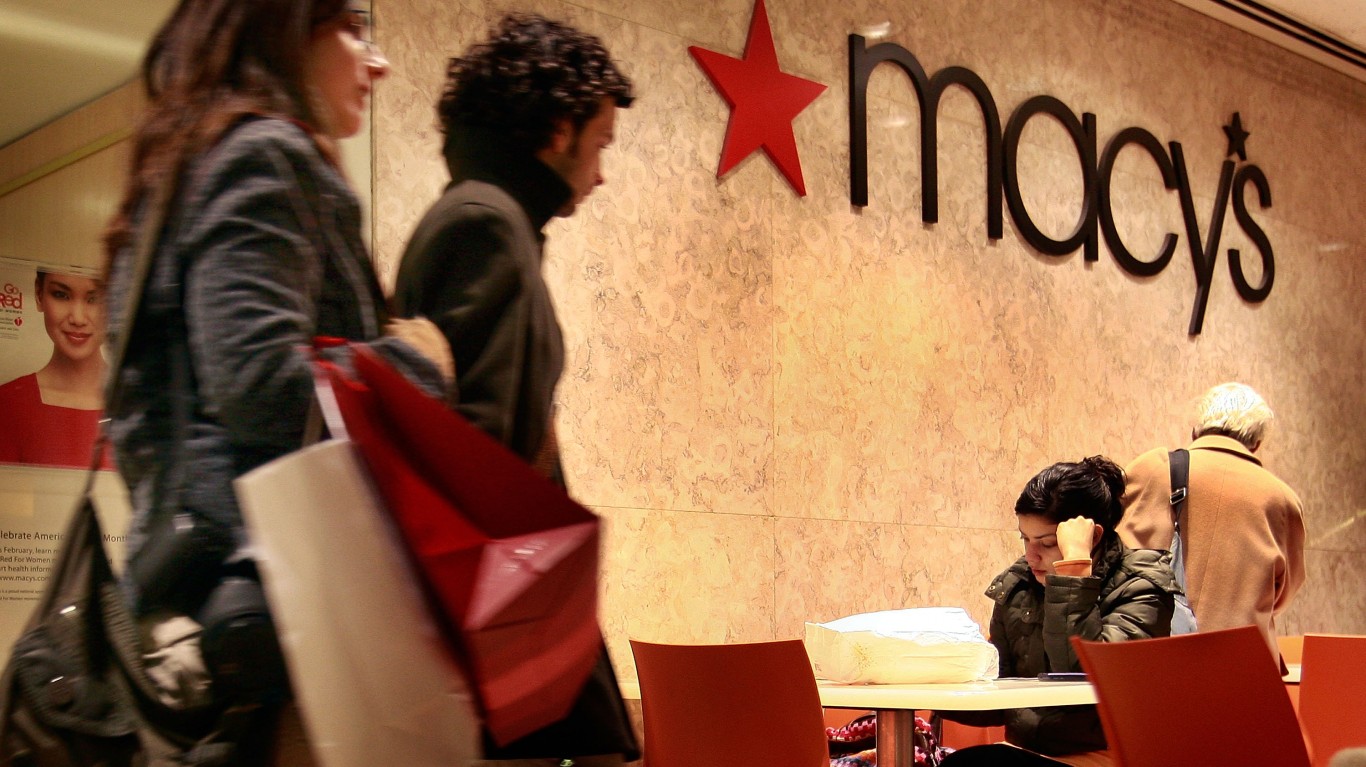
Macy’s (M): Tariff Refunds Made Earnings Look Bigger
Macy’s (NYSE:M) pays $0.1915[3] a quarter, or $0.766 a year. That’s a yield of about 3.21%, and it has been raised every year since 2022. The stock gained 26.51% over the past year, so this yield also rests on the payout itself, with price increases holding it down.
Tariff refunds flattered earnings. Q2 adjusted EPS of $0.63[3] included a $0.23 net tariff benefit. Without it, adjusted EPS would have been $0.40[3]. Macy’s dividend history also shows management will cut under stress. The quarterly payout was $0.3775 through March 2020 and fell to just $0.15 in 2021. Operating cash flow was -$8M in the quarter ending October 2025, while the company paid out $49M in dividends.
On the bullish side, the payout is about 28% of trailing EPS of $2.73. Q2 comps rose 2.7%[3], and Bloomingdale’s climbed 11.3%. The turnaround has to keep working without tariff refunds.
Best Buy (BBY): The Biggest Payout, Covered by the Thinnest Margin
Best Buy (NYSE:BBY) pays $0.96[4] a quarter, or $3.84 a year. That’s about a 3.90% yield at $98.57. It held its payout through 2020 and has raised it every year since. Shares are up 52.76% year to date.
Best Buy has the highest payout ratio in this group: about 64% of trailing EPS of $5.97. Last fiscal year, dividends of $801M took a big share of free cash flow of $1.258 billion. On top of that, the company spent $273M on buybacks. In the quarter ending October 2025, operating cash flow was -$99M while dividends were $199M. International comps fell 1.8%[4], Q2 margins got help from a $34M tariff refund, and a new CEO took over on Nov. 1, 2026.
On the other side, FY27 adjusted EPS guidance was raised to $6.70-$6.90[4] and cash stands at $2.255B. As long as electronics demand holds, the payout looks sustainable.
Wendy’s (WEN): Already Cut Twice, With a Takeover Fight Underway
The trailing yield of 5.92% is the trap. It still counts payments made before the cut. At $8.76, the forward $0.28 payout yields about 3.20%, and shares are down 49.25% over five years.
The quarterly dividend went from $0.25 in 2023 and 2024 to $0.14 in 2025, then to $0.07. U.S. same-restaurant sales fell 5.7% in Q3 after falling 7.0%[5] in Q2. Adjusted EBITDA dropped 17.8%, and the company pulled its 2026 outlook. The balance sheet is stretched: shareholders’ equity is just $124.45M against $4.739B in liabilities.
A Trian-led group offered $7.35 per share in cash. On Nov. 5, the board turned down the bid, saying it “substantially undervalues” the company, and adopted a one-year poison pill. If a deal goes through, shareholders would get cash and the public dividend would end. If the bid fails, the payout rests on a turnaround that cost $11.85M in consulting fees in Q3 alone. One point in Wendy’s favor: Q3 operating cash flow of $79.0M covered $13.4M in dividends.
What Retirees Should Check Before Trusting These Yields
When a dividend gets cut, the share price tends to drop too so that income investors can lose on both. Before relying on any of these payouts, watch three things: comparable sales, results once tariff refunds drop out, and quarterly free cash flow compared with dividends paid. For Wendy’s, also follow how the Trian dispute plays out. A yield by itself isn’t enough to justify a purchase.
Contact [email protected] for any questions or corrections.
Chris Lange is a financial and geopolitical writer with more than a decade of experience covering a myriad of topics. He has published thousands of articles for 24/7 Wall St., with past coverage focused heavily on stocks, IPOs, healthcare, defense, global affairs, and technology.
His work has been quoted, or referenced by a number of outlets including Business Insider, USA Today, Yahoo Finance, MSN, The Motley Fool, and many other publications. A graduate of Southwestern University, he studied business with a focus on investments and has previous experience in banking and startups.
When not reading or writing the news, he is following his passion for Lacrosse, playing chess, or building solar projects with his dad.