AST SpaceMobile Stock: My Price Target Depends on One Important Milestone

This post may contain links from our sponsors and affiliates, and Flywheel Publishing may receive compensation for actions taken through them.

AST SpaceMobile (NASDAQ:ASTS) is building a space-based cellular broadband network that connects directly to standard smartphones. It sells that capacity through carriers instead of to consumers, and its ecosystem spans over 60 mobile network operators representing over 3 billion subscribers.
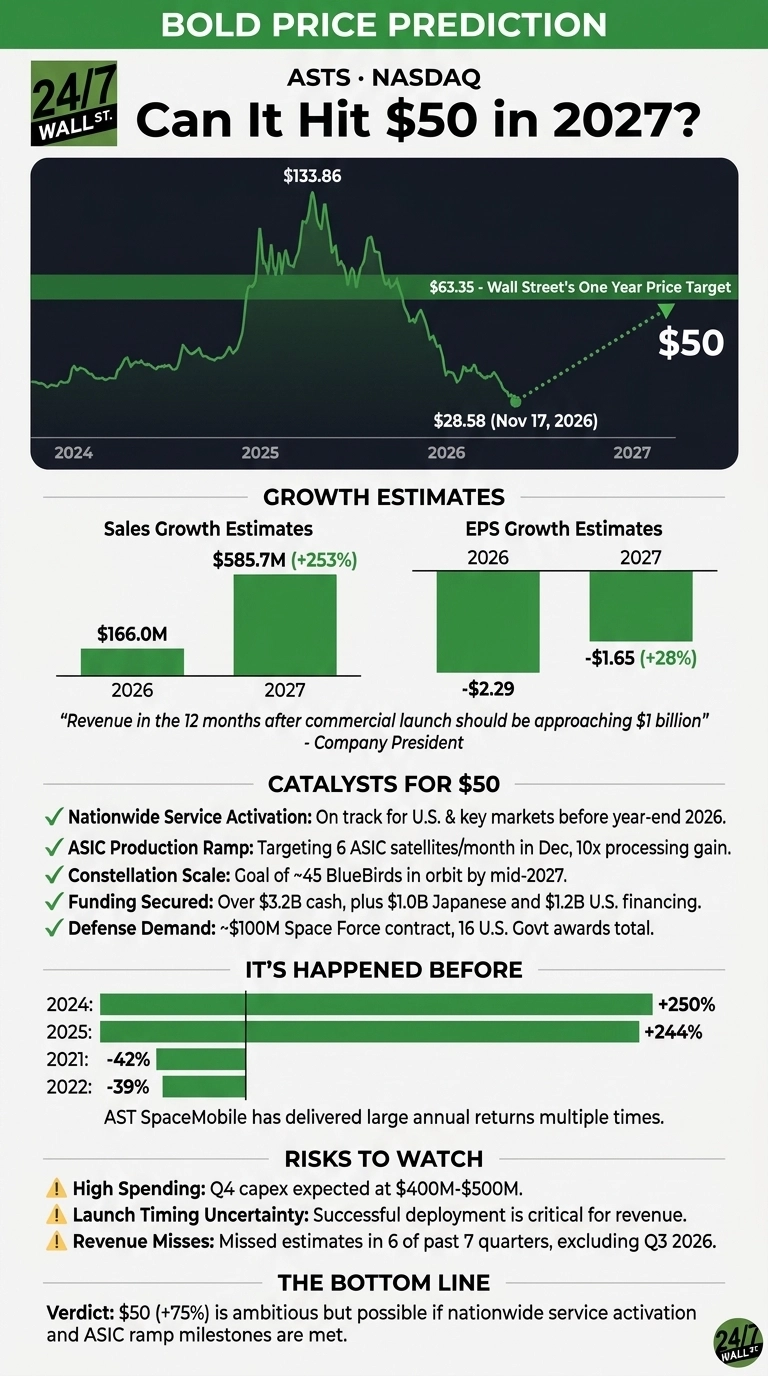
Shareholders have had a difficult 2026. Shares are down 60.65% year-to-date to $28.58, including a 22.53% drop last week. That follows gains of 250% in 2024 and 244% in 2025. Revenue misses and a satellite launch incident drove the selloff. My case for $50 in 2027 depends on one milestone.
Wall Street’s Target Still Implies the Stock Could Double
Analysts’ average price target is $63.35, which works out to roughly 122% upside from here. Their ratings are split: 5 at buy or strong buy, 6 at hold and 2 at sell or strong sell. The growth outlook is steep: consensus revenue rises from $166 million in 2026 to $585.7 million in 2027, and the high estimate reaches $911 million.
Estimates have declined: the 2027 EPS estimate has slid to -$1.6495, versus -$1.0493 90 days earlier. AST SpaceMobile has also missed revenue estimates in six of the past seven quarters. Q3 did bring its first EPS beat in that stretch: -$0.44[1] against -$0.4479 expected.
Here’s What It Takes to Reach $50
AST SpaceMobile has no earnings yet, so sales are the better measure. It currently trades at about 15x 2027 revenue estimates. At $50, its market cap would reach about $15.04 billion, or roughly 26x 2027 sales.
That multiple contracts if management delivers what it promised. The company’s president said revenue in the 12 months after commercial launch should be “approaching $1 billion,”[2] which would put a $50 share price near 15x sales.
What Could Push AST SpaceMobile to $50?
- The milestone: CEO Abel Avellan said, “We’re on track for nationwide intermittent service activation in the United States and other key markets before year-end 2026.”[2] The first markets are the U.S., Canada, Japan, Saudi Arabia and the U.K., with carrier beta trials set for early 2027.
- Proof with carriers: AST and AT&T (NYSE:T | T Price Prediction) demonstrated “the first-ever satellite beam handover between ground-based and space-based cellular broadband networks.”[2]
- ASIC ramp: AST is targeting six ASIC satellites per month[1] in December. The new chip delivers a 10-times[2] gain in processing, which means “a lower cost per gigabyte delivered to an end user.”
- Constellation scale: The goal is about 45 BlueBirds in orbit by mid-2027[1].
- Funding: AST holds over $3.2 billion[2] in cash, with about $1B in Japanese non-dilutive funding and a $1.2B U.S. financing pipeline lined up.
- Defense demand: A roughly $100M[1] Space Force contract brings AST to 16 U.S. Government awards.
AST SpaceMobile Has Delivered Gains Like This Before
Reaching $50 takes a 75% gain. AST cleared that bar in two of its last six full years, with 250% in 2024 and 244% in 2025. It has also had bad years, falling 42% in 2021 and 39% in 2022.
The stock opened 2026 at $72.63 and hit a 52-week high of $133.86, so $50 is well inside its recent range. With a beta of 2.847, big moves work in both directions.
My Verdict on $50 Hinges on Service Activation
Hitting $50 means a 75% gain, which is still below Wall Street’s average target. Spending is the main hurdle. Fourth-quarter capex is expected at $400 million to $500 million[2], and launch timing is still uncertain.
Even so, if nationwide service goes live on schedule and the ASIC ramp holds, investors could value AST as a carrier partner with real revenue. Returns at this level vary widely from year to year, and we’ve outlined the scenario for how AST SpaceMobile could see outsized returns in 2027.
Contact [email protected] for any questions or corrections.
Vandita Jadeja is a financial publisher with over a decade of experience writing about financial topics, including investment, savings, retirement, insurance and banking. Vandita is a Chartered Accountant who loves to debunk financial concepts for readers.
Her work has appeared on sites that include The Motley Fool, InvestorPlace, and Benzinga. She covers investing and focuses on stock picks and price prediction for 24/7 Wall St.
When not looking for the next stock investment opportunity, she can be found traveling, reading, chasing sunsets and enjoying her iced latte.