Fund Managers Are Cutting Tech at the Fastest Pace Since 2006

This post may contain links from our sponsors and affiliates, and Flywheel Publishing may receive compensation for actions taken through them.
Bank of America (NYSE:BAC | BAC Price Prediction) released its November Global Fund Manager Survey on November 17, 2026. It shows the net share of managers overweight technology fell to 12% from 37% in October. That 25-point drop is the largest one-month drop since June 2006.
Tech is still a net overweight, and the survey measures how managers say they are allocated rather than what they traded. Between 169 and 193 managers managing $461 billion to $526 billion answered the global poll from November 6 to November 12.
Stocks fell on the release date. The S&P 500 dropped 1.03% to 7,340.53, its fourth straight lower close, down from 7,619.38 on November 11.
The State Street Technology Select Sector SPDR ETF (NYSEARCA:XLK) closed lower at $163.26. The Invesco QQQ Trust (NASDAQ:QQQ) fell 0.73% to $656.95, and Salesforce (NYSE:CRM) dropped 9.45% to $194.52.
Both funds rose after hours once NVIDIA (NASDAQ:NVDA) reported, with XLK at $166.78 and QQQ at $665.93. After-hours quotes can change before the open.
Managers Are Turning Against AI Spending
Now 52% of managers expect at least one AI hyperscaler to announce a capex cut within six months, up from 30% in October. This forecast remains unconfirmed by any hyperscaler announcement.
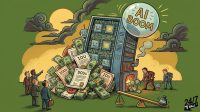
A record net 38% say companies are overinvesting in AI. Only 16% want companies to raise capital spending, the lowest share since May 2020, and managers named an AI bubble as their biggest tail risk.
This matters to fund owners because hyperscaler capex is revenue for chipmakers and the rest of the AI supply chain. When investors push the biggest buyers to spend less, they threaten the sales of the stocks that carry the most weight in XLK and QQQ.
In a separate question, 38% picked AI hyperscaler bonds as the most likely source of a credit event, ahead of private credit at 30%. AI buildouts are increasingly paid for with debt. If bond buyers demand higher yields, the spending that supports chip revenue becomes harder to finance. Stock and bond investors now share the same risk.
Too Little Fear to Signal a Bottom
Average cash holdings are 3.6%, which the bank describes as extremely low. Almost no one expects a recession, and the average forecast for the S&P 500 at the end of 2027 is 7,926.
Bottoms usually come after managers build up cash and turn gloomy, but here they cut tech yet stayed fully invested and optimistic, so they have room to sell more.
Strategist Michael Hartnett’s team reads the results as investors telling companies to pause AI capex. It also signals the AI boom is ending. The team says the survey does not yet show enough fear to be a buy signal, and it remains tactically risk-off. Riding a mania is one problem, knowing when to step aside is another, and we covered both parts in a free bubble survivor’s handbook.
Rates add pressure. The Fed meets December 8-9, and a hike is widely expected, which hurts highly valued growth stocks most.
Index funds hold a lot of this risk.
NVIDIA alone made up 14.65%[1] of XLK and 7.6%[2] of QQQ as of June 30. XLK’s next two holdings were 12.85%[1] and 8.38%.
XLK fell 11.02% over the past month, and QQQ fell 7.45%, although XLK is still up 13.8% for the year.
What Could Change the Outlook for XLK
XLK carries higher risk. Its biggest positions depend on AI spending that managers now want to reduce, and a rate hike would hit those valuations.
The 13.8% year-to-date gain leaves the fund with a buffer if the AI trade weakens further. Because cash is low and recession fear is rare, managers could still sell more.
An equal-weight S&P 500 fund spreads exposure so that no single chip supplier drives results, and companies that use AI to cut costs carry different risks from those building AI infrastructure.
Two events would suggest the pressure is letting up. If the December survey shows cash rising well above 3.6%, or if XLK holds above $163.26 after the December 8-9 Fed meeting, the selling may be done.
Contact [email protected] for any questions or corrections.
Omor Ibne Ehsan is a writer at 24/7 Wall St. He is a self-taught investor with a focus on growth, cyclical, and dividend equities that have strong fundamentals, value, and long-term potential. He also has an interest in high-risk, high-reward investments such as penny stocks.