Inflation Is Running Above 3%. These 3 Passive Income REITs Raise Rents to Keep Up.

This post may contain links from our sponsors and affiliates, and Flywheel Publishing may receive compensation for actions taken through them.
A lease escalator is the clause that lets a landlord raise rent without renegotiating the lease. Some escalators add a fixed bump every year. Others tie the increase to the Consumer Price Index, so the rent check rises when the cost of living does. Leases that expire and roll to market rent do the same job more directly, resetting rent to whatever tenants will pay today.
That matters right now because the latest CPI reading shows consumer prices up 3.7%[1] from a year earlier, and a landlord collecting flat rent loses purchasing power every month. The three NYSE-listed REITs below push rents higher in different ways. Each also covers its dividend with funds from operations (FFO) or adjusted funds from operations (AFFO), the cash-earnings measures that show whether a REIT payout is safe.
Higher Rates Are the Other Side of the Inflation Ledger
Inflation usually comes with higher interest rates, and higher rates work against REITs. The 10-year Treasury yield stood at 5.12%[2] in its latest reading, putting it in the 92.4th percentile over the past year. Higher yields raise the cost of refinancing debt and funding acquisitions. They also give income investors a competing option in bonds, which weighs on REIT valuations. Rent escalators offset part of that drag.
How fast that offset arrives depends on lease length. A long lease with a fixed bump locks in rent and delays any benefit from rising prices. A long lease with a CPI clause passes inflation through on a schedule, usually with a lag. Short leases, and leases that roll over often, reprice fastest. The three names below sit at different points on that spectrum.
W. P. Carey: Rent Linked Directly to Inflation
W. P. Carey (NYSE: WPC) owns 1,755 single-tenant net-lease properties, meaning tenants cover most property costs. Measured by annualized base rent (ABR), the mix is 39% industrial, 25% warehouse, 22% retail, and 14% other. Europe accounts for 33% of ABR.
W. P. Carey leads this list because of how its leases are written. CPI escalators cover 47.8% of ABR, and over 99% of ABR carries contractual rent increases. Leases are long, with a 12.0-year weighted-average term, so the escalators do the work that frequent re-leasing does elsewhere. Contractual same-store rent growth was 2.6%[3] year over year on a constant-currency basis, and occupancy stood at 98.6%. On the third-quarter earnings call, CFO Toni Ann Sanzone said, “With nearly half of our rent coming from leases tied to CPI, we expect inflation to remain a tailwind to contractual same-store rent growth, trending slightly higher over the next few quarters and remaining in the mid- to high-2% range throughout next year.”[4]
The stock yields 5.66% at $65.64, which puts it in high-yield territory. Third-quarter AFFO of $1.33[3] per share covered the $0.950 quarterly dividend, a payout of 71.4% of AFFO. Management put the payout ratio at 71%[4]. Full-year AFFO guidance of $5.23 to $5.29[3] per share compares with an annualized dividend of $3.80. The balance sheet is conservative: 95%[5] of debt is fixed-rate at a 3.2% weighted-average rate, net debt runs 5.5x adjusted EBITDA, and the unsecured debt carries investment-grade ratings of Baa1/BBB+. Each of the last five quarterly declarations came in 4.0% to 4.5% above the year-earlier payout.
For an income investor, the appeal is growth from within the portfolio. Management expects AFFO per share growth to “approach 6% this year,”[3] and CEO Jason Fox called the rent bumps “a hedge against rising inflation”[4] that leaves the company “less dependent overall on transaction market conditions to drive earnings growth.”
The catch is refinancing. W. P. Carey issued 5.200% senior notes due 2036 to replace maturing 4.250% notes, and management expects interest expense to keep rising into next year as higher rates flow through.
Federal Realty: Shopping Center Rents That Reprice Fast
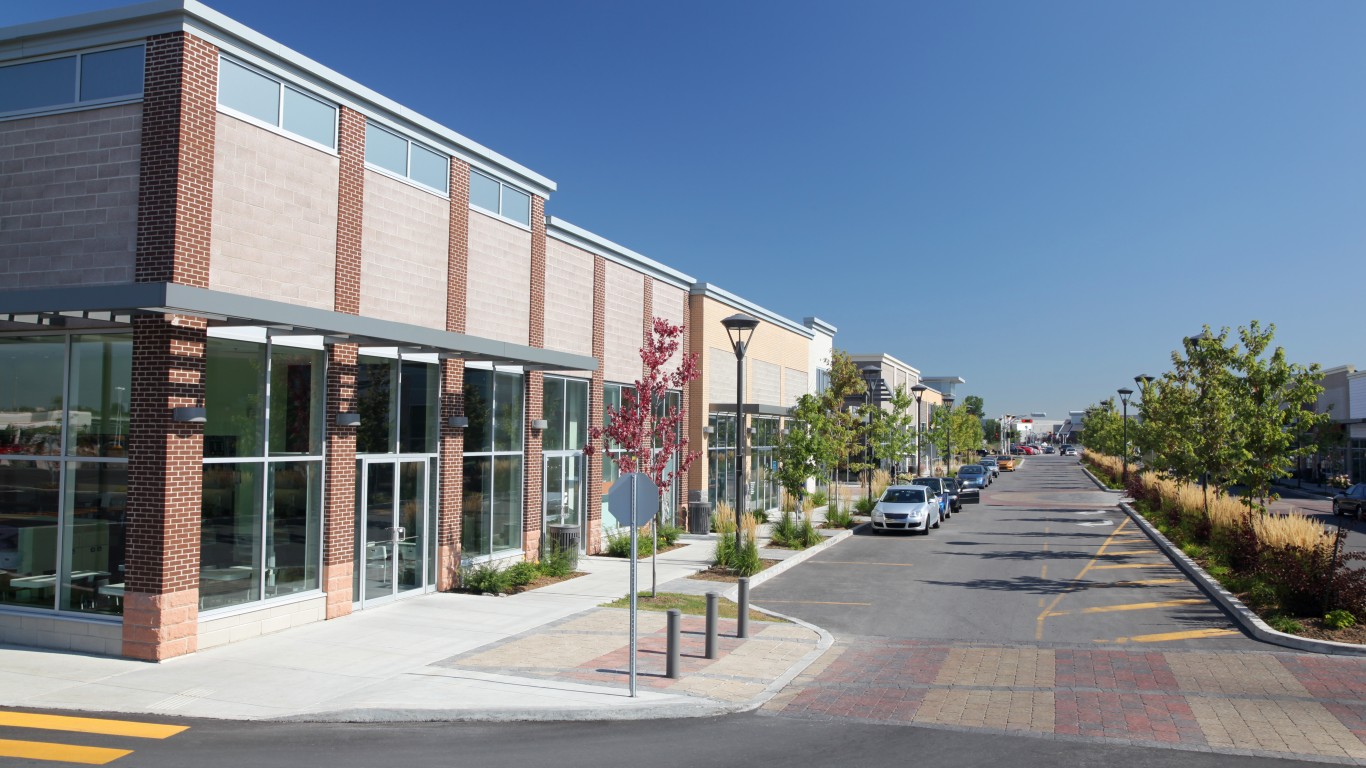
Federal Realty (NYSE: FRT) owns 102 open-air shopping centers and mixed-use properties, mostly in major coastal markets. It has about 3,700 tenants in 28.8 million commercial square feet, plus about 2,700 residential units.
Federal Realty keeps up with inflation through repricing. Shop space turns over far more often than a 12-year net lease, and Federal Realty has been sharply increasing rents each time. In the third quarter, it signed 117 comparable leases at 14% higher cash rent. Comparable average rent came to $40.01 per square foot, compared with $35.07 under the prior leases. The leased rate reached 96.5%, which management called the highest since 2007[6]. The pipeline holds more than 130[6] deals covering about 1.3 million square feet, and management expects double-digit rollover on those leases. CEO Donald Wood said, “On the retailer side, demand remains strong, new supply remains limited, and that supports our pricing power and future growth.”[6]
The stock yields 3.99% at $112.62. It has the strongest coverage of the three: the $1.16 quarterly dividend used 62.0% of third-quarter Core FFO of $1.87 per share. Full-year Core FFO guidance of $7.54 to $7.58 compares with an indicated annual dividend of $4.64. The latest 3%[7] raise marked 59 straight years of annual dividend increases, the longest record in the REIT sector, which makes Federal Realty a Dividend King. The company upsized its revolver to $1.4 billion[7] and issued $460 million of 3.50% convertible notes due 2031. It also bought back 869,748 shares at $108.82.
For income investors, the draw is a well-covered payout that keeps growing. Federal Realty bought The Summit in Birmingham for $508 million. About 30%[6] of that center’s leases roll over in the next five years, and management expects mark-to-market spreads “in the mid- to high-teen range.” That rent growth shows up at renewal, without waiting on an escalator.
The tradeoff is a smaller starting check. Shares have risen 22.34% over the past year, leaving Federal Realty with the lowest yield in this group, so more of the return depends on continued rent gains.
Realty Income: Monthly Income With a Slower Escalator
Realty Income (NYSE: O) owns or holds interests in 15,536 properties leased to 1,842 clients in 96 industries. The portfolio covers retail, industrial and data center properties in all 50 U.S. states, the U.K. and eight other European countries.
Of the three, Realty Income has the leases that respond least to inflation. Its weighted average remaining lease term is about 8.5 years, and CEO Sumit Roy put annual bumps in its traditional U.S. retail business at “circa 1%.”[8] Same-store rental revenue rose 1.1%. The mix is changing. Third-quarter property acquisitions carried weighted average annual rent increases of 1.9%[8], and Roy said international industrial leases are “largely tied to inflation and market rent growth.” When space turns over, Realty Income has re-leased at a 103.5% rent recapture rate.
The stock yields 5.29% at $57.60, which is considered high yield. Third-quarter AFFO of $1.12 per share covered $0.813 in monthly dividends paid during the quarter, a payout of 72.6% of AFFO. Full-year AFFO guidance of $4.45 to $4.46 compares with an annualized dividend of $3.258. The company holds an ‘A’ rating from Fitch with a Stable Outlook, and company-reported net debt stood at 5.4x annualized pro forma adjusted EBITDA as of the second quarter. The dividend record is long and verified: 116 straight quarterly increases, 136 increases since its 1994 NYSE listing, and 676 straight monthly dividends declared. Realty Income is a member of the S&P 500 Dividend Aristocrats index.
Monthly checks are the main appeal for retired people who budget month to month, and management is adding a hedge against rates. Roy said higher-yielding credit investments “can also serve as a natural hedge to the higher financing costs we incur in a higher rate environment.”[8] A Dallas logistics park it acquired has in-place rents about 45% below market, so rents there can reset higher as those leases roll.
Rates hit hardest here. Third-quarter interest expense rose to $333.6 million from $294.5 million, and with modest escalators, rent growth does less to absorb that cost.
Matching Each REIT to a Retirement Paycheck
These three REITs suit investors at or near retirement who want income that rises with prices and who can sit through rate-driven swings in share prices. W. P. Carey has the most direct link to CPI. Federal Realty has the fastest-repricing rents and the longest dividend-raise streak in the REIT sector. Realty Income sends a check every month and has raised it every quarter for 116 straight quarters. Together, they cover all three ways a landlord keeps pace with inflation: indexed escalators, rents marked to market, and a dividend that keeps growing.
Contact [email protected] for any questions or corrections.
Lee Jackson has covered Wall Street analysts' equity and debt research and equity strategy daily for 24/7 Wall St. since 2012. His broad, diverse career, including a stint as creative services director at an NBC affiliate in Austin, Texas, gives him unique insight into the financial industry.
Lee Jackson's journey in the financial industry spans more than 30 years, including nearly two decades as an institutional equity salesperson at Bear Stearns, Lehman Brothers, and Morgan Stanley. His career spanned pivotal sell-side Wall Street events, from the dot-com rise and bubble to the Long-Term Capital Management debacle, 9/11, and the Great Recession of 2008. This reflects his resilience and adaptability amid market volatility.
Lee Jackson’s practical financial industry experience, gained through a career at some of the biggest banks and brokerage firms, is complemented by a lifetime of writing across various platforms. This unique combination allows him to shed light on the intricacies of Wall Street in a way only someone with deep insider experience and knowledge can. Moreover, his extensive network across Wall Street continues to provide direct access for him and 24/7 Wall St., a privilege few firms enjoy.
Since 2012, Jackson’s work for 24/7 Wall St. has been featured in Barron’s, Yahoo Finance, MarketWatch, Business Insider, TradingView, Real Money, The Street, Seeking Alpha, Benzinga, and other media outlets. He attended the prestigious Cranbrook Schools in Bloomfield Hills, Michigan, and has a degree in broadcasting from the Specs Howard School of Media Arts.