IonQ Drops 5%, Extending Losing Streak on Dilution Worries After $2 Billion Stock Sale; D-Wave Slides 3%, Rigetti Dips

This post may contain links from our sponsors and affiliates, and Flywheel Publishing may receive compensation for actions taken through them.

Shareholders are evidently weighing dilution concerns at IonQ (NYSE:IONQ | IONQ Price Prediction), even as the quantum computing company posts record growth. IonQ trades at $23.59, down 5% in midday trading. The decline extends a losing streak that ran six straight trading days through the November 17 close[1].
IonQ stock fell 30%[1] across that six-session stretch, and its November 17 close of $24.84 marked a one-year low. Pure-play quantum peers are lower alongside IonQ, though by smaller margins. New York Fed President John Williams said on November 17 that surging AI investment could argue for more rate hikes next year, a drag for speculative growth stocks.
How IonQ’s Stock Sale Fed Dilution Worries
IonQ closed a $2 billion equity offering on October 16, lifting its pro forma cash position to $3.7 billion[2]. On November 4, the company completed its acquisition of cybersecurity firm Elisity, paying $1.15 billion[2] in stock plus an earnout of up to $150 million. Both moves expand IonQ’s share count, which now stands at 464,696,000, and that’s the math weighing on the stock as the selling stretches on.
Management framed the raise as long-term funding. During IonQ’s November 5[3] earnings call, CFO and COO Inder Singh spoke. He said, “It is for long-term capital, not for any particular need.”[3] Singh added that the offering was done at a premium to the share price.
IonQ’s Growth Story Still Runs Hot
IonQ’s Q3 2026 revenue reached $173.83 million[2], up 336% year over year and ahead of the $141.2 million consensus estimate. Executives lifted full-year 2026 revenue guidance to $505 million[4] to $515 million. Remaining performance obligations at IonQ, a measure of contracted backlog, more than doubled to $1.2 billion[2].

Acquisitions supplied a meaningful share of that growth. SkyWater Technology, which IonQ acquired on July 31, contributed $83.5 million[2] through the SkyWater Foundry Services segment, while the IonQ Platform segment grew 127% to $90.3 million. That mix makes IonQ’s organic growth harder to judge.
Profitability remains further off for IonQ. Under generally accepted accounting principles (GAAP), the company booked Q3 net income of $563.96 million[2], but a non-cash $896.16 million warrant liability gain drove that result. On an operating basis, the quarter looked weaker, as IonQ’s adjusted earnings before interest, taxes, depreciation and amortization (EBITDA) loss grew to $133.61 million[2] from $48.91 million a year earlier.

What the Peer Group Says About IonQ
D-Wave Quantum (NYSE:QBTS) stock is at $7.85, down 3%. That’s a softer decline than IonQ’s. D-Wave sits in an unusual spot as both a competitor and a SkyWater foundry customer under an extended multi-year manufacturing agreement with IonQ.
Meanwhile, Rigetti Computing (NASDAQ:RGTI) stock is at $8.39, down 0.8%. Of the featured trio, Rigetti is holding up best, posting a fraction of IonQ’s decline. Quantum Computing Inc. (NASDAQ:QUBT) is another pure-play peer; QUBT stock is down 1% to $5.07.
How IonQ’s Business Model Differs From D-Wave and Rigetti
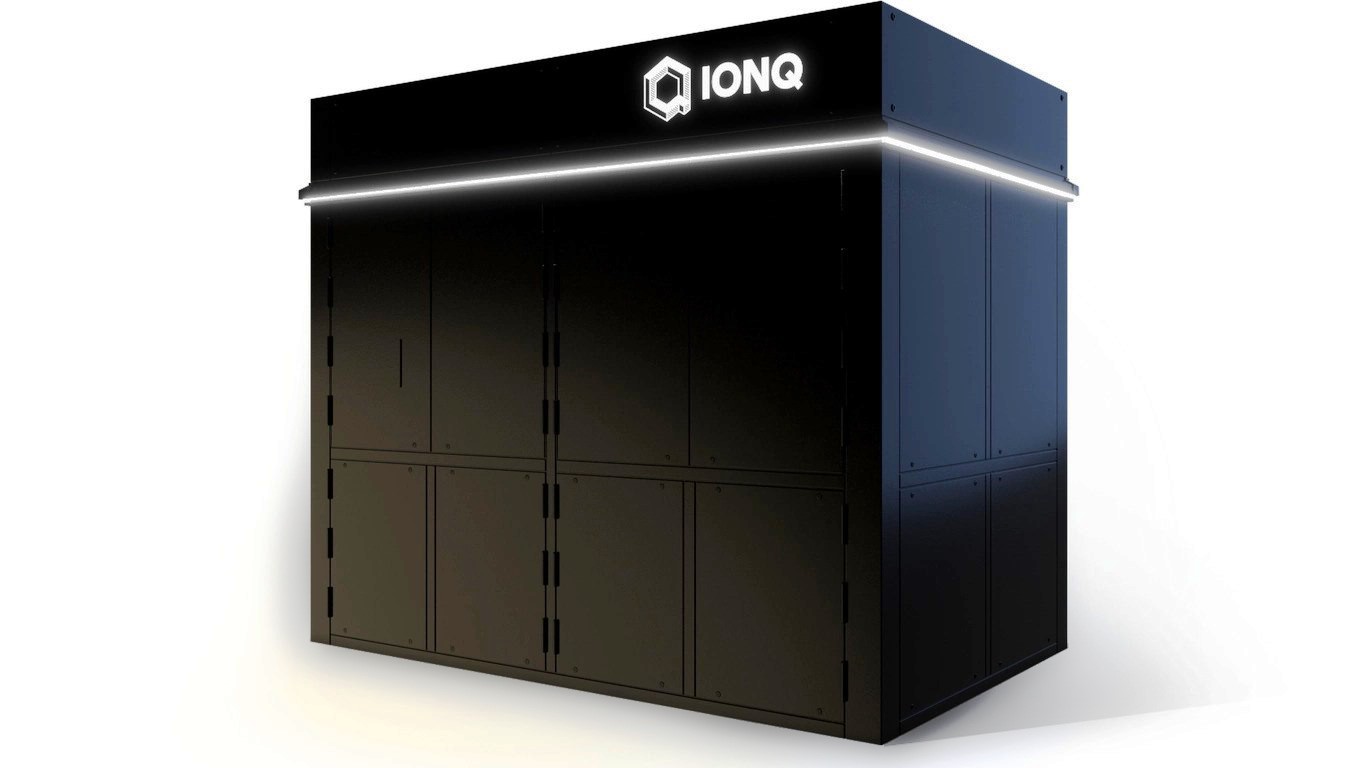
IonQ runs a vertically integrated trapped-ion platform, selling its Tempo and Superion systems while its SkyWater foundry manufactures chips for IonQ and outside customers. Elisity and Nexus Photonics push that portfolio into Zero Trust security and integrated photonics, giving IonQ revenue streams beyond quantum computers.
D-Wave centers its commercial business on annealing systems built for optimization problems, with gate-model machines further out on its roadmap, while superconducting gate-model computers are Rigetti’s focus, with chips fabricated in-house and revenue from system sales, cloud access and government research contracts. Photonics anchors Quantum Computing Inc.’s approach, which is designed to run at room temperature.
IonQ’s Growth Engine Faces a Dilution Test
IonQ’s next test is whether the cash from its offering turns into revenue and margin gains fast enough to justify the larger share count. The bulls can point to sold-out 2027[3] capacity for Superion systems and IonQ’s advance to Stage C of the Defense Advanced Research Projects Agency (DARPA) Quantum Benchmarking Initiative, a program worth up to $300 million. The bears can cite a $433.1 million Q3 loss from operations and a track record of stock-funded deals.
Rising rate expectations add another variable for IonQ. Speculative growth names often struggle when borrowing costs climb (we spelled out the sizing and exit rules for keeping speculative names like this one from hurting a portfolio in a free guide here: Small Stakes, Big Swings). The dilution debate around IonQ could create pressure on the stock until it settles.
Contact [email protected] for any questions or corrections.
David Moadel is financial writer specializing in stocks, ETFs, options, precious metals, and Bitcoin. David has written well over 1,000 articles for leading online publications, helping investors understand markets, income strategies, and risk. His work has appeared in 24/7 Wall St., The Motley Fool, InvestorPlace, U.S. News & World Report, TipRanks, ValueWalk, Benzinga, Market Realist, MarketScreener, TalkMarkets, Finmasters, and others. With a master’s degree in education, David has taught at the elementary, high school, and college levels. That teaching background shapes his writing style: clear, educational, and practical. David has also built a loyal social-media audience by providing trustworthy financial content on YouTube, X/Twitter, and StockTwits.