$1,000 Invested in Eli Lilly 10 Years Ago Would Be Worth a Fortune Today

This post may contain links from our sponsors and affiliates, and Flywheel Publishing may receive compensation for actions taken through them.
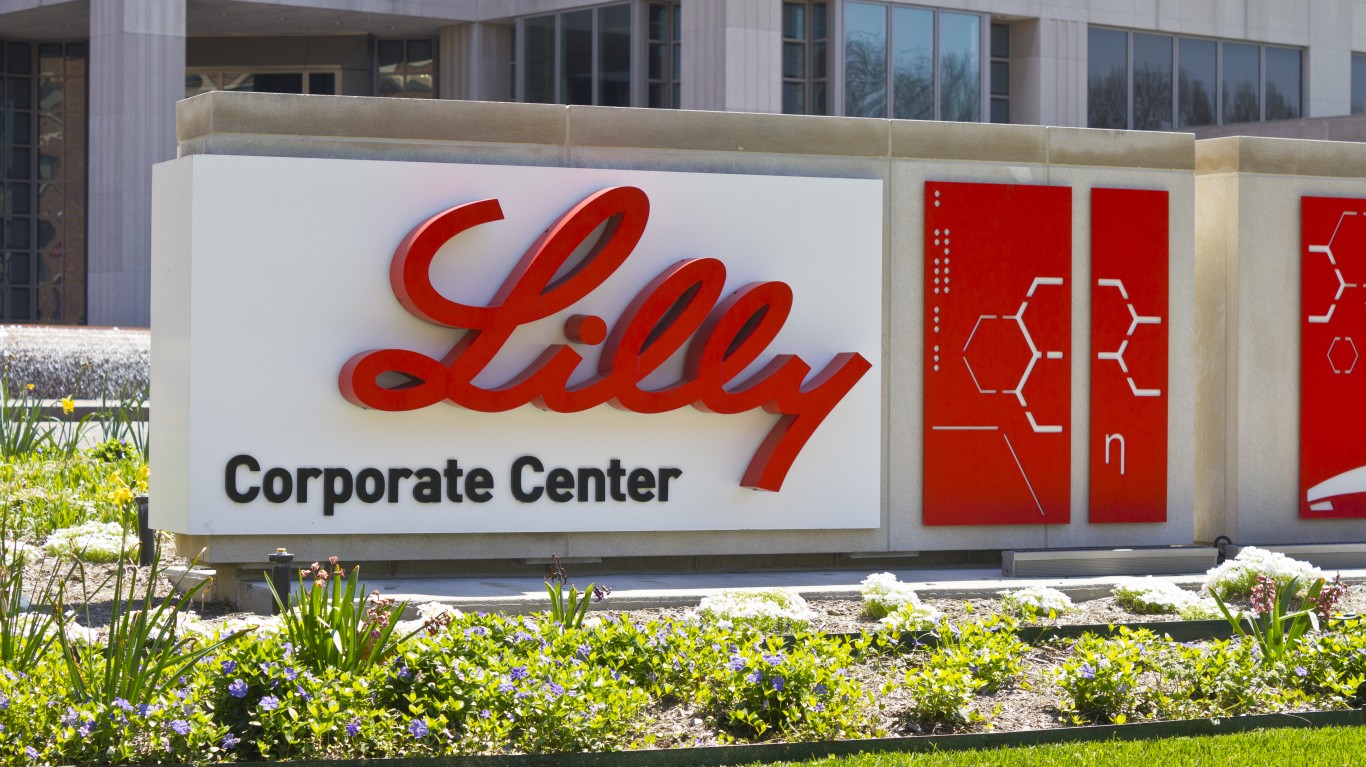
Ten years ago, Eli Lilly (NYSE:LLY | LLY Price Prediction) was a diversified drugmaker with a promising diabetes shot. Today it has a $1.204 trillion market cap. One molecule connects those two companies: tirzepatide.

How Trulicity Led to the Tirzepatide Machine
Lilly’s incretin run started with Trulicity, a GLP-1 diabetes drug approved in 2014. That franchise paid for a bigger move. The FDA approved Mounjaro (tirzepatide) for type 2 diabetes in 2022, then cleared the same drug as Zepbound for obesity in 2023. Demand ran ahead of supply, so Lilly put money into U.S. plants, including a $6.5 billion[1] Houston facility and a $5 billion site in Richmond.
The latest quarter shows how far that went. Third-quarter revenue hit $24.40 billion[2], up 38.6%, with Mounjaro at $10.72B and Zepbound at $5.35B. Lilly drugs account for about 6 out of 10[1] U.S. incretin prescriptions, ahead of rival Novo Nordisk (NYSE:NVO). Lilly also has Kisunla, an Alzheimer’s drug approved in 2024, and Foundayo, an oral GLP-1 pill, approved in 2026.

Your $1,000 Became More Than $20,500
Lilly’s figures use adjusted prices, which account for dividends and approximate reinvestment. The stock had no splits in this period. The S&P 500 figures are price-only.
1-Year Return
- Initial Investment: $1,000
- Current Value: $1,320.40
- Total Return: 32.04%
- S&P 500 (same period): $1,103.40 (10.34%)
5-Year Return
- Initial Investment: $1,000
- Current Value: $5,414.30
- Total Return: 441.43%
- Annualized Return: 40.19%
- S&P 500 (same period): $1,553.30 (55.33%)
10-Year Return
- Initial Investment: $1,000
- Current Value: $20,510.80
- Total Return: 1,951.08%
- Annualized Return: 35.27%
- S&P 500 (same period): $3,333.40 (233.34%)
Lilly beat the index over all three periods, and the gap grew with time. The big gains followed Mounjaro’s approval, which explains why the five-year return eclipses the decade. Nobody buying in 2016 could have known that a weight-loss blockbuster was coming. Holding still took patience: shares were $1,101.57 when Lilly reported fourth-quarter results in February and $855.49 by its April report, even as quarterly revenue jumped 55.5%[3].
A Great Business at a Full Price
I’d put $1,000 into Eli Lilly today if volume keeps growing faster than prices fall. But I’d avoid it if price cuts and competition shrink margins before the pipeline matures.
On the bullish side: The CFO says U.S. treatment reaches “two patients out of 100 patients”[1]. Lilly raised 2026 guidance to $91-$92B[2] in revenue and $35.00-$36.00 in non-GAAP EPS, and it plans to file for approval of retatrutide in Q1 2027.

On the bearish side: Realized tirzepatide prices fell 15%[2] last quarter, and about $2 billion[1] of one-time items in 2026 revenue won’t repeat. Two drugs brought in more than $16 billion[1] of the quarter’s sales. At $1,351.93, the stock trades at about 38x to 39x guided earnings.
I lean bullish, but only slightly. Lilly is performing better than any large drugmaker I follow. At this multiple, though, Foundayo and retatrutide have to work. I would keep an eye on actual pricing each quarter.
Contact [email protected] for any questions or corrections.
Chris Lange is a financial and geopolitical writer with more than a decade of experience covering a myriad of topics. He has published thousands of articles for 24/7 Wall St., with past coverage focused heavily on stocks, IPOs, healthcare, defense, global affairs, and technology.
His work has been quoted, or referenced by a number of outlets including Business Insider, USA Today, Yahoo Finance, MSN, The Motley Fool, and many other publications. A graduate of Southwestern University, he studied business with a focus on investments and has previous experience in banking and startups.
When not reading or writing the news, he is following his passion for Lacrosse, playing chess, or building solar projects with his dad.