Despite Oracle Falling 40% Year-to-Date This Wall Street Analyst Predicts 250% Returns Within a Year

This post may contain links from our sponsors and affiliates, and Flywheel Publishing may receive compensation for actions taken through them.
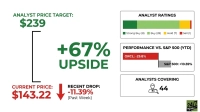
Oracle (NYSE:ORCL | ORCL Price Prediction) currently trades at $113.89, compared with Wall Street’s average price target of $236.18. That gap implies about 107% upside.
Oracle has rebuilt itself around AI cloud infrastructure. Cloud now makes up 60%[1] of revenue, and its RPO (signed future revenue) reached $664 billion. Guggenheim analyst John DiFucci holds the Street-high $400 target, roughly 251% above the current price.
The business keeps speeding up while the stock keeps dropping. One of those trends will eventually give way.
Microsoft’s Pullback and Heavy Cash Burn Sent Oracle Down 40%
The newest blow came when Microsoft (NASDAQ:MSFT) moved to wind down an arrangement to rent AI computing from Oracle as part of a broader review of billions of dollars in cloud partnerships. Reports of slower-than-expected OpenAI revenue growth added pressure on Oracle shares. The stock is down 40.79% year to date, a sharp selloff well beyond 30%, including an 11.29% drop in the past week alone.
Cash is the deeper worry. Last quarter’s capex of $28.50 billion[1] left free cash flow at -$5.40 billion. Interest expense rose 55% to $1.4 billion[2], and Oracle plans to raise roughly $40 billion[3] this fiscal year through debt and equity. Legacy software revenue fell 3%[2].
Guggenheim Sees $400 as the Backlog Turns Into Revenue
Wall Street remains firmly bullish. Of 43 analysts, 7 rate it Strong Buy, 28 Buy, 7 Hold and 1 Sell. DiFucci called Oracle his firm’s “best idea”[4] on the latest earnings call, and his 12-month thesis centers on backlog conversion. Management expects around half of RPO to convert into sales over the next 36 months[4].
GPU utilization hit 97.9%[4], and renewing capacity was re-signed or resold at a 20% premium. Multicloud database revenue grew 353%[4], embedding Oracle’s database inside rival clouds. Oracle also booked more than $30 billion[1] in new AI contracts that management says require no additional Oracle capital.
Oracle guides for fiscal 2027 revenue of at least $90 billion[1] and non-GAAP EPS of $8.10. Next quarter calls for revenue growth of 30% to 34%[4] and cloud growth of 65% to 71%.
Mizuho once carried a $400 target and later cut it, leaving Guggenheim alone at the top. Management also gave no specific timeframe[4] for positive free cash flow. Still, one analyst this week argued the stock looks cheap even in the most gloomy scenarios.
Oracle Fell Alone While Microsoft and Amazon Climbed
Oracle sold off by itself. Its hyperscaler rivals are higher this year.
Microsoft is up 5.77% year to date despite a 4.73% slide over the past month. At $508.29 against a $636.12 target, implied upside is about 25%. Analysts count 12 Strong Buy, 41 Buy, 5 Hold and zero Sell ratings, though its implied upside is far smaller than Oracle’s.
Amazon (NASDAQ:AMZN) has gained 16% year to date as AWS grew 39%. Shares at $267.74 sit below a $326.09 target, implying about 22% upside, with 16 Strong Buy, 43 Buy and 2 Hold ratings.
Oracle carries the group’s largest implied upside by a wide margin. Targets are estimates, though, and that spread reflects either a pricing error or a risk premium on leverage its cash-rich peers avoid.
Oracle Sits Near Its 52-Week Low at About 15x Forward Earnings
Oracle currently trades at $113.89, close to its 52-week low of $109.21 and far from its $248.46 high. The $236.18 consensus from 43 analysts implies about 107% upside.
The stock is down 40.79% year to date and 47.66% over the past year. The S&P 500 is up 7.09% year to date and 10.63% over twelve months. Oracle trades around 15x forward earnings, versus roughly 26x for Microsoft.
Oracle’s Backlog Justifies a Measured Look Despite the Debt
The optimistic view holds if the backlog keeps converting on schedule, cloud growth lands inside guidance and the new prepaid contracts slow the cash drain. That path, plus a warming in AI infrastructure multiples, is how the stock closes in on consensus.
Concerns mount if Microsoft’s retreat signals broader customer review. Concentrated AI contracts, rising interest costs and repeated capital raises could turn the RPO into a liability long before it becomes cash.
I lean bullish. At about 15x forward earnings, the market prices in a lot of failure. Guggenheim’s $400 needs nearly perfect execution, so I treat the consensus target as the more realistic marker and keep an eye on the stock around the next earnings report.
Contact [email protected] for any questions or corrections.
Alex Sirois is a financial writer with experience spanning both retail and institutional investing. He has written for InvestorPlace and held roles at BNY Mellon and Bernstein, giving him a perspective that bridges Main Street portfolios and Wall Street analysis.
Alex holds an MBA from George Washington University and has built his career across multiple industries, including e-commerce, education, and translation — a breadth of experience that informs how he breaks down complex financial topics for everyday investors. His writing is conversational, actionable, and grounded in long-term, buy-and-hold investing principles.
At 247 Wall St., Alex focuses on delivering analysis that is both accessible and useful, with a clear emphasis on helping readers make more informed decisions with their money.