Oracle Has a Growth Opportunity That Goes Beyond Its Cloud Business

This post may contain links from our sponsors and affiliates, and Flywheel Publishing may receive compensation for actions taken through them.
The 24/7 Wall St. price target for Oracle (NYSE:ORCL | ORCL Price Prediction) is $191.42. That implies 60.73% upside from the latest close of $119.09. The stock earns a buy rating with high confidence.
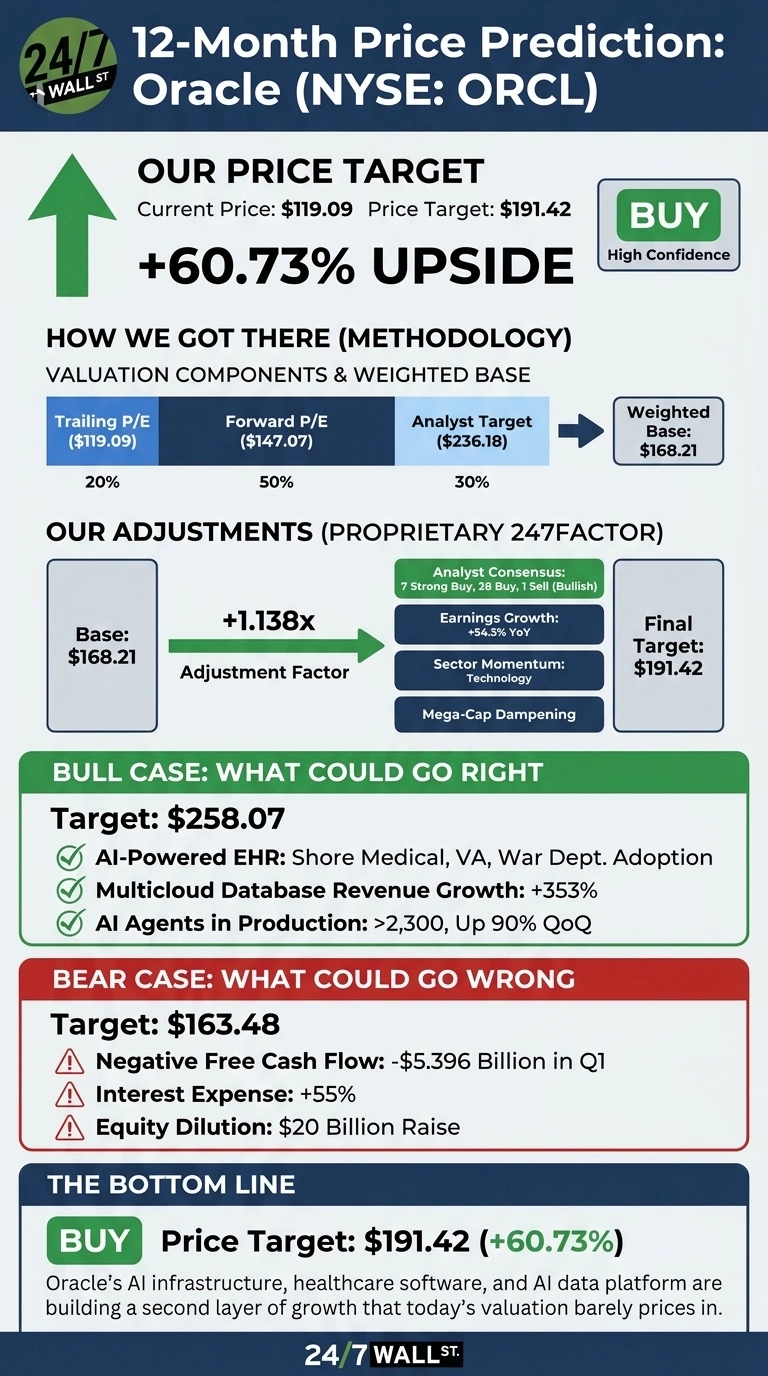
24/7 Wall St. Price Target Summary
| Metric | Value |
|---|---|
| Current Price | $119.09 |
| Price Target from 24/7 Wall St. | $191.42 |
| Upside/Downside | 60.73% |
| Recommendation | BUY |
| Confidence Level | 90% |

Oracle’s AI infrastructure business gets most of the attention. Healthcare software, the AI Data Platform and multicloud database revenue are building a second layer of growth that today’s valuation barely prices in.
Shares Down 38.58% in 2026 While Guidance Keeps Rising
Oracle shares are down 1.38% over the past week, 7.87% over the past month and 38.58% year to date. The stock sits 52.07% below its 52-week high of $248.46 and only 9.05% above its $109.21 low.
Funding worries explain much of the drop. Oracle priced $20 billion of common stock and senior notes[1] on November 3, shortly after completing a separate $20 billion[2] at-the-market equity program.
The business results tell a stronger story. Fiscal Q1 2027 non-GAAP EPS of $1.92[2] beat the $1.7391 consensus. Revenue rose 29.61%[2] to $19.345 billion, ahead of the $19.129 billion estimate. Remaining performance obligations (contracted revenue not yet recognized) reached $664 billion[2]. Management also raised full-year guidance to at least $90 billion[2] in revenue and $8.10 in non-GAAP EPS.

Healthcare and Enterprise AI Could Push Oracle Toward $258
The bull case of $258.07 assumes Oracle earns AI revenue well beyond renting out GPU capacity. Management expects Oracle Health to grow at a double-digit[3] rate in fiscal 2027, driven by its new AI-based Cerner system. Shore Medical Center chose Oracle Health’s AI-powered EHR (electronic health record) on November 16[1].
On November 13[1], the Department of Veterans Affairs and the Department of War went live on the Oracle Health Information Network. Management said healthcare go-lives that once took “high double-digit months”[4] now take single-digit months.
The AI Data Platform gives Oracle another way to grow. On the September earnings call, CEO Michael Sicilia said it is “agnostic and able to pull in and automate the ontologies from any data source.”[4]
Multicloud database revenue grew 353%. Customers ran more than 2,300[4] AI agents in production, up 90% from the prior quarter. Wall Street’s consensus target of $236.18 is close to our bull case.

Capital Intensity Remains Oracle’s Biggest Risk
The bear case of $163.48 still sits above today’s price, which shows how much pessimism is already in the stock. Free cash flow was -$5.396 billion[2] in Q1. Interest expense rose 55%[2], and software revenue fell 3%. Repeated equity raises also dilute existing shareholders.
There are counterpoints. Management says many new contracts rely on prepayments or customer-supplied hardware and need no extra Oracle capital.
CFO Hilary Maxson expects projects to reach free cash flow conversion of “something like 100% of post-tax EBITDA”[4] once they ramp up. The software decline partly reflects customers moving to the cloud, which now makes up 60%[2] of revenue.
Oracle Trades at a Steep Discount to Microsoft and Amazon
Microsoft (NASDAQ:MSFT) is Oracle’s most direct competitor in hyperscale cloud and enterprise AI. Azure grew 48% last quarter, and Microsoft trades at roughly 29x earnings. Oracle’s infrastructure business is growing faster at a lower multiple.
Amazon (NASDAQ:AMZN) is the AWS comparison. AWS grew 39%, yet Amazon carries trailing free cash outflow of $42.4 billion. Greatest capital spending is the norm across the industry, so Oracle’s spending alone does not explain its discount.
| Company | Trailing P/E | Cloud Growth (Latest Quarter) |
|---|---|---|
| Oracle | 19 | 121%[2] (OCI) |
| Microsoft | 29 | 48% (Azure) |
| Amazon | 36 | 39% (AWS) |
Against these peers, the 24/7 Wall St. price target looks reasonable and arguably conservative.
Oracle’s Discount Looks Too Steep to Ignore
The 24/7 Wall St. price target is $191.42, with a buy rating and 90% confidence. Valuation is the deciding factor. The stock trades at a forward P/E of 15 while its growth rate keeps improving.
I would view the case as stronger if Oracle shows a clear path to positive free cash flow and Oracle Health turns its AI-powered EHR deals into revenue. I would grow more cautious if another equity raise comes before contracted revenue starts converting faster. The next checkpoint is the earnings report on December 14, 2026[4].
The model projects where Oracle could trade in the coming years if current growth trends and market conditions hold:
| Year | Price Target from 24/7 Wall St. |
|---|---|
| 2026 | $191.42 |
| 2027 | $190.92 |
| 2028 | $262.98 |
| 2029 | $329.26 |
| 2030 | $392.51 |
The projections rest on Oracle continuing to execute its current strategy. The result could land well above or below these figures depending on how quickly Oracle’s $664 billion[2] backlog turns into revenue and whether its funding needs ease.
Contact [email protected] for any questions or corrections.
Vandita Jadeja is a financial publisher with over a decade of experience writing about financial topics, including investment, savings, retirement, insurance and banking. Vandita is a Chartered Accountant who loves to debunk financial concepts for readers.
Her work has appeared on sites that include The Motley Fool, InvestorPlace, and Benzinga. She covers investing and focuses on stock picks and price prediction for 24/7 Wall St.
When not looking for the next stock investment opportunity, she can be found traveling, reading, chasing sunsets and enjoying her iced latte.