Oil Is Taking the Long Way Around, and $90,000 Across These 3 Tanker Stocks Pays More Than $10,000 a Year

This post may contain links from our sponsors and affiliates, and Flywheel Publishing may receive compensation for actions taken through them.
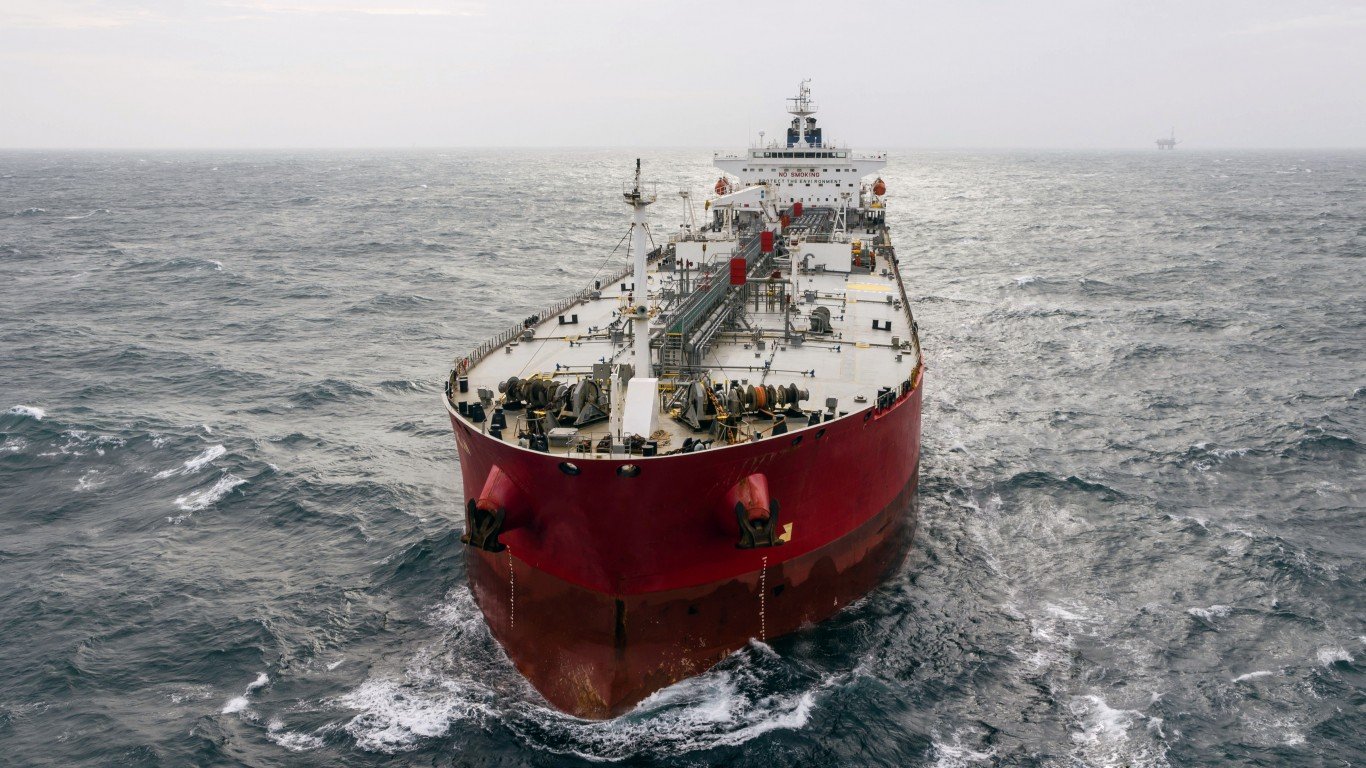
Crude oil is spending more time at sea. Ship-to-ship transfers and alternative routes going around the Strait of Hormuz have extended voyage times and cut the number of tankers available at any given moment. On its third-quarter call, Teekay Tankers (NYSE:TNK) management said moving Saudi crude north through the Suez Canal and SUMED Pipeline added about 30 days[1] to each voyage. When every barrel stays on a ship for longer, the same fleet can move less oil, and day rates stay high.
Income investors see that freight boom in their dividend checks. Three tanker owners pass a large share of their earnings straight to shareholders, and this article works out the income a $30,000 position in each would produce: $90,000 in total. Based on the last four declared dividends and share prices as of November 20, 2026, the three positions generate more than $10,000 a year in passive income.
Every yield below is a trailing figure: the sum of the last four declared payouts divided by the current share price. Two of these companies pay variable dividends, so future checks will track tanker earnings up or down.
Teekay Tankers
- Stock #3: Teekay Tankers
- Yield (trailing, last four declared payouts): 2.35%
- Shares for $30,000: 351.86
- Annual Passive Income: ~$704
Teekay Tankers operates Suezmax and Aframax/LR2 crude tankers, and it agreed to buy a 2020-built MR product tanker to rebuild its presence in that segment. Its yield trails the group because it pays a fixed $0.25 quarterly dividend and adds an annual special payment on top. The trailing $2.00 includes a $1.25 May payment. Teekay has made a similar larger May payment in prior years, but the company does not guarantee it.
Coverage is substantial, as third-quarter adjusted EPS of $5.04[2] compares with the $0.25 regular dividend, and the company held $1.05 billion in cash with no debt[1]. CEO Kenneth Hvid said the board will now consider the special dividend alongside full-year results expected in February 2027[1], calling it “a more natural closure of the year.” One risk is fleet age: about 65%[3] of the fleet is 15 years or older, so newbuild payments compete with special dividends for cash.
DHT Holdings
- Stock #2: DHT Holdings (NYSE:DHT)
- Yield (trailing, last four declared payouts): 17.24%
- Shares for $30,000: 1,390.18
- Annual Passive Income: ~$5,171
DHT Holdings runs a fleet of VLCCs, the supertankers built for long-haul crude. Its ultra-high yield comes from its payout policy: DHT distributes 100% of ordinary net income every quarter. The last four dividends rose from $0.41 to $0.64, $1.22, and $1.45 as VLCC spot earnings went up to $167,100 per day[4] in the third quarter.
Coverage matches by design, as adjusted EPS of $1.45[4] equaled the dividend, DHT’s 67th consecutive quarterly payout. For the fourth quarter, 86%[4] of VLCC days were fixed at an average of $267,500 per day. The risk is the formula itself: if the Strait of Hormuz reopens and voyage inefficiencies reverse, the dividend shrinks with earnings. CEO Svein Moxnes Harfjeld said he had “a hard time seeing anything falling out of bed”[5] in that scenario, though a variable payout can fall as fast as it rose.
International Seaways
- Stock #1: International Seaways (NYSE:INSW)
- Yield (trailing, last four declared payouts): 17.30%
- Shares for $30,000: 308.90
- Annual Passive Income: ~$5,189
International Seaways owns VLCC, Suezmax, and Aframax crude tankers plus a product carrier fleet. It returns at least 85% of adjusted net income each quarter, which is why payouts stepped from $2.15 to $4.55 and then $5.05 twice, totaling $16.80.
Third-quarter adjusted EPS of $5.84[6] covered the $5.05 dividend, supported by $234.05 million in free cash flow and $305 million of signed time charter revenue. The board also raised its buyback to $100 million[6] through 2028. CEO Lois K. Zabrocky said the company “delivered record quarterly net income.”[6] The key risk is supply: Zabrocky acknowledged the order book has grown as high rates and financing encourage new building, and faster deliveries would pressure both rates and the formula-driven payout.
Three Tanker Payouts in One Table
| Name | Yield (Trailing) | Annual Dividend Income |
|---|---|---|
| Teekay Tankers | 2.35% | $704 |
| DHT Holdings | 17.24% | $5,171 |
| International Seaways | 17.30% | $5,189 |
| Total | 12.29% blended | $11,064 |
What $90,000 in Tanker Stocks Pays Each Year
Combined, these three positions generate $11,064 in annual passive income on a $90,000 investment, a blended yield of 12.29%. International Seaways brings $5,189, DHT Holdings adds $5,171, and Teekay Tankers rounds out the group with $704.
All three draw their income from the same source: longer voyages that keep ships busy. DHT and International Seaways pass that cash through by formula, while Teekay leans on a fixed base and a discretionary special payment.
The flip side is that a formula that grows with day rates can shrink with them too, the exact pattern we flagged when we shared the seven warning signs of a dividend about to be cut, here. Dividends paid out by formula can also be reinvested by formula. Each quarterly payout that buys more shares adds to the base for the next payout, and a full cycle of reinvested dividends from a freight rally can still be producing income well after day rates come down.
Contact [email protected] for any questions or corrections.
David Beren has been a Flywheel Publishing contributor since 2022. Writing for 24/7 Wall St. since 2023, David loves to write about topics of all shapes and sizes. As a technology expert, David focuses heavily on consumer electronics brands, automobiles, and general technology. He has previously written for LifeWire, formerly About.com. As a part-time freelance writer, David’s “day job” has been working on and leading social media for multiple Fortune 100 brands. David loves the flexibility of this field and its ability to reach customers exactly where they like to spend their time. Additionally, David previously published his own blog, TmoNews.com, which reached 3 million readers in its first year. In addition to freelance and social media work, David loves to spend time with his family and children and relive the glory days of video game consoles by playing any retro game console he can get his hands on.