T-Bills Are Beating the Nasdaq, S&P 500 and Dow This Year

This post may contain links from our sponsors and affiliates, and Flywheel Publishing may receive compensation for actions taken through them.

Jeffrey Gundlach, chief executive of DoubleLine Capital, posted on X at 11:58 a.m. ET on Friday as stocks slipped: “YTD the NASDAQ has underperformed T-Bills.” At 12:41 p.m., he followed up: “YTD the DJIA and the S&P 500 have underperformed T-Bills.”
He posted no figures, so we ran them ourselves. We used the iShares 0-3 Month Treasury Bond ETF (NYSEARCA:SGOV) and the SPDR Bloomberg 1-3 Month T-Bill ETF (NYSEARCA:BIL) as proxies for a T-bill holder, and as of the November 20 close, the numbers support him on all three indexes.
On Friday, the S&P 500 fell 3.70% for its seventh straight loss and finished the week down 8.4%, and the NASDAQ Composite dropped 5.28% on the day.
A sharp rebound could reverse this within days. If you’re determining how much to hold in cash, the result still shows what 2026 has paid for so far, and it shows the rate outlook going into the Fed’s December meeting.
Stocks Trail Cash Even on Price Alone
The S&P 500 closed Friday at 6,910.39, compared with 6,845.50 at the end of 2025. That works out to a 0.95% gain.
The Dow closed at 48,147.33, compared with 48,063.29 at year-end, for a gain of just 0.17%. The NASDAQ Composite finished at 22,617.73, below its 23,241.99 starting point, and is down 2.69% for the year.
Over the same period, SGOV returned about 3.3% including payouts, and BIL returned about 3.2%. Both the S&P 500 and the Dow are now in correction territory.
Banking Dividends Leave the Result Unchanged
Price returns leave out dividends, which help the stock side. The S&P 500 Total Return index rose from 15,220.45 to 15,522.21, a gain of 1.98%. Over that stretch, the SPDR S&P 500 ETF Trust (NYSEARCA:SPY) paid quarterly distributions, most recently $1.888834 per share.
Including dividends, the Invesco QQQ Trust (NASDAQ:QQQ) is down about 0.6%. The SPDR Dow Jones Industrial Average ETF (NYSEARCA:DIA) is up about 1.2%. Every one of those figures trails both bill funds, so Gundlach’s claim still holds once dividends are banked.
Rising Short-Term Rates Made Cash Pay More
The 13-week bill yielded about 3.55% at the end of 2025 and about 4.12% on Friday. Treasury’s coupon-equivalent yield for November 20 was 4.25%.
The Fed raised its target range to 3.75% to 4.00%[1] in September. Markets treat a quarter-point increase at the December 8-9 meeting as close to certain.
Bill funds hold securities that mature within weeks, so their payouts move up soon after each increase. SGOV paid $0.328581 per share in November, up from $0.300547 in October, while a 5.04%[2] 10-year yield raises the return stocks have to beat.
Where SGOV and BIL Fit, and Where They Fall Short
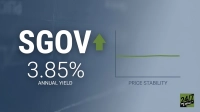
SGOV closed at $100.64. It yields 3.62%, charges 0.09%, and holds $118.17 billion, nearly all in Treasury bills listed in its SEC filing. BIL closed at $91.59, yields 3.67% and holds $50.11 billion.
Both funds pay monthly, and their share prices just move because almost all of the return comes from those payouts. Treasury interest is generally exempt from state and local income tax.
If the Fed starts cutting, payouts will fall quickly, and inflation reduces what the income can buy. Over long periods, stocks have historically beaten cash, so for investors near retirement, bills typically serve as a reserve for near-term spending that avoids selling stocks in a drawdown (that reserve is the whole point of what planners call sequence-of-returns risk, something we walked through in a free guide to the first five years of retirement).
Why SGOV’s Payouts Could Keep Rising Into December
SGOV is built for the cash portion of a portfolio. Its payouts follow the policy rate, and with a December increase priced in, those payouts likely have more room to rise.
BIL has a slightly higher stated yield. SGOV has a low 0.09% fee and a much larger asset base, which gives it a cost and scale edge over BIL for cash holdings.
Two things would change this view: a sharp equity rebound that closes the year-to-date gap, or a Fed shift toward rate cuts that drives bill payouts lower. The first test comes with the Fed’s decision on Wednesday, December 9.
Contact [email protected] for any questions or corrections.
Omor Ibne Ehsan is a writer at 24/7 Wall St. He is a self-taught investor with a focus on growth, cyclical, and dividend equities that have strong fundamentals, value, and long-term potential. He also has an interest in high-risk, high-reward investments such as penny stocks.