SanDisk and Micron’s Early-2027 Worst Cases: A NAND Inflection After a Split vs. Peak-Cycle Fear Amid Heavy CapEx

This post may contain links from our sponsors and affiliates, and Flywheel Publishing may receive compensation for actions taken through them.
SanDisk (NASDAQ:SNDK | SNDK Price Prediction) and Micron Technology (NASDAQ:MU) both just reported record quarters on AI memory demand. Even so, both stocks sold off hard heading into SanDisk’s first split-adjusted session on November 20[1]. SanDisk sells only NAND and could get hit if flash prices turn. Micron leads with DRAM and HBM but has a heavy construction budget. Their worst cases for early 2027 come from different places.
Data Center Flash Lifts SanDisk While HBM Anchors Micron
SanDisk’s fiscal Q1 revenue came in at $11.03B[2], up 377.9% from a year earlier. Datacenter revenue rose 61% sequentially to $4.80B[2], which shows hyperscalers are drawing more flash into inference. Consumer moved the other way, falling 29% sequentially to $397M[2] as shoppers balked at higher prices. David Goeckeler, the CEO, pointed to “robust and growing demand for our products driving outpaced growth in our data center business.”[2]
Micron’s fiscal Q4 revenue of $54.23B[3] exceeded the $50.97B consensus. Its non-GAAP gross margin reached 87.0%[3], compared with 45.7% a year earlier, a sign of how scarce supply has become. Management said it has “no line of sight to when supply and demand balance.”[4]
| Business Driver | SanDisk | Micron |
|---|---|---|
| Main Engine | Enterprise SSDs for AI | Server DRAM and HBM |
| Contract Cover | ~50%[1] of FY27 bids under long-term deals | More than 75%[4] of FY27 shipments committed |
| Next-Quarter Revenue Guide | $12.20B-$12.60B[2] | $61.5B ± $1.5B[3] |
SanDisk’s Downside Starts With a NAND Price Flip
In the bear case, NAND contract prices rise 8% to 13% in Q4 2026, then come in flat to down 5% in Q1 2027. Spot prices would drop more than 20% while industry bit supply grows 25% to 30%. Higher prices supplied about 40%[1] of last quarter’s growth, so any reversal would hit margins directly. Management has already told investors to be conservative when modeling Q2-to-Q3 growth. The stock fell 54% in a month, so some of that fear is already in the price.
Micron’s Risk Is a Cheap Multiple That Stays Cheap
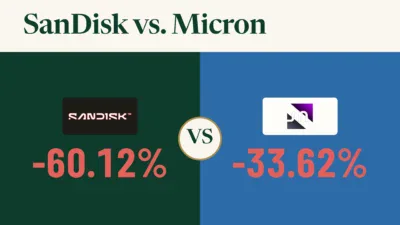
Memory investors often read a low P/E as a sign of peak earnings, a worry MarketWatch flagged this weekend. Micron spent $30.712B[3] on capex in fiscal 2026. CFO Mark Murphy said that clean-room spending “doesn’t translate into bits”[4] right away. If AI rack builds slip, that spending would eat into free cash flow. Shares are down 33.62% over six months, a smaller drop than SanDisk’s 60.12%.
January Pricing Resets Will Show Who Holds Up
Micron said HBM pricing for calendar 2027 “will reset at the beginning of the calendar year.”[4] I will be watching whether those higher prices stick. For SanDisk, keep an eye on whether new long-term agreements keep closing, and whether HBF samples make it next calendar year[1] as promised.
Why Micron Looks Sturdier Through an Early-2027 Shakeout
Micron looks better positioned to absorb a memory wobble. Most of its shipments are committed, and DRAM remains the main constraint for AI. SanDisk offers more leverage. It has no debt and returned $5.0B[2] through buybacks last quarter. Still, pure NAND exposure leaves SanDisk vulnerable if spot weakness spreads to contract prices. If Q1 contract prices hold flat, SanDisk’s outlook would improve quickly.
Contact [email protected] for any questions or corrections.
Alex Sirois is a financial writer with experience spanning both retail and institutional investing. He has written for InvestorPlace and held roles at BNY Mellon and Bernstein, giving him a perspective that bridges Main Street portfolios and Wall Street analysis.
Alex holds an MBA from George Washington University and has built his career across multiple industries, including e-commerce, education, and translation — a breadth of experience that informs how he breaks down complex financial topics for everyday investors. His writing is conversational, actionable, and grounded in long-term, buy-and-hold investing principles.
At 247 Wall St., Alex focuses on delivering analysis that is both accessible and useful, with a clear emphasis on helping readers make more informed decisions with their money.