D-Wave Declines 9% as Quantum Stocks Reverse Monday’s Surge; Rigetti Drops 7%, IonQ Falls 5%

This post may contain links from our sponsors and affiliates, and Flywheel Publishing may receive compensation for actions taken through them.
Quantum computing stocks are giving back a big piece of Monday’s surge, and D-Wave is leading the retreat. D-Wave Quantum (NASDAQ:QBTS) stock is at $6.67 in afternoon trading, down 9%. That pullback compounds a rough year, with D-Wave stock down 74% year to date (YTD).
The selling reaches well beyond D-Wave. Speculative tech and artificial intelligence (AI) stocks are giving back part of Monday’s rally, with Federal Reserve rate worries and Iran sanctions also cited in market coverage. The technology sector is under pressure as the NASDAQ 100 is down 1.9%.
Monday’s Quantum Rally Unwinds
Quantum names jumped on Monday, November 23, as Jensen Huang’s return to NVIDIA (NASDAQ:NVDA | NVDA Price Prediction) lifted speculative tech, a move we covered in our look at Monday’s rally. D-Wave’s reversal now fits a familiar pattern of investors locking in gains after a sharp one-day run. All four pure-play quantum stocks tend to trade as a group, so the unwind is hitting each of them.
Skepticism about the group has returned as well. An investor warned on Monday that quantum computing is “one of the most overhyped technologies of our time,” per Yahoo Finance. That doubt tends to weigh hardest on D-Wave and other small quantum names whose revenue remains modest next to their market values.
Recent results from D-Wave show both sides of the argument. The company disclosed on November 10[1] that its Q3 2026 revenue rose 20.7% year over year (YoY) to $4.51 million, while its loss under generally accepted accounting principles (GAAP) of $0.13 per share missed the consensus estimate of a $0.10 loss. Margins also contracted, as D-Wave’s gross margin slipped to 52.9%[1] from 71.4% on a heavier mix of lower-margin professional services. On the positive side, nine-month bookings at D-Wave jumped 611%[1] to $37.4 million.
How Rigetti, IonQ and Quantum Computing Inc. Stack Up
Rigetti Computing (NASDAQ:RGTI) stock is at $7.50, down 7%. This year has been harsh for Rigetti as well, with the stock down 66% YTD, the second-steepest decline of the four after D-Wave. The company’s market value of $2.57 billion is similar to D-Wave’s $2.51 billion, which makes Rigetti the most direct comparison in the group.
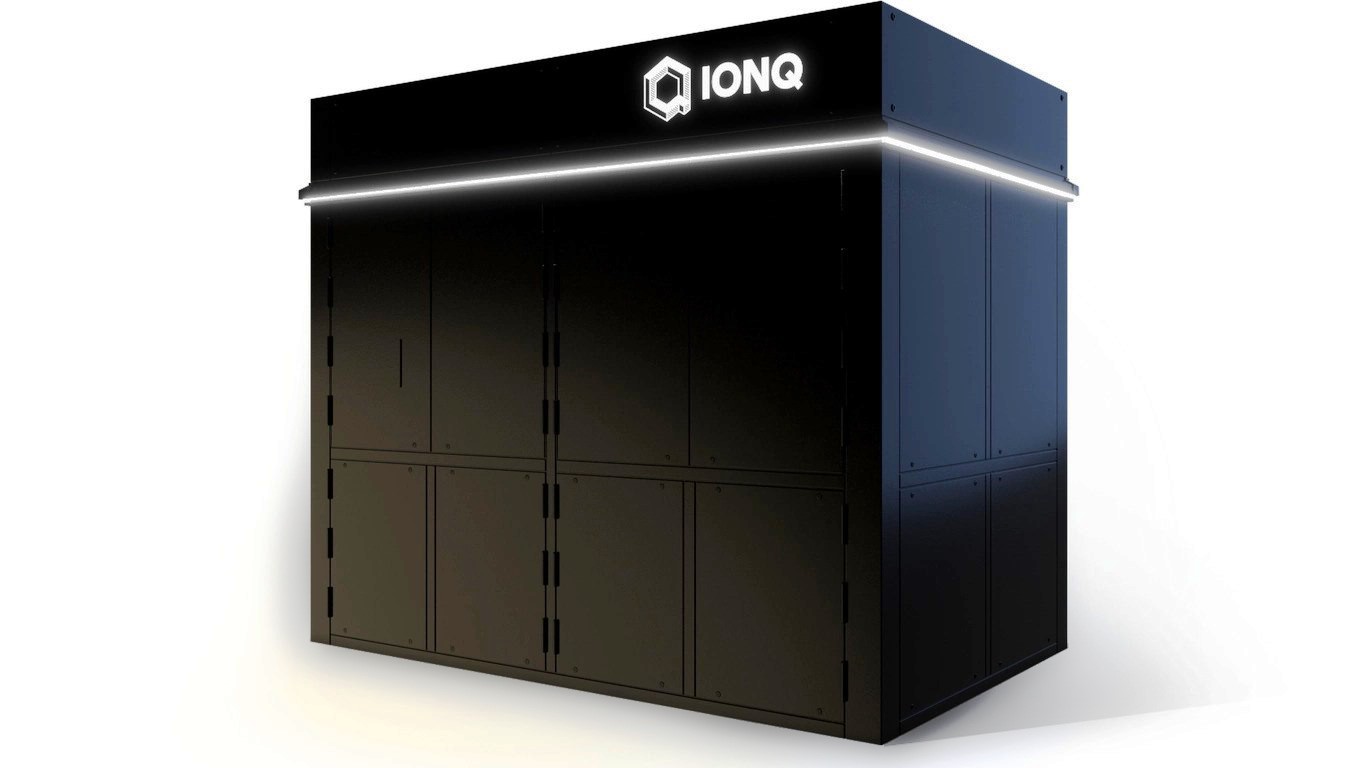
Meanwhile, IonQ (NYSE:IONQ) stock is at $22.26, down 5%. Over the year, IonQ stock has held up best of the four, down 50% YTD. The company also carries far more weight than D-Wave or Rigetti, with IonQ’s market value at $10.3 billion.
Quantum Computing Inc. (NASDAQ:QUBT) stock is at $4.39, down 7%. Measured from the start of the year, Quantum Computing Inc. stock is down 57%.
Four Different Paths to Quantum Hardware
D-Wave describes itself as the only company offering both annealing and gate-model quantum computers. Its annealing systems, which it views as production-ready now, target optimization problems like scheduling and logistics, and it added gate-model technology through its Quantum Circuits acquisition. That dual-platform approach sets D-Wave apart from peers that focus only on gate-model machines.
Rigetti builds superconducting gate-model systems from chiplets, an architecture that relies on cryogenic cooling. IonQ takes a trapped-ion approach and has become vertically integrated after acquiring the SkyWater foundry business, which now manufactures for third parties including D-Wave.
Quantum Computing Inc. uses a photonic architecture that runs at room temperature, setting the company apart from its cryogenic rivals, a design that gives it a distinct pitch, though its business remains far smaller than IonQ’s.
What Comes Next for D-Wave After the Quantum Whipsaw
The big question for D-Wave is how fast its growing bookings turn into recognized revenue, and whether that pace satisfies the hype critics. The bulls can point to the company’s expanding backlog, new customer partnerships and up to $100 million[1] in U.S. CHIPS Act funding tied to milestones.
The bears have their own evidence, including D-Wave’s growing operating loss, a sharply lower gross margin and a share price that has lost most of its value this year. One-day rallies like Monday’s can reverse just as fast, a pattern that could keep volatility high across quantum names. A conservative investment approach could make sense for those following the group until the quantum hype debate settles (we wrote a free handbook on riding a mania while planning the exit, which you can grab here).
Contact [email protected] for any questions or corrections.
David Moadel is financial writer specializing in stocks, ETFs, options, precious metals, and Bitcoin. David has written well over 1,000 articles for leading online publications, helping investors understand markets, income strategies, and risk. His work has appeared in 24/7 Wall St., The Motley Fool, InvestorPlace, U.S. News & World Report, TipRanks, ValueWalk, Benzinga, Market Realist, MarketScreener, TalkMarkets, Finmasters, and others. With a master’s degree in education, David has taught at the elementary, high school, and college levels. That teaching background shapes his writing style: clear, educational, and practical. David has also built a loyal social-media audience by providing trustworthy financial content on YouTube, X/Twitter, and StockTwits.