HP Earnings: Memory Went From 15% to 40% of a PC’s Parts Cost in a Year

This post may contain links from our sponsors and affiliates, and Flywheel Publishing may receive compensation for actions taken through them.

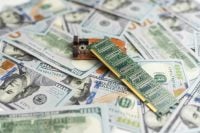
Memory chips used to account for a small share of the parts cost of an HP (NYSE:HPQ | HPQ Price Prediction) laptop. On Tuesday’s fiscal fourth-quarter call, CFO Karen Parkhill said memory and storage were 15% to 18% of a PC’s bill of materials at the start of fiscal 2026 and “closer to 40% of the BOM” by the fourth quarter.

The bill of materials is what HP pays for a PC’s components, which is a different number from the shelf price. HP’s fiscal year ended October 31, 2026, so this shift in HP’s own machines happened in about twelve months.
HP still beat estimates and raised its dividend. But its PC business made a 3.0% operating margin and shipped 29% fewer units than a year earlier, and the company expects the market to shrink again in 2027, so you have to decide whether a 4.4% yield and a steady printing business are enough reason to own a company that bears the higher memory prices.
Why Memory Now Dominates HP’s Parts Costs
AI data centers are buying huge amounts of DRAM and NAND flash. That leaves less supply for PCs, so chipmakers can charge HP more for the same parts. When one component grows that fast inside a parts budget, the other components have to get cheaper to make room for it, or the selling price has to go up.
Parkhill expects memory and storage costs “to continue to increase, but at a lesser rate”[1] in fiscal 2027. She also said HP will stop updating the bill-of-materials figure, which means you will need to follow segment margins to see how the cost pressure is going.
Redesigns and Promotions Squeeze Margins From Both Ends
HP’s response is cheaper designs, new component configurations, and competitive sourcing, and it will raise prices only after trying those steps first. The $699[1] Omnibook 5 was the first result.
Putting less memory in each machine helps the margin. But it works against HP’s AI PC strategy, because Interim CEO Bruce Broussard said AI PCs reached nearly 60% of shipments, and AI that runs on the device works better with more memory.
Broussard said consumer demand softened late in the quarter as retailers and other channel partners reported slower sales, and HP plans more promotions to clear inventory. Those discounts cut prices while memory pushes costs up.
Fewer PCs at Higher Prices
Parkhill said HP projects PC market unit sales to fall by a high-single-digit to low-double-digit percentage in calendar 2027, while market revenue stays roughly flat[1]. If revenue holds steady while fewer units sell, average prices have to rise, and that means buyers are absorbing the memory costs.
HP’s fourth quarter already showed this pattern. Personal Systems revenue rose 14% to $11.8 billion while consumer units fell 31% and commercial units fell 28%.
Commercial revenue rose 23%[2] because businesses bought premium machines. Consumer revenue fell 7% as homes pulled back.
A Beat Padded by Tariff Refunds
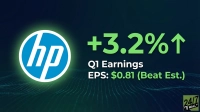
Revenue of $16.0 billion rose 9.3%, ahead of Wall Street’s consensus of $15.3 billion. Non-GAAP EPS of $0.83 beat the Wall Street analyst consensus of $0.74, but it included $0.15 from tariff refunds and was lower than the $0.93 HP made a year earlier.
Printing still produces HP’s profits. HP’s fourth-quarter release shows printing revenue slipped to $4.3 billion at a 19.7% operating margin.
HP Inc. forecast fiscal 2027 non-GAAP EPS to $3.15 to $3.45, and the low end matches the Wall Street analyst consensus of $3.15. Starting with the new fiscal year, though, non-GAAP results will leave out stock-based compensation, and that change alone would have added $0.38[3] per share in fiscal 2026.
The quarterly dividend rises to $0.31 from $0.30, which is $1.24 a year, payable January 6, 2027. HP Inc. forecast fiscal 2027 free cash flow to $2.9 billion to $3.1 billion, below the $3.33 billion[3] it produced in fiscal 2026.

What HP’s Shrinking Cash Flow Means for Its Dividend Now
Shares fell 3.32% Tuesday to close at $27.94, then traded at $28.50 at 7:59 p.m. ET in after-hours trading, up 2.01%. HP is valued at $25.2 billion, and its 52-week range runs from $17.56 to $36.23.
Earnings comfortably cover the dividend, but free cash flow is shrinking, and EPS guidance gets a boost from the accounting change. Meanwhile, HP’s largest segment is selling fewer units and bears more for its most expensive parts.
Micron Technology (NASDAQ:MU) is getting those higher prices. It reported fiscal fourth-quarter revenue of $54.2 billion at an 87.0% non-GAAP gross margin. The trade-off is that memory is a cyclical business, Micron’s $712.6 billion valuation already prices in demand staying strong, and its dividend bears much less income than HP’s.
Contact [email protected] for any questions or corrections.
Omor Ibne Ehsan is a writer at 24/7 Wall St. He is a self-taught investor with a focus on growth, cyclical, and dividend equities that have strong fundamentals, value, and long-term potential. He also has an interest in high-risk, high-reward investments such as penny stocks.