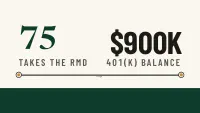
A Couple Who Retires at 62 With $560,000 in Two IRAs Now Has 13 Years to Convert Before RMDs Start at 75. Many Couples With the Same Balance Convert $0 and Face About $43,000 of RMDs

This post may contain links from our sponsors and affiliates, and Flywheel Publishing may receive compensation for actions taken through them.

Retirement at 62 often looks quiet on a tax return. The paychecks stop, taxable income drops close to zero, and the two IRAs holding $560,000 keep growing with no plan.
Those quiet years are also some of the cheapest tax years many couples will see, and they end on a fixed date. That balance turns into required minimum distributions (RMDs) at 75, and a year-by-year Roth conversion schedule can use the years before then.
How $560,000 Becomes About $43,000 a Year
For someone born in 1964, federal law sets the RMD age at 75, so 2039 is the first year a distribution is required. A couple who turns 62 in 2026 has 13 tax years, 2026 through 2038, before the government starts setting a minimum withdrawal.
That $43,000 number is an illustration resting on one growth assumption. If the IRAs earn 5% a year for 13 years with nothing taken out, the balance grows to about $1.06 million. A different return would push the result higher or lower.
IRS Publication 590-B’s Uniform Lifetime Table gives a divisor of 24.6 at age 75. Splitting the balance by that number gives a first-year RMD of about $43,000 for the couple combined. That withdrawal comes on top of Social Security, and the required share of the account grows as the divisor gets smaller with age.
Roth IRAs follow a different rule. Under IRS rules, “The RMD rules do not apply to Roth IRAs or Designated Roth accounts while the owner is alive.” So every dollar converted before 75 is excluded from that future calculation.
Why Low-Income Years Make Conversions Cheaper
A converted amount counts as ordinary income in the year it’s moved. With no salary coming in, the lowest brackets sit empty. For 2026, married couples filing jointly get a $32,200 standard deduction, and the 12% bracket runs up to $100,800 of taxable income.
Put those two numbers together, and a couple with no other income could convert $133,000 in 2026 and stay inside the 12% bracket. The federal tax on $100,800 of taxable income is $11,600, or about 8.7% of the amount converted. Paying a tax bill nobody is requiring can still feel uncomfortable, even when the rate is low.
A Year-by-Year Conversion Schedule
Medicare drives most of the timing. Income-related premium surcharges, called IRMAA, are based on income from the tax year 2 years prior, and Medicare eligibility starts at 65. For this couple, that breaks the window into phases.
- 2026, age 62: This year’s income sets 2028 insurance premiums, and the couple will be 64 and not yet on Medicare. That makes it the only conversion year with no IRMAA exposure. Some couples convert into the 22% bracket, which ends at $211,400 of taxable income.
- 2027 and 2028, ages 63 and 64: Income in these years sets insurance premiums at 65 and 66. Under the 2027 schedule, the first joint surcharge starts above $224,000 of modified adjusted gross income. It adds $83.70 a month to Part B and $15.40 to Part D.
- 2029 through 2038, ages 65 to 74: Each spouse gets an additional standard deduction of $1,650 in 2026. If Social Security starts during these years, up to 85% of benefits can become taxable, leaving less room in the lower brackets.
- 2039, age 75: By April 1, 2040, an initial RMD must be taken, and it’s based on whatever is still in the traditional IRAs.
Brackets and IRMAA levels change every year, so each year’s conversion has to be sized using that year’s numbers.
Trade-Offs That Come With Converting
The most obvious cost is paying tax now. Paying it from a taxable account leaves more money growing inside the Roth.
A conversion is also permanent, because federal law under 26 U.S.C. § 408A(d)(6)(B)(iii) doesn’t allow it to be recharacterized back to the pretax account. If the market falls right after a conversion, you still owe tax on the higher value.
Each conversion also starts its own five-year period under 26 U.S.C. § 408A(d)(3)(F). The five-year conversion penalty generally applies to withdrawals before age 59.5, so this couple, already age 62, is exempt from that penalty. Couples who already have after-tax money in an IRA face the pro-rata rule, which treats all traditional IRAs as one account when projecting how much of a conversion is taxable.
Converting nothing keeps a couple’s tax bills low for 13 years, then brings an RMD near $43,000 in 2039 under the 5% illustration. Converting steadily means paying more tax now in exchange for a smaller required withdrawal later.
The window runs from 2026 through 2038, and each low-income year that passes without a conversion can’t be used again (we sized up that gap between the final paycheck and the initial RMD in a free Roth Window guide).
Contact [email protected] for any questions or corrections.
David Beren has been a Flywheel Publishing contributor since 2022. Writing for 24/7 Wall St. since 2023, David loves to write about topics of all shapes and sizes. As a technology expert, David focuses heavily on consumer electronics brands, automobiles, and general technology. He has previously written for LifeWire, formerly About.com. As a part-time freelance writer, David’s “day job” has been working on and leading social media for multiple Fortune 100 brands. David loves the flexibility of this field and its ability to reach customers exactly where they like to spend their time. Additionally, David previously published his own blog, TmoNews.com, which reached 3 million readers in its first year. In addition to freelance and social media work, David loves to spend time with his family and children and relive the glory days of video game consoles by playing any retro game console he can get his hands on.