Broadcom’s AI Revenue is Contracted to Double in 2027, So I’m Buying

This post may contain links from our sponsors and affiliates, and Flywheel Publishing may receive compensation for actions taken through them.
My position in Broadcom (NASDAQ:AVGO | AVGO Price Prediction) keeps growing, and every earnings report hands me another reason to keep going. The latest one came in September, when management said it has secured enough supply to double AI revenue again in fiscal 2027.
My thesis: the world’s biggest AI model builders design their own chips with Broadcom, and those partnerships lock in years of demand. I want that kind of visibility in a retirement account.
A Fiscal 2027 AI Book I Refuse to Ignore
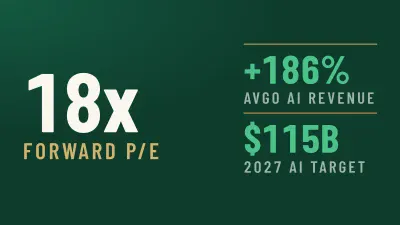
Broadcom raised its fiscal 2026 AI revenue guidance to $58 billion, up 186%[1]. Then Hock Tan laid out the next step: “In 2027, we have secured the supply to again double AI revenue to approximately $115 billion. Our demand actually exceeds this outlook, and we will work to improve supply.”[1]
Tan said “Anthropic is on track to become our largest XPU customer in 2027.”[1] OpenAI’s Jalapeno chip is planned for a 1.3-gigawatt deployment in 2027. Alphabet (NASDAQ:GOOGL) unit Google reached a multiyear agreement covering “multi-tens of billions of dollars of TPUs annually over the next several years.”[1]
Three Reasons My Conviction Keeps Growing
The growth already shows up. Third-quarter revenue reached $29.591 billion, up 85.5%[2], with AI semiconductor revenue of $16.7 billion, up 221%. Non-GAAP EPS of $3.32[2] beat the $3.24 consensus, continuing the beat run to 9 consecutive quarters. Management guided Q4 revenue to approximately $34.8 billion[2].
The cash keeps coming. Free cash flow hit $13.665 billion[2], or 46% of revenue. That cash paid $3.1 billion[1] in dividends and retired $5.6 billion of long-term debt in one quarter. VMware software adds a steady base: Infrastructure Software revenue rose 29%[2] to $8.752 billion at a 94%[1] gross margin.
The income grows and the price looks reasonable. Broadcom raised its dividend 10% to $0.65 per share[3], its 15th consecutive annual increase since fiscal 2011. At $333.40, the stock is down 3.14% year to date and is valued at 18 times forward earnings.
Why My Money Goes Here Instead of NVIDIA or AMD
Shares of NVIDIA (NASDAQ:NVDA) trade cheaper, at 10 times forward earnings. For an income investor, though, its 0.17% yield trails Broadcom’s 0.71%. I also want exposure to customers moving toward custom silicon, and Broadcom says Jalapeno runs advanced models at half the cost of a GPU[1].
AMD (NASDAQ:AMD) costs 32 times forward earnings and pays no dividend. I pass.
One Risk That Could Hurt Me
Six key customers drive this AI outlook, and their buildouts depend on land, power and data-center shells. Tan admitted it himself: “The question in our minds sometimes is, even as we ship the chips, will they be deployed on a timely basis?”[1] Gross margin is also slipping toward approximately 73% in Q4, from 78% a year ago, as lower-margin XPUs make up more of the mix.
I accept that risk because operating margin should hold near 66%[2] of revenue. The company’s $59.6 billion[1] of fixed-rate debt carries a 4% average coupon, and the cash flow covers it.
Why I Keep Adding Ahead of December 9
Broadcom reports fiscal 2026 results on December 9, 2026[4], and I will keep an eye on the stock for the next dividend decision and any update on supply. Management has already said it projects $230 billion[1] in fiscal 2028 AI revenue. A company that tells me demand runs ahead of the supply it can secure remains at the top of my research list (we reverse-engineered what the biggest AI chip winners looked like early in a free playbook here).
Contact [email protected] for any questions or corrections.
Alex Sirois is a financial writer with experience spanning both retail and institutional investing. He has written for InvestorPlace and held roles at BNY Mellon and Bernstein, giving him a perspective that bridges Main Street portfolios and Wall Street analysis.
Alex holds an MBA from George Washington University and has built his career across multiple industries, including e-commerce, education, and translation — a breadth of experience that informs how he breaks down complex financial topics for everyday investors. His writing is conversational, actionable, and grounded in long-term, buy-and-hold investing principles.
At 247 Wall St., Alex focuses on delivering analysis that is both accessible and useful, with a clear emphasis on helping readers make more informed decisions with their money.