Heading Into FY27: How to Trade Broadcom’s ~$115B AI Target Against Nvidia’s Multiple Reset

This post may contain links from our sponsors and affiliates, and Flywheel Publishing may receive compensation for actions taken through them.
Broadcom (NASDAQ:AVGO | AVGO Price Prediction) and NVIDIA (NASDAQ:NVDA) both beat estimates in their latest earnings reports. Even so, each stock has fallen more than 28% over six months. Broadcom heads into fiscal 2027 needing to deliver on a roughly $115 billion[1] AI chip outlook. NVIDIA’s valuation has reset after an 11-day leadership drama that ended with Jensen Huang restored as CEO on November 23.
Custom XPUs Drive Broadcom While Vera Rubin Drives NVIDIA
Broadcom’s Q3 AI semiconductor revenue reached $16.70 billion[2], up 221% year over year. XPUs made up 73%[1] of that AI revenue. Hock Tan expects fiscal 2027 AI revenue to roughly double to $115 billion[1] and says the supply to support it is already secured. He expects Anthropic to become the largest XPU customer in 2027[1]. OpenAI plans to deploy 1.3 gigawatts[1] of its Jalapeno chip that same year. The customer list is specific, but it rests on only six buyers.
NVIDIA’s revenue of $115.84 billion[3] beat the $108.73 billion estimate. Vera Rubin brought in nearly $20 billion[4] in its first quarter of shipments, which management called “the fastest product ramp in NVIDIA’s history.” NVIDIA raised its fiscal 2028 growth outlook to approximately 75% from 70%. That points to demand spreading out beyond the hyperscalers.
| Business Driver | Broadcom | NVIDIA |
|---|---|---|
| Growth Engine | Custom XPUs for six customers | Vera Rubin rack-scale systems |
| Q4 Gross Margin Guide | About 73%[1] | 71.0% to 72.0%[3] |
| Key Vulnerability | Customer concentration | $118 billion in guarantees, governance |
NVIDIA’s Discount Runs Deeper Than Broadcom’s
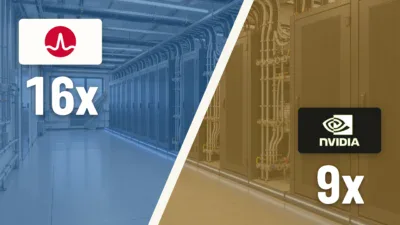
At $300.86, Broadcom trades near 16x fiscal 2027 consensus EPS of $19.3547. That multiple is modest for a company growing AI revenue at triple digits. The pressure shows up in gross margin, which fell to 75%[1] in Q3 as XPUs with more memory content made up a larger share of sales. Tan pointed investors to a different line: “Focus on operating margin because growth in revenue far surpasses growth in OpEx to support that revenue.”[1]
NVIDIA looks even cheaper. At $149.30, the shares trade near 9x fiscal 2028 consensus EPS of $16.6053, up from $12.9992 90 days ago. Analysts raised their earnings estimates even as the stock fell 30.88% in a month. Huang’s return left questions open. S&P warned it could cut NVIDIA’s credit rating over governance risk, and the internal investigation is still running.
Q4 Margins and Data Center Readiness Will Decide Who Rebounds First
For Broadcom, I am watching three things: Q4 AI revenue landing near the $21.70 billion[2] guide, production shipments of the MTIA chip for Meta Platforms (NASDAQ:META), and operating margin holding near 66%. NVIDIA management called Q4 the bottom[4] for gross margin. A move into the 72% to 73%[4] range it expects for fiscal 2028 would confirm its pricing power. A clean end to the investigation matters just as much.
Both management teams named land, power and building shells as the limits on how fast customers can deploy chips. Both stocks depend on the same data center expansion, which links their outlooks to one AI spending cycle.
Why I Favor Broadcom’s Visibility While Tracking NVIDIA’s Discount
For me, Broadcom offers clearer view. It has named customers, gigawatt targets and secured supply. NVIDIA has a wider range of results. At roughly 9x forward earnings, a clean resolution of the governance questions could lift its valuation quickly, though I want the investigation closed first. If Broadcom’s Q4 gross margin lands well below 73%[1], I would revisit that preference.
Contact [email protected] for any questions or corrections.
Alex Sirois is a financial writer with experience spanning both retail and institutional investing. He has written for InvestorPlace and held roles at BNY Mellon and Bernstein, giving him a perspective that bridges Main Street portfolios and Wall Street analysis.
Alex holds an MBA from George Washington University and has built his career across multiple industries, including e-commerce, education, and translation — a breadth of experience that informs how he breaks down complex financial topics for everyday investors. His writing is conversational, actionable, and grounded in long-term, buy-and-hold investing principles.
At 247 Wall St., Alex focuses on delivering analysis that is both accessible and useful, with a clear emphasis on helping readers make more informed decisions with their money.