SK Hynix Just Revealed the Next Generation of DRAM. Can It Beat Micron in the Next Memory Supercycle?

This post may contain links from our sponsors and affiliates, and Flywheel Publishing may receive compensation for actions taken through them.
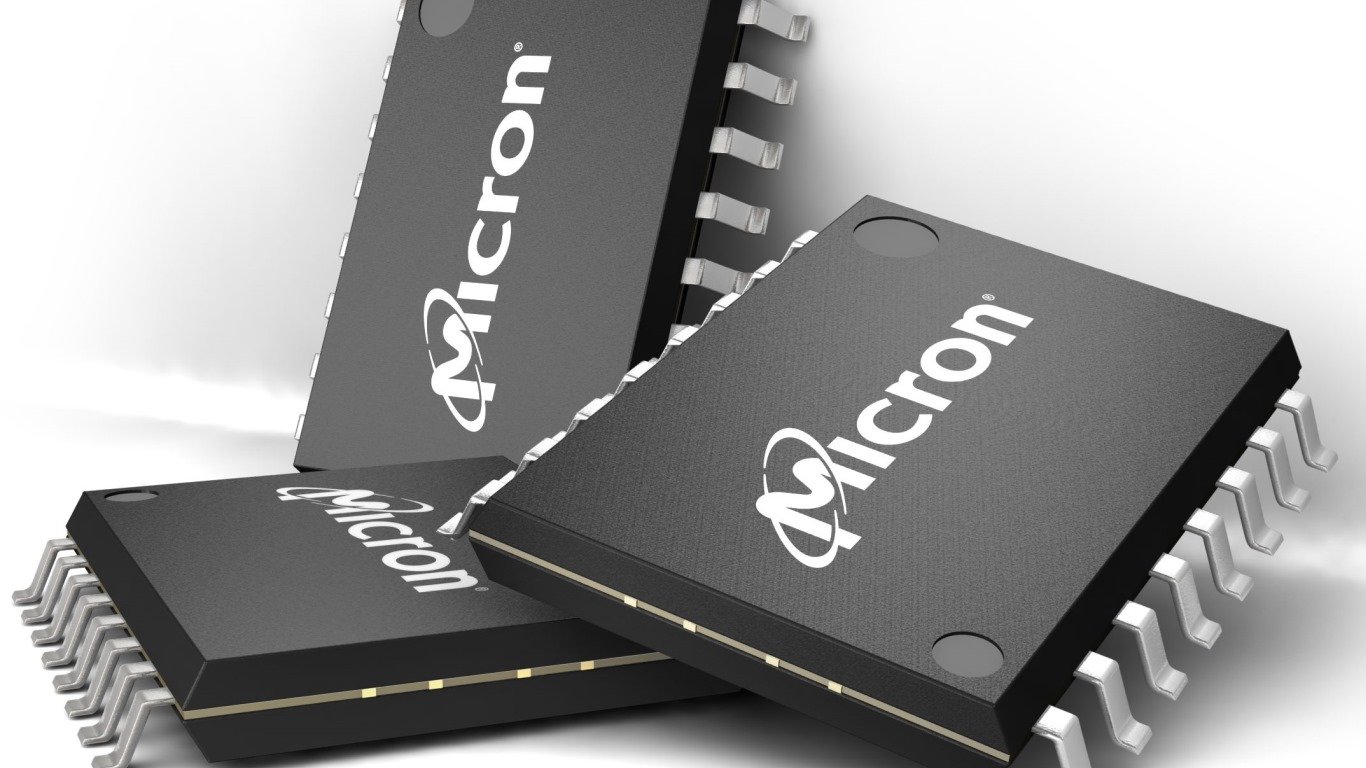
Which memory stock offers more resilience right now for investors focused on the long haul: SK hynix (NASDAQ:SKHY) or Micron Technology (NASDAQ:MU | MU Price Prediction)? SK hynix brought into focus the question by revealing plans to market its first 100-layer 3D DRAM chip around 2030-2031. Its engineers estimate that approximately 75 layers are needed to match today’s leading-edge DRAM density, which would leave it a meaningful density lead.
SKHY closed at $111.14 on November 25, down 33.84% since July 10. Micron fell 33.47% over the past month to $601.25, though it remains up 110.83% year to date, as a global tech rout deepened this week. Both trade near 3x next-year earnings estimates, so the market already prices in a sharp downturn. Counterpoint Research projects industry DRAM capacity will rise 50% between 2026 and 2028. With valuation roughly even, three other dimensions settle the comparison.

Income: SK hynix Pays Retirees to Wait
SK hynix yields 2.145% and has a free cash flow yield of 31.64%. Micron pays $0.15 quarterly[1], even after a 30% dividend increase[2], which works out to a yield of about 0.09%. For an investor who needs cash flow from a portfolio, Micron’s payout barely registers. Winner: SK hynix.
Growth Trajectory: Micron Has Visibility Through 2030
SK hynix’s Q3 revenue rose 327.9% YoY[3] and operating income climbed 632.1% to $62.83B. Micron’s fiscal Q4 revenue of $54.23B[1] rose 379.3%, GAAP operating income jumped 1,065.5%, and non-GAAP EPS of $33.42 beat estimates. Guidance calls for fiscal Q1 revenue of $61.5B ± $1.5B[1].
More than 75% of its shipments[4] for fiscal 2027 are already committed, backed by 26 SCA agreements that run through 2030. SK hynix has reportedly sold out of DRAM and next-generation HBM through 2029, but its filings disclose far less. On the technology roadmap, Micron bypasses the intermediate 4F² architecture that Samsung and SK hynix are developing, and plans to extend its current design with wafer bonding before moving to 3D DRAM. That approach skips the cost of an extra architecture transition. Its 1-gamma[4] node already makes up the majority of its bits. Winner: Micron.

Risk Profile: SK hynix’s Disclosures Hide Too Much
SK hynix’s Q3 pre-tax profit fell 58.7% QoQ[3] to $38.23B because of non-operating charges the company did not list. The results are preliminary and unaudited, and ADR holders also take on Korean won exposure. Micron carries a beta of 2.398, so it will stay volatile. In exchange, it reports in dollars, holds $38.4B[1] in cash, generated $62.31B in fiscal 2026 free cash flow, and has beaten EPS estimates eight consecutive quarters. Winner: Micron.

Verdict: Micron’s Balance Sheet Wins the Memory Matchup
If 3D DRAM increases supply faster than AI inference demand grows, prices fall, and technology leadership will not protect industry margins. The company that comes out ahead is the one that can pay for 3D DRAM development through a 2028-2029 downturn without stalling. That is Micron. Its committed shipments, contracts that run through 2030, and audited cash generation give it that buffer. CEO Sanjay Mehrotra said in the September earnings release, “Micron delivered record fiscal 2026 results, and we expect an even stronger fiscal 2027.”
SK hynix asks holders to accept currency swings and unaudited, unitemized results in exchange for a 2.145% yield, and an earlier claim on 3D DRAM density. Its 100-layer chip is still years from production. Micron’s advantages are already in its filings. On these measures, Micron screens as the more durable business heading into the next memory cycle. (We studied what the biggest tech winners looked like years before their monster runs and put the pattern in a free playbook here: The Next Nvidia Playbook.)
Contact [email protected] for any questions or corrections.
After two decades of patrolling the dark corners of suburbia as a police officer, Rich Duprey hung up his badge and gun to begin writing full time about stocks and investing. For the past 20 years, he’s been cruising the markets looking for companies to lock up as long-term holdings in a portfolio while writing extensively on the broad sectors of consumer goods, technology, and industrials. Because his experience isn’t from the typical financial analyst track, Rich is able to break down complex topics into understandable and useful action points for the average investor. His writings have appeared on The Motley Fool, InvestorPlace, Yahoo! Finance, Money Morning, and, of course, 24/7 Wall St. He has been featured in both U.S. and international publications, including MarketWatch, Financial Times, Forbes, Fast Company, and USA Today.