4 Self Storage REITs Turn Spare Space Into Steady Passive Income Dividends

This post may contain links from our sponsors and affiliates, and Flywheel Publishing may receive compensation for actions taken through them.

Self storage is one of the few property types where rent resets almost continuously. Tenants sign month-to-month agreements, so landlords can raise rates on new move-ins and existing customers within weeks when demand firms up, far faster than an office or retail landlord locked into multi-year leases. The same flexibility works in reverse: when demand moderates, customers leave quickly, and operators cut move-in rates to fill units. After a slow stretch, the cycle is turning upward.
At Extra Space Storage (NYSE:EXR), same-store occupancy reached 94.0%[1] in the third quarter, up from 93.7% a year earlier. The four REITs below are equity REITs that own physical storage facilities, distinguishing them from mortgage REITs, whose payouts depend on interest-rate spreads and borrower credit. Dividend safety here is measured on funds from operations (FFO) or adjusted FFO (AFFO), the cash-flow measures REITs use in place of GAAP earnings, which one-time charges and depreciation can skew.
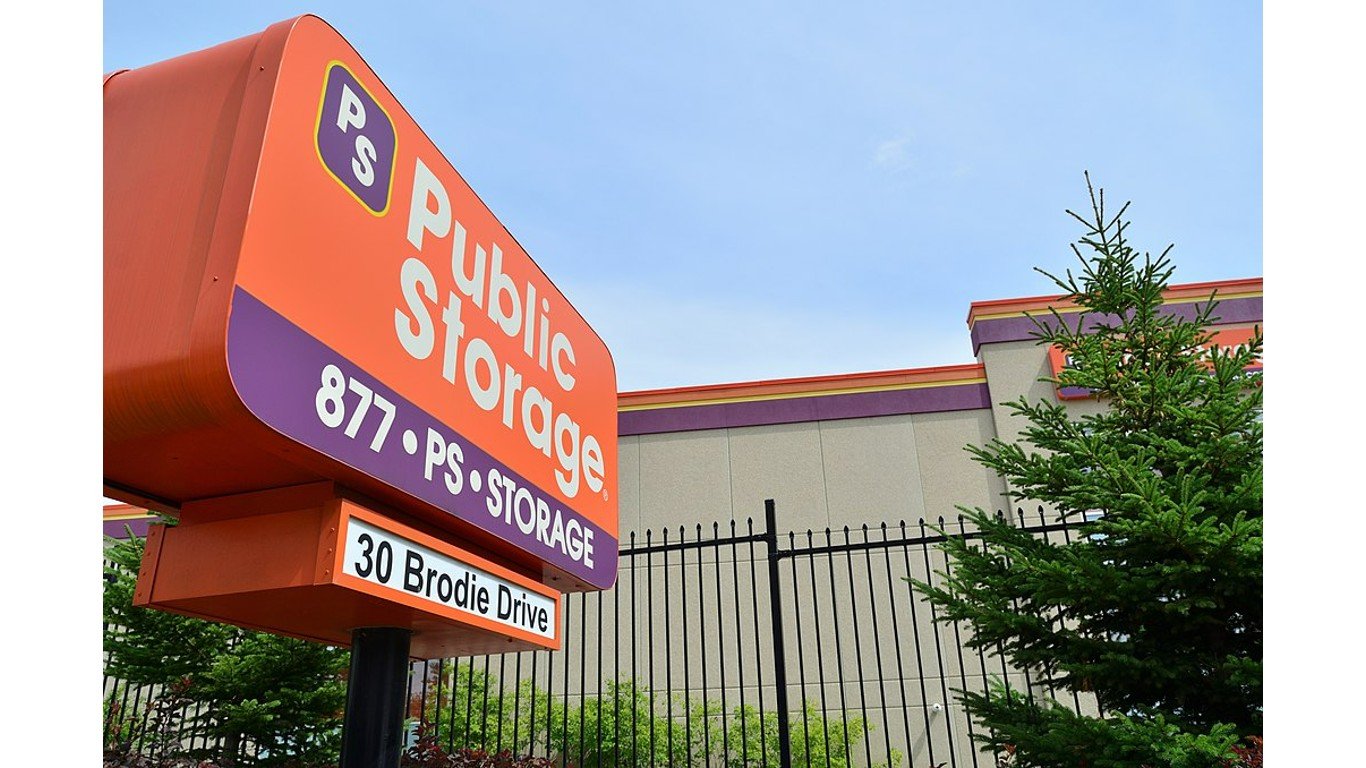
Public Storage Builds a North American Giant With Room to Cover Its $12 Payout.
Public Storage (NYSE:PSA) is the largest U.S. self-storage REIT. After closing its acquisition of National Storage Affiliates on July 22, 2026, and Public Storage Canada on September 1, 2026 (roughly $1.2 billion for 68 properties), it owns more than 4,500 locations covering more than 327M sq ft across North America.
Demand background: Occupancy at same-store properties rose to 92.2%[2], up 30 basis points from a year earlier, and same-store revenue grew 0.5% in Q3. Chief Executive Tom Boyle said the quarter “was better than expected and demonstrates the strength and scalability of our platform as well as improving industry fundamentals.”[2]
Yield and coverage: The quarterly dividend of $3 has held steady since 2023, for an annualized $12 and a 3.62% yield with shares at $337.98. Management raised full-year Core FFO guidance to $16.90-$17.10[2] per share. The dividend uses about 70.6% of the guidance midpoint, a comfortable buffer. GAAP earnings tell a different story: Q3 net income of $1.69[2] per reduced share was weighed down by $114.6M in transaction and integration costs, showing why an earnings payout ratio can mislead with REITs.
Bull case: Public Storage expects $110M to $130M[2] in run-rate synergies from the NSA deal within three to four years, and it has a $788.9M development and expansion pipeline. Shares are up 34.16% year to date.
Risk: Leverage. Net debt to EBITDA rose to 3.4x[2] from 3.0x, the weighted average interest rate climbed to 3.6% from 3.0%, and $650M of debt matures in Q4 2026. Integrating more than 1,100 stores must also go smoothly.
Extra Space Storage Pairs Industry-Leading Occupancy With Raised Guidance
Extra Space Storage, the second-largest U.S. self-storage REIT, owns and operates storage facilities nationwide and runs a third-party management platform totaling 2,371 managed stores.
Demand background: Fundamentals are improving faster here than at any other name on this list. Across 1,869[1] same-store properties, revenue grew 2.7%, expenses fell 1.8%, and NOI rose 4.6%. Core FFO per share grew 4.3%[1].
Yield and coverage: The $1.62 quarterly dividend has been unchanged since December 2023, for an annualized $6.48 and a 4.08% yield at $161.39. Full-year Core FFO guidance moved up to $8.40 to $8.50[1] from $8.25 to $8.40, so the dividend uses about 76.7% of the midpoint.
Bull case: Guidance for NOI from the same-store portfolio jumped from 0.5% to 2.5%, and from 2.5% to 3.5%. Management also bought back 2,390,497[1] shares at an average of $136.85, used up its prior program, and authorized a new $500M buyback on October 15, 2026.
Risk: Extra Space carries $1.4B[1] in outstanding bridge loans to storage developers and owners. That lending book adds borrower credit risk, the kind more typical of a mortgage REIT, on top of its core ownership business. Leadership is also changing hands: Noah Springer becomes CEO effective January 1, 2027.
CubeSmart Offers the Only Rising Payout in the Group
CubeSmart (NYSE:CUBE) owns a 623-property same-store pool totaling 45.2M rentable square feet and manages 882 stores for third parties. It also has a New York joint-venture development in the pipeline, expected to open in Q3 2027[3].
Demand background: Revenue growth at same-store properties has picked up from -0.1%[3] in Q4 2025 to 1.9%[4] in Q3 2026, and NOI rose 2.1%. Occupancy ended the period at 89.9%[4], up from 89.0%. CEO Christopher P. Marr cited “higher occupancy and improving rental activity.”[4]
Yield and coverage: The quarterly dividend is $0.53, a 1.9%[3] increase from $0.52, for an annualized $2.12. That works out to a 4.72% yield at $45.25. Every year since 2021 has brought a higher payout, starting at $0.34 per quarter. Adjusted FFO for the full year is guided to $2.58 to $2.60[4] per share, so the dividend uses about 81.9% of the midpoint. This is the closest coverage among the three large caps.
Bull case: CubeSmart has the lowest occupancy of the group, so it has the most room to grow if it can fill units. It is also returning capital: it bought back 2.1M shares for $83.9M in Q3 and is contributing 15 stores[4] to a Heitman joint venture at a $197M agreed value.
Risk: Operating costs. Same-store property taxes rose 4.0%,[4] and personnel costs rose 4.3%. Meanwhile, realized rent per occupied square foot grew just 0.5%[4] to $22.81.
Global Self Storage Has the Highest Yield and the Least Room for Error
Global Self Storage (NASDAQ:SELF) is a micro-cap REIT with a market value of roughly $55.2M. It owns a small portfolio of storage properties, including a site in Lima, Ohio, where it is converting former student housing into climate-controlled units, and it runs a third-party management arm under the Global MaxManagement brand.
Demand background: Revenue at same-store facilities grew 0.6%[5], but occupancy slid to 92.9% from 93.2%, and same-store NOI fell 0.6% as operating costs rose 2.5%. Average tenant stays reached a record of about 3.7 years[5].
Yield and coverage: At $4.83, the stock yields 6.04%, making it the only ultra-high-yield name here. The quarterly dividend has held at $0.0725 since September 2022. Q3 AFFO reached $0.10[5] per reduced share, so the quarterly dividend used about 72.5% of it. That read rests on a single quarter. FFO rose 5.8%[5] to $1.06M, while GAAP EPS was just $0.04 after a $229,231 unrealized loss on securities.
Bull case: Management replaced the live call center with an AI-based virtual agent and is moving to QR code-based rentals, and it expects marketing costs to fall through year-end. It also has about $24.3M in capital resources available for acquisitions.
Risk: Scale and liquidity. A small portfolio means one weak property can swing results, and shares are down 1.18% year to date, while the three large caps have each gained more than 28%. The high yield reflects that gap.
Dividend Coverage Matters More Than Yield in Self Storage
Public Storage has the widest FFO buffer of the group, Extra Space has the strongest same-store momentum, and CubeSmart is the only one actively raising its dividend. Global Self Storage pays the most but has contracting NOI at same-store properties and coverage based on a single quarter. The next test is fourth-quarter results and 2027 guidance, when month-to-month repricing will show whether this recovery can lift same-store revenue across all four names.
Contact [email protected] for any questions or corrections.
Lee Jackson has covered Wall Street analysts' equity and debt research and equity strategy daily for 24/7 Wall St. since 2012. His broad, diverse career, including a stint as creative services director at an NBC affiliate in Austin, Texas, gives him unique insight into the financial industry.
Lee Jackson's journey in the financial industry spans more than 30 years, including nearly two decades as an institutional equity salesperson at Bear Stearns, Lehman Brothers, and Morgan Stanley. His career spanned pivotal sell-side Wall Street events, from the dot-com rise and bubble to the Long-Term Capital Management debacle, 9/11, and the Great Recession of 2008. This reflects his resilience and adaptability amid market volatility.
Lee Jackson’s practical financial industry experience, gained through a career at some of the biggest banks and brokerage firms, is complemented by a lifetime of writing across various platforms. This unique combination allows him to shed light on the intricacies of Wall Street in a way only someone with deep insider experience and knowledge can. Moreover, his extensive network across Wall Street continues to provide direct access for him and 24/7 Wall St., a privilege few firms enjoy.
Since 2012, Jackson’s work for 24/7 Wall St. has been featured in Barron’s, Yahoo Finance, MarketWatch, Business Insider, TradingView, Real Money, The Street, Seeking Alpha, Benzinga, and other media outlets. He attended the prestigious Cranbrook Schools in Bloomfield Hills, Michigan, and has a degree in broadcasting from the Specs Howard School of Media Arts.