$500 a Month Into SCHD for 20 Years: the Dividend Snowball Will Shock You
Most SCHD investors quit before the moment that changes everything: when their dividends start buying more shares each year than their own contributions do. Running the full 20-year projection reveals why that crossover point matters more than the starting yield.

This post may contain links from our sponsors and affiliates, and Flywheel Publishing may receive compensation for actions taken through them.
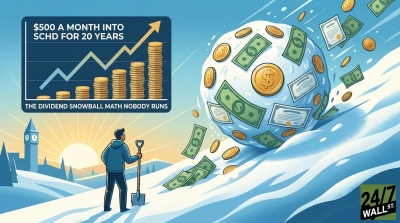
Somewhere in the second decade of a $500 monthly deposit into the Schwab U.S. Dividend Equity ETF (NYSEARCA:SCHD), the dividends paid back to the account start buying more new shares each year than the saver does.
That is the moment the snowball outruns the shoveler, and it is why SCHD gets pitched as a retirement building block. Very few people run the projection all the way out, because the first stretch feels like nothing is happening. That is exactly why the crossover is worth mapping.
What SCHD Is Built to Do
SCHD tracks the Dow Jones U.S. Dividend 100 Index, which screens for companies with a record of dividend payments, healthy cash flow to debt, return on equity, and yield. The result is a portfolio of large, cash-generating businesses with solid foundations. Their dividends compound, and the underlying companies grow those dividends over time. There is no options overlay, no leverage, no exotic structure.
Shares trade near $34. Trailing twelve-month distributions came to $1.048 per share, with the forward annualized figure at $1.01. That works out to a starting yield in the low 3% range.
If we look at the past, we can see how well this dividend machine has worked. If you invested $10,000 into SCHD at inception (in 2011), reinvested the dividends, and added $500 monthly, you’d have $308,000 today. Among defensive dividend ETFs, this is very strong.
The Snowball Math
SCHD has grown its dividend from $0.1217 in its first quarterly payment back in late 2011 to roughly a quarter per share today, with a long history of high single-digit annual growth in the payout. When you feed that growth rate into an ever-larger share count built by reinvestment plus $500 monthly contributions, yield-on-cost takes over. Your starting yield may be about 3%, but after two decades of dividend increases layered onto shares bought years earlier at lower prices, the effective yield on the money you originally put in can push toward high single digits or better.
In year one, $500 a month is doing almost all the work, and dividends buy a rounding error’s worth of new shares. By year seven or eight, the dividend stream is real but still smaller than the contributions. Somewhere in years 12 to 15, under reasonable assumptions about continued dividend growth, the annual dividend income crosses above $6,000 and starts buying more shares each year than the saver contributes. That is the crossover.
This is a projection, and dividend growth and price appreciation are never guaranteed. The screen can spit out different holdings after any reconstitution, and the payout has wobbled: 2024 included unusually large distributions of $0.8241 and $0.7545 in Q2 and Q3 before payments normalized to the mid-$0.20s per quarter in 2025 and 2026.
Total Return Versus the S&P 500
Over the last ten years, SCHD returned roughly 231% on a total-return basis, against the S&P 500’s roughly 314%. Over five years, SCHD gained about 58% versus about 86% for the S&P. In the AI-driven bull market, SCHD lagged because the screen deliberately excludes most of the mega-cap tech that drove the index.
Over the past year, SCHD returned 30% against the S&P’s 23%, and it has led the index year-to-date in 2026 by a wide margin. A saver who wants growing income trades some upside in tech-led rallies for a smoother, cash-paying ride.
The Real Tradeoffs
- Sector shape. The screen tilts toward healthcare, consumer staples, energy, and industrials. Investors get less exposure to non-dividend compounders, so SCHD alone will trail a total-market fund in tech-heavy stretches.
- Dividend volatility. Payouts are not smooth. The 2024 distributions jumped and then reset. Retirees planning around a fixed monthly check should model a range, not a straight line.
- The patience tax. The first five years feel like nothing is compounding, which is why many savers stop contributing. In one 2025 study, 37% of all workers had taken an early or hardship withdrawal from a retirement account. The math only works for people who keep feeding it.
Who Should Own It
SCHD fits a saver who wants a growing income stream inside a long-horizon account and can accept that in strong tech-led years the fund will look boring. It works well as a 20% to 40% sleeve alongside a total-market or S&P 500 index fund, letting the broad index capture growth while SCHD builds the dividend base. Investors who want maximum capital appreciation and do not care about yield are better served by a lower-cost broad-market fund like Vanguard Total Stock Market ETF (NYSEARCA:VTI) or Vanguard S&P 500 ETF (NYSEARCA:VOO). The snowball is real, but it only rewards savers who keep shoveling long enough to feel it start rolling on its own.
Contact [email protected] for any questions or corrections.
Omor Ibne Ehsan is a writer at 24/7 Wall St. He is a self-taught investor with a focus on growth, cyclical, and dividend equities that have strong fundamentals, value, and long-term potential. He also has an interest in high-risk, high-reward investments such as penny stocks.