Montana Steer Prices Are Up 71%. Social Security Can Treat a Breeding Cow and a Market Steer as Two Different Kinds of Income
Selling two cattle from the same herd in the same year can produce two completely different Social Security outcomes, and the distinction has nothing to do with the size of the check you bring home from the auction.

This post may contain links from our sponsors and affiliates, and Flywheel Publishing may receive compensation for actions taken through them.
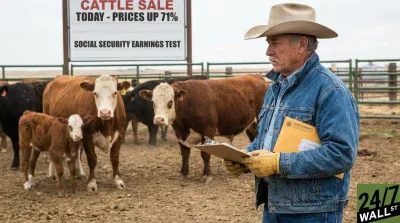
Montana cattle prices have climbed hard. Benchmark 550 to 649 pound steers are up about 71% since 2023, and recent Billings sales still show strong prices across feeder and replacement cattle. Stronger auction prices can turn an ordinary herd sale into a much larger check, making the Social Security classification of each animal more consequential.
Picture a 64-year-old rancher who already collects Social Security. This year he hauls two animals to the sale barn: a mature breeding cow and a market steer. Both checks land in the same bank account. Social Security may treat them as two entirely different kinds of income.
He started benefits before full retirement age (FRA), so a rule called the retirement earnings test applies to him. It temporarily holds back benefits when a younger retiree’s work income climbs too high, and it is the reason the difference between those two animals matters.
Why an Animal’s Job on the Ranch Drives the Outcome
Cattle raised or bought mainly for resale are part of the farm business. The sale runs through Schedule F, the farm profit and loss form on his tax return, where feed, vet bills and other farm costs come off the top. Social Security counts net earnings from self-employment after the applicable self-employment adjustment. The gross auction check is only the starting point.
Breeding animals follow a separate rule. Social Security says not to count income from selling livestock not held for sale, including breeding, dairy, work and sporting animals. A steer is inventory, like cans on a grocery shelf. A cow kept to produce calves is closer to a tractor that happens to eat hay: equipment that helps the business earn money.
Same $20,000, Very Different Monthly Checks
His current age of 64 falls below his FRA of 67. In 2026, the earnings limit is $24,480, and Social Security withholds $1 in benefits for every $2 above it.
Suppose he already has $20,000 of other covered earnings from part-time work. That leaves him $4,480 of room before withholding starts. Here is how each sale plays out:
| Market Steers | Breeding Cows | |
|---|---|---|
| Net profit or gain | $20,000 | $20,000 |
| Added to earnings test income | About $18,470 | $0 |
| Total countable earnings | $38,470 | $20,000 |
| Benefits withheld | About $6,995 | $0 |
The steer figure is lower than $20,000 because Social Security counts 92% of net self-employment profit. On a $2,000 monthly benefit, that withholding equals about three and a half checks. An eligible breeding cow sale leaves his countable earnings right where they were.
Withheld benefits are not simply repaid later. Once he reaches full retirement age, Social Security recalculates his monthly benefit to give him credit for the months benefits were withheld. The cash he wanted this year, though, is still delayed.
Herd Records Decide Which Side of the Line He Lands On
Social Security does not classify an animal by breed or age. What counts is why he held it. A mature cow does not automatically earn breeding stock treatment, especially if he regularly buys older cows and flips them.
The strongest proof comes from breeding and calving records, depreciation schedules, herd inventories, purchase records and sale records that separate breeding stock from market animals. A rancher who can show a cow calved for five seasons and sat on his depreciation schedule the whole time has a clean story.
Breeding Stock Gains Still Land on the Tax Return
Leaving a sale out of the earnings test is separate from leaving it off the tax return. A breeding animal sale can still produce taxable gain, depending on his cost basis, past depreciation and how long he held the cow. Market cattle generally show up as ordinary farm income. The earnings test may treat the two sales differently, while federal income tax can reach both.
Five Questions to Answer Before the Next Trip to the Sale Barn
- Purpose: Was the animal held to breed or held for resale? His answer should match how he actually ran the herd, not how he would like the sale treated after the fact.
- Proof: Can calving records, inventories and depreciation schedules back up that classification if Social Security asks questions later?
- Net farm income: After feed, vet and other costs, how much profit do his ordinary livestock sales actually produce this year?
- Other earnings: How close is he already to the $24,480 limit from wages or other self-employment?
- Tax consistency: Does his return treat each animal the same way his herd records do? A mismatch between the two undermines the breeding stock position.
High cattle prices make every animal look like the same kind of payday. For a retiree below FRA, why he kept an animal can matter more than what it brings at auction. The toughest mistake to undo is selling first and sorting out the paperwork later. Every herd has its own history, and small details in the records can change the answer, so a short conversation with a tax preparer who knows farms, held before the sale, is worth the time.
Contact [email protected] for any questions or corrections.
Gerelyn Terzo is the author of dividend investing handbook "Dividend Investing Strategies: How to Have Your Cake & Eat It Too." A veteran financial journalist, she covers agri-finance for outlets like Global AgInvesting and the broader stock market and personal finance for 24/7 Wall Street. She began at CNBC and later helped launch Fox Business in New York. Gerelyn currently resides in Woodland Park, Colorado and dabbles in nature photography as a hobby.