This $10 Billion ETF Owns the Companies Wiring America’s $68 Billion Data Center Boom
A single ETF quietly holds the small-cap contractors wiring, cooling, and powering the hyperscaler campuses behind America's AI buildout, but a looming index rebalance could strip out its best-performing names just as backlog numbers hit all-time highs.

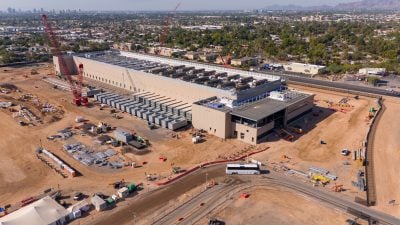
The First Trust RBA American Industrial Renaissance ETF (NYSEARCA:AIRR) has quietly become one of the purest public-market proxies for the AI data center buildout. AIRR owns the small and mid-cap industrials wiring, cooling, and powering hyperscaler campuses, and its top holdings just posted the strongest backlogs in their history. With roughly $10 billion in assets and a portfolio concentrated in electrical and mechanical contractors, AIRR now trades as a levered bet on one specific line item: hyperscaler capital spending.
What AIRR Actually Owns
The fund tracks the Richard Bernstein Advisors American Industrial Renaissance Index and holds 54 equity positions across U.S. industrials and community banks. As of the latest NPORT filing, net assets stood at $8.39 billion, with the top five names representing roughly 21% of the portfolio. The data center exposure is unusually direct: Comfort Systems USA (NYSE:FIX | FIX Price Prediction) at 4.18%, Sterling Infrastructure (NASDAQ:STRL) at 3.96%, EMCOR Group (NYSE:EME) at 3.54%, and Powell Industries (NASDAQ:POWL) at 1.83%. These four names alone touch nearly 14% of the fund.
Comfort Systems is up 85% year to date, Sterling 80%, Powell 92%, and EMCOR 36%. Each has also pulled back in the past month, with Sterling down nearly 19% and Powell off 13%. That combination of dominant returns and fresh drawdowns is exactly what makes the next twelve months a live question.
The One Macro Number That Drives AIRR
The single most important variable for AIRR over the next year is the combined 2027 capex guidance from Microsoft, Meta, Alphabet, and Amazon. Those four fund the campuses that convert into backlog at Comfort Systems, EMCOR, Sterling, and Powell. Comfort Systems President Trent McKenna told analysts on the July 24 call that hyperscalers show “a very deep and calm certainty among these people that they’re going to continue to build…we see no letdown whatsoever.” EMCOR’s data-center-heavy Network and Communications work more than doubled year over year in mechanical construction, pushing total remaining performance obligations to $17.14 billion.
The data source that matters is the late-January 2027 mega-cap earnings releases and the follow-up 10-Ks that formalize capex figures. Check them quarterly. A single-digit downward revision to hyperscaler capex has historically flowed through to contractor bookings within one to two quarters. If aggregate 2027 capex guidance moves lower, AIRR loses the fuel behind its four-name engine. If it steps up again, contractor backlogs get another year of visibility.
The Fund-Specific Risk: The Next Rebalance
AIRR is a rules-based small and mid-cap index, and that mechanic is now working against holders. After this year’s rally, Comfort Systems carries a market cap near $61 billion, well above what most investors picture as small or mid-cap. The index rebalances quarterly, and the September reconstitution could trim the winners or push them out entirely, forcing turnover in the fund’s most productive positions. Powell’s Q3 book-to-bill of 3.0x and a $400 million-plus behind-the-meter data center order show how tightly these companies are wired to a single end market. Sterling’s mission-critical work is now more than 92% of e-infrastructure backlog.
Two items on First Trust’s AIRR page deserve regular checks: the quarterly holdings changes published shortly after each rebalance, and the top-holdings weights. A rebalance that meaningfully cuts FIX, EME, or STRL exposure would reduce AIRR’s data center beta before most holders notice the shift on their statements.
The Signal to Act On
If January hyperscaler capex guidance holds or expands, AIRR’s contractor backlogs, already $14.1 billion at Comfort Systems and $4.3 billion signed at Sterling, should keep compounding into 2027. The September AIRR rebalance is the near-term signal that could reshape the fund’s exposure before that macro story plays out.
Contact [email protected] for any questions or corrections.
Marc Guberti is a personal finance writer who has written for US News & World Report, Business Insider, Newsweek and other publications. He also hosts the Breakthrough Success Podcast which teaches listeners how to use content marketing to grow their businesses.